Latter-day Saints need to treat the Pentagon’s reclassification of their religion as something outside Christianity as a warning. Fascism always requires an outsider. As the circle of belonging gets smaller, Latter-day Saints should vocally and unabashedly defend democracy, religious freedom, and human dignity for everyone.
TLDR – What Should Latter-Day Saints Do About Christian Nationalism?
- Treat the Pentagon reclassification as a warning sign.
- MAGA loyalty will not protect Latter-day Saints.
- Christian nationalism is oppression dressed up as faith.
- Purity tests always need a next outsider — no one is exempt.
- Defend religious freedom for every faith — and no faith.
- Stop using government to legislate morality and lives.
- Apply Christian values to immigrants and LGBTQ people.
- Replace culture-war bills with family-stability policies.
- Build cross-faith coalitions before the next crisis.
- We must defend everyone’s freedom — or lose our own.
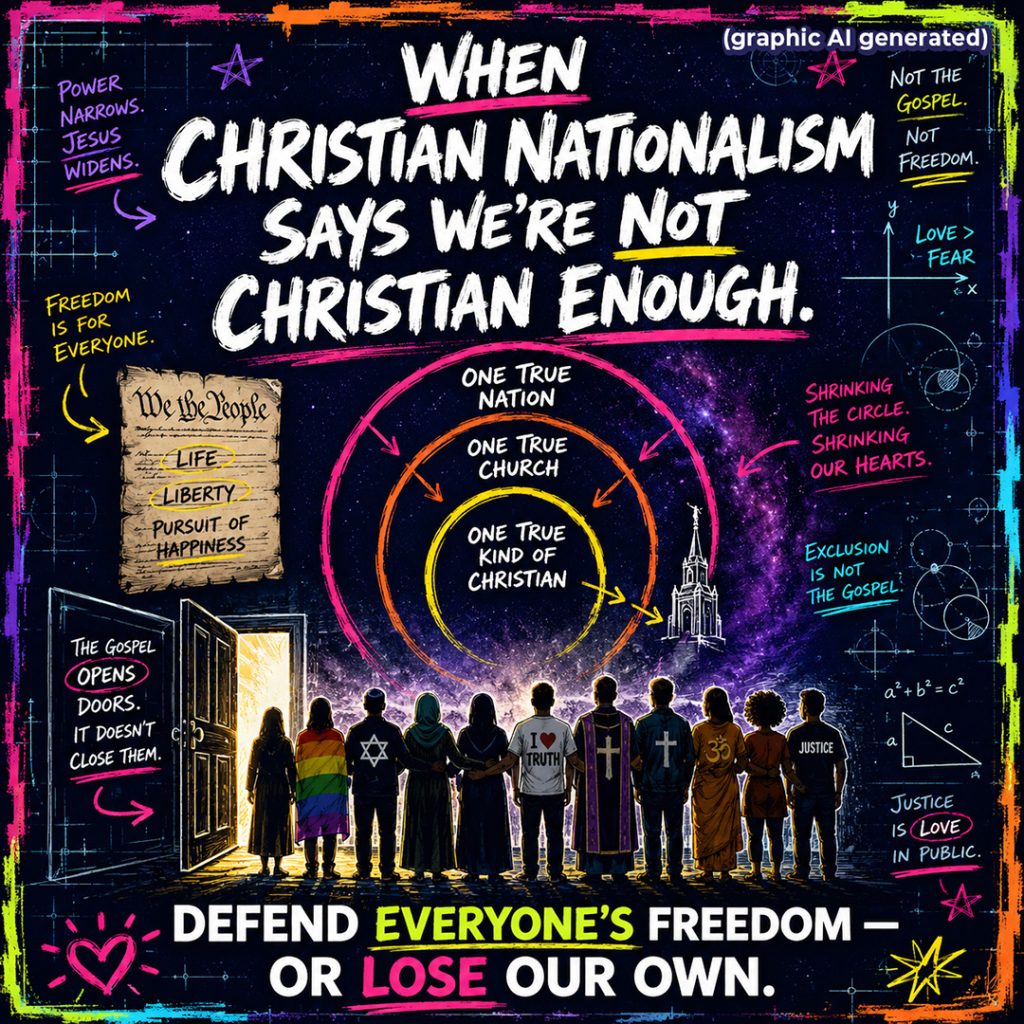
Christian Nationalism Turns Its Sights On Latter-Days Saints
Recently, Utah’s Republican senators likely found themselves in a bit of an uncomfortable situation when they had to ask why the federal government’s shortened military faith list did not categorize Latter-day Saints under Christianity.
The Pentagon says this change is administrative, not theological. And, while that might be immediately true — we also shouldn’t be naïve.
Government classifications and recognition shape services, data, status, and belonging. And fascism always requires a new outsider — leading to ever-increasing purity tests. So when a government that is heading toward Christian nationalism starts omitting and reclassifying things, the circle of acceptable people is bound to get smaller and smaller.
If Utahns or Latter-day Saints think loyalty to Trump or MAGA will protect us as that circle closes, we aren’t paying attention. In fact, we’re repeating some pretty big mistakes that we should know better than anyone else not to do.
The simple fact is, no one can defend religious freedom by trying to be one of those in the circle of favoritism. That’s always a losing game. The only way we can truly defend religious freedom is by refusing to let government draw that circle around anyone.
We’re All To Blame For The Rise of Christian Nationalism
I want to be clear here that we only have ourselves to blame for where we find ourselves now. Proposition 8, Amendment 3, the legislating of trans people, the support of ICE, not standing up for Black Lives Matter, and many more missteps along the way have helped build the infrastructure and culture that have brought us to this moment.
This isn’t an argument against Christianity, but we need to acknowledge the role we’ve played so we can make the changes required to protect ourselves. Similarly, I’m not arguing against conservative values here. On the contrary, I think we need to see a return to the actual conservative and Christian values we claim to hold: limited government, rule of law, family stability, freedom, agency, humility, loving our neighbors, and protection for all. Even those different from us. Especially those different from us.
And this is definitely not an argument for Latter-day Saints to abandon their faith, but rather an appeal to really start applying it.
Why Should Latter-Day Saints Care About The Pentagon’s Updated Religious Affiliation List?
The Pentagon’s new list still recognizes The Church of Jesus Christ of Latter-day Saints, but — as Utah senators have pointed out — it doesn’t place the Church under the broader Christian category. The department says the change is administrative. Even so, the way a government classifies something shapes services, status, data, and belonging for real people — and this one exposes a dangerous purity-test logic.
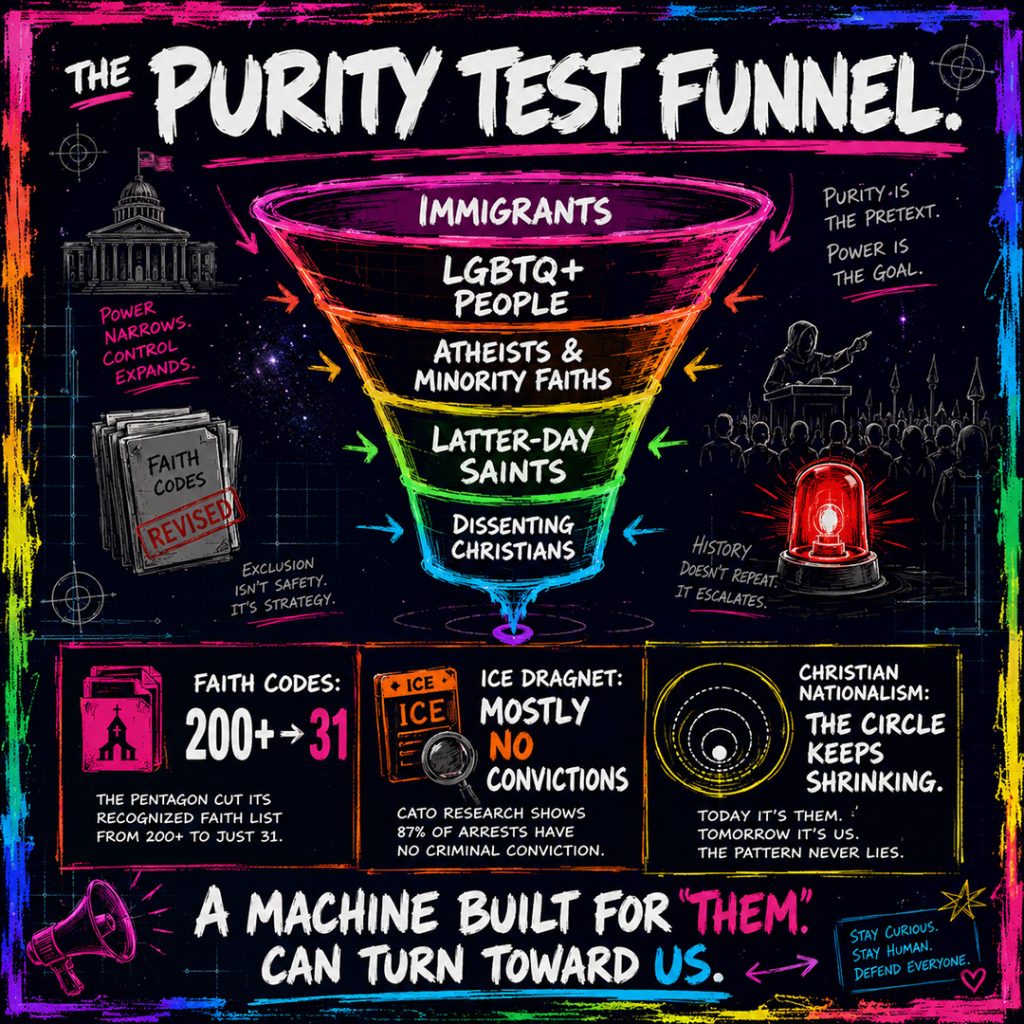
According to the Associated Press, the Defense Department reduced its religious affiliation list from more than 200 options to 31. The new list no longer includes options such as atheists, Unitarian Universalists, pagans, or Wiccans. A Pentagon spokesperson said the change was not meant to judge the legitimacy of any faith, but to help chaplains organize resources more efficiently.
Still, Utah Sens. John Curtis and Mike Lee criticized the Pentagon because the new structure doesn’t categorize the Church under the broader Christian designation. Curtis called Latter-day Saints “unequivocally Christian,” while Lee pointed to the name of the Church itself.
When atheists, Unitarian Universalists, pagans, Wiccans, and other groups disappear from the list, and Latter-day Saints get demoted outside of Christianity — that should ring alarm bells.
Immediately, this impacts whether certain soldiers can get the resources to practice their faith dutifully while stationed overseas or on stateside military bases. But longer-term, it positions any removed religions and non-Christian faiths as prime targets for oppression.
It’s a pattern not without precedent. Immigration enforcement has been sold for years as a tool for removing dangerous criminals. However, ongoing Cato Institute research has found that only 5% of ICE detainees have violent convictions and 73% have no convictions at all. TRAC Immigration reported that, as of April 4, 2026, 70.8% of people in ICE custody had no criminal conviction.
First, the infrastructure is built to go after “bad” people. Then it expands to include new outliers. Finally, the people who defended the trampling of rights for some discover it’s coming for them, as well. That is the lesson Latter-day Saints need to learn — because they are actively being positioned as outsiders as we speak.
What Is Christian Nationalism Actually Trying To Build?
Christian nationalism is attempting to build a fascist, authoritarian state. It should not be confused with Christianity, which is generally an inclusive and loving ideology. Instead, it weaponizes Christianity to decide who gets to belong in America. Ultimately, because fascism always requires an outsider, it’s dangerous to everyone — including Latter-day Saints, Catholics, Jews, Muslims, atheists, immigrants, queer people, and eventually dissenting Christians too.
A person can love Jesus, love America, and still reject Christian nationalism. In fact, that may be the only Christian thing to do.
The problem is not prayer or bringing moral conviction into public life. The problem is government using religious identity as a purity test for citizenship, patriotism, military service, education, family policy, immigration, and civil rights.
The political climate is growing increasingly alarming. Pew Research Center reported in May 2026 that 17% of U.S. adults supported the federal government declaring Christianity the official religion of the United States, up from 13% in 2024. Notably, Pew also found most Americans still want churches to stay out of politics, which is a bit comforting, at least.
The country is not monolithic. But the appetite for state-sponsored Christianity is growing in a loud and organized minority.
The same trend shows up in Christian nationalism research. PRRI’s 2025 American Values Atlas found that 46% of white Christians and 67% of white evangelical Protestants qualified as Christian nationalism adherents or sympathizers. This doesn’t mean every person in those groups is cruel or authoritarian. But it does mean a significant political bloc is being trained to see national belonging through religious purity.
We can see Christian nationalism bleeding into governance, as well. Reuters reported that Defense Secretary Pete Hegseth led a Christian prayer and worship service at the Pentagon in 2025, billed internally as the “Secretary of Defense Christian Prayer & Worship Service.” While the Pentagon described it as voluntary, such public worship led from the top of the military hierarchy sends a cultural message about which faith belongs and which faiths do not.
So Latter-day Saints should be extremely concerned that our government has removed them from their list of Christian religions.
This is how purity tests work. They don’t start by announcing their final target. They start by choosing an easy one — the marginalized, the disenfranchised, the outliers. And guess what? As a religion that barely makes up 1-2% of the U.S. population, The Church of Jesus Christ of Latter-day Saints is an extreme outlier.
There are more LGBTQ+ people (9%) and immigrants (15%) in the U.S. than faithful, practicing Latter-day Saints.
Why Won’t MAGA Loyalty Protect Latter-Day Saints?
MAGA loyalty can’t protect Latter-day Saints because authoritarian movements reward usefulness, not covenant loyalty. And a purity movement always needs a next outsider. If LGBTQ people, immigrants, atheists, Muslims, and Jews can be pushed outside the circle today, Latter-day Saints will be pushed outside it tomorrow.
I really need every single Latter-day Saint to pay super close attention here.
Too many church members have treated Trump and MAGA as if they are awkward but useful allies in the defense of faith, family, and freedom. The thinking seems to be: yes, the rhetoric is harsh; yes, the cruelty is uncomfortable; yes, the personal conduct is hard to defend; but at least they are protecting Christianity.
But whose Christianity?
This is a critical question that Latter-day Saints seriously need to ponder and answer truthfully.
Because, while the federal government’s reclassification of The Church of Jesus Christ of Latter-day Saints outside of Christianity is not proof that every MAGA voter or evangelical hates Latter-day Saints — nor is it proof that the Pentagon necessarily intended an insult — it is proof that state power can now dictate what religions qualify as “Christian.” And it is proof that the Church didn’t make the cut.
This shouldn’t need to be explained. Our own history is full of warnings about majoritarian religion, state power, mob politics, forced expulsion, and official indifference. Latter-day Saints have been driven from homes, buried loved ones, and inherited family stories about what happens when people decide that someone’s faith or lifestyle is too strange, too foreign, too un-American, too dangerous, or too unchristian.
So why have we been supporting policies and people who do exactly that? Why would we ever support things like Proposition 8, Amendment 3, the legislating of trans people and women’s bodies, or the deportation of hard-working immigrants?
The Trap Of Fascism
This is the trap of fascism — and the road Republicanism and Christianity have been walking down for decades now. It seems that “good” people are perfectly willing to accept cruelty as long as it starts somewhere else.
We look away when immigrants are dehumanized. We stay silent when LGBTQ people are turned into political targets. And we treat Muslims, atheists, drag performers, trans kids, professors, journalists, federal workers, and dissenters as if their rights are negotiable.
But one day that very same infrastructure and culture we nurtured must turn on us. Because that is the nature of fascism. That’s the nature of Christian nationalism.
And, now, we are finally starting to see that.
Religious freedom and the civil liberties we enjoy are not a private insurance policy for our own beliefs. They are a public covenant that only works when we defend it for people we don’t know, understand, or even agree with.
How Did Utah’s Identity Politics Bring Us To This Point?
We helped protect and build the infrastructure that is now turning on us whenever we treated state power as a tool for enforcing our preferred morality on someone else’s family. When we ask government to decide whose love, body, faith, and belonging count, we give them power to do that for everyone — and we should not act shocked when it is turned against us, as well.
Utah’s dominant religious-political culture has spent decades trying to legislate a narrow moral order around gender, sexuality, family, education, and reproductive life. To be clear, this doesn’t mean every concern is fake or that every church member acted in bad faith. I’ve no doubt that many people sincerely believe they were protecting children, families, and society.
But sincerity and good intentions do not make a system righteous, helpful, or good.
When we fight LGBTQ civil equality, we are not just defending a doctrine. We are using the state to make daily life harder for our neighbors. When we restrict reproductive autonomy without building massive support for mothers, children, housing, health care, food security, domestic violence prevention, and child care, we are not protecting life — we are shifting risk onto women and families with fewer resources. When we attack DEI as if representation itself is some kind of corruption, we protect privilege and may even mistakenly believe it’s actual merit.
So we shouldn’t be surprised when people use that same infrastructure and culture to dictate that The Church of Jesus Christ of Latter-day Saints is now among the outsiders.
A Hard Lesson On Fidelity
The irony of Fidelity Month happening right as this is happening seems almost God-sent. It’s almost as if God is reminding us that fidelity isn’t loyalty to our own comfort. It truly is faithfulness to God, neighbor, truth, family, freedom, agency, and the people our systems keep pushing to the edge.
And if Utah’s LGBTQ communities can model fidelity through care, endurance, family, and belonging, then our politics should make room for that fruit instead of trying to cut down the tree.
Doctrine and Covenants 134:4 says civil government should restrain crime, but should not “control conscience” or “suppress the freedom of the soul.” Doctrine and Covenants 134:9 says, “We do not believe it just to mingle religious influence with civil government.” Meanwhile, Second Nephi 26:33 says all are alike unto God: Black and white, bond and free, male and female, Jew and Gentile.
That does not leave much room for engaging in identity politics.
The Plan of Salvation also places agency at the center of human growth. We can argue about what that means in law. We can disagree about where liberty ends and harm begins. But any Latter-day Saint politics worth defending should start from this premise: God does not need anyone to coerce others into being righteous. God needs His children to be cared for, loved, and treated with dignity.
That means less legislating others and more feeding, healing, housing, welcoming, teaching, listening, and protecting.
How Have Church Leaders Already Subtly Rebuked Trumpism?
Church leaders may not rebuke Trump or MAGA by name from the pulpit, but they have given principles that point away from MAGA politics. Namely, keeping families together, loving immigrants, rejecting contention, respecting free agency, avoiding partisanship, and listening to LGBTQ brothers and sisters. The gap is not in doctrine. The gap is in application.
When it comes to rebuking Trumpism, Church leaders have been more direct than some members may want to admit.
On immigration, the Church has repeatedly emphasized love, law, and family unity. In January 2025, the Church reaffirmed that “neighbor” includes all of God’s children and said members should provide basic food and clothing regardless of immigration status. The Church’s statement also stressed concern for keeping families together.
The Church’s broader official statement on immigration says forced separation weakens families and damages society. It also warns that mass expulsion or mistreatment should give pause, especially when one group is targeted by race, culture, or religion.
In 2016, Elder Patrick Kearon reminded Latter-day Saints that Jesus Christ was a refugee and urged members to take a stand against intolerance. His General Conference address, “Refuge From The Storm,” asked members to begin on their knees, then act. Sister Linda K. Burton, then Relief Society General President, asked members to consider refugees with the question, “What if their story were my story?” Her 2016 talk, “I Was A Stranger,” gave members a simple task: move from abstract morals to real human kinship.
On political identity, the Church’s General Handbook says the Church is neutral on political parties and candidates. It also says faithful Latter-day Saints can belong to a variety of political parties and vote for a variety of candidates. That should be seen as a quick rebuke to any ward culture or individual that sees one party as gospel and the other as apostasy.
President Russell M. Nelson has also been direct about the spirit of Latter-day Saint politics. In “Peacemakers Needed,” he taught that contention is evil and said there is no room for prejudice, condemnation, or contention among disciples of Christ. President Dallin H. Oaks, in “Love Your Enemies,”, emphasized both loyalty to law and the command to love political adversaries.
On LGBTQ dignity, certainly, the Church’s doctrine remains conservative. But even there, leaders have created room that many members refuse to honor. President M. Russell Ballard told BYU students, “We need to listen to and understand what our LGBT brothers and sisters are feeling and experiencing. Certainly we must do better.”
The Church also supported the Respect for Marriage Act once religious freedom protections were included. In its public statement, the Church said the approach preserved religious freedom while respecting the rights of “our LGBTQ brothers and sisters.” The Church’s own newsroom published that position.
None of this is radical, though much of it flies in the face of MAGA politics. Which is kind of the point.
What Should Church Leaders Say Now?
Church leaders need to state, unequivocally and repeatedly, that religious freedom belongs to everyone. They should reject state-sponsored Christianity, decry the legislating of morality, condemn dehumanizing immigration raids, defend LGBTQ civil dignity, and tell members clearly that the Church does not belong to or affiliate with any single political movement or party. Potential legal or government repercussions are not a reason for silence when democracy and freedom are on the line.
Church leaders need to stop speaking in broad strokes that everyone can ignore. While the Church might risk their tax exempt status by endorsing a candidate or intervening in a political campaign (which is still a line worth crossing to save democracy and peoples lives), they can still speak strongly on moral issues.
In fact, it already speaks strongly on marriage, gambling, abortion, religious liberty, immigration, war, pornography, family, and education. But will it speak clearly and plainly when authoritarian religious nationalism threatens democracy, free agency, and the safety of vulnerable people?
Pope Leo XIV has offered a useful example of how church leaders should be acting. Reuters reported in April 2026 that he warned against forms of democracy captured by economic or technological elites and stressed that power must serve the common good. Vatican News reported in 2025 that Pope Leo expressed concern about migrants who had lived good lives for years being treated disrespectfully and violently. Reuters also reported in June 2026 that he urged leaders to reject divisive rhetoric and “sterile simplifications” while focusing on unity and human dignity.
Pope Francis, before him, warned repeatedly about populism, nationalism, and the decline of democratic health. Reuters reported in 2024 that Francis said democracy was “not in good health.”
Latter-day Saint leaders do not need to become Catholic to learn from Catholic courage.
They can say:
- Government should not define real Christianity.
- Religious freedom must protect every faith and no faith.
- Immigrants should not be dehumanized, profiled, or separated from families.
- LGBTQ people are not political props. They are children of God.
- Latter-day Saints should not confuse party loyalty with covenant loyalty.
- Any movement that asks us to trade free agency for power asks too much.
This would anger some members. And it might invite political pressure. It could even lead to backlash. But if fear of backlash keeps us from defending freedom and the right for people to live authentically, then what exactly are we preserving?
How Should Latter-Day Saints Return To Conservative And Christian Values?
Latter-Day Saints should demand limited government that doesn’t legislate morality or oppress people, while encouraging public investment in resources that strengthen families. That means feeding, healing, welcoming, protecting, and uplifting everyone. Together, those values point toward religious freedom for all, safer families, humane immigration, LGBTQ dignity, and evidence-based support for people.
Latter-day Saints do not need to abandon every conservative instinct. On the contrary, we need to apply those instincts rigorously:
- Limited government should mean the state does not get to police any body, bedroom, classroom, chapel, family structure, and private medical decision.
- Fiscal responsibility should mean we invest early in the things that reduce suffering, crime, crisis, and long-term public cost.
- Family values should mean families can afford rent, food, health care, child care, education, and safety.
That is not a rejection of conservatism, but true conservatism in action.
| Value We Say We Hold | What It Looks Like In Law |
|---|---|
| Religious Freedom | Defend Muslims, Jews, Hindus, Sikhs, Catholics, Protestants, atheists, pagans, Wiccans, and Latter-day Saints from government favoritism or exclusion. |
| Limited Government | Keep the state out of conscience, worship, peaceful family life, and private medical decisions unless there is clear, direct, evidence-based harm. |
| Family Values | Fund maternal care, child care, housing stability, food security, mental health care, addiction treatment, and public education. |
| Rule Of Law | Protect due process for immigrants, citizens, protesters, defendants, workers, and religious minorities. |
| Meritocracy | Remove artificial barriers and build equitable social programs so talent can rise from every neighborhood, race, gender, disability, class, and family background. |
| Public Safety | Treat root causes before crisis: poverty, addiction, trauma, hunger, isolation, untreated illness, and housing insecurity. |
| Strong Communities | Build cross-faith, cross-party, local-first relationships before fear turns neighbors into enemies. |
We cannot claim fidelity to God while using government to make life smaller for God’s children. We cannot claim fidelity to family while voting against the material support families need to survive. We cannot claim fidelity to religious freedom while only defending our own faith.
And we cannot claim we oppose identity politics while our politics are built around deciding which identities deserve recognition, dignity, and power.
What Does Love And Free Will Require On Abortion, LGBTQ Rights, Immigration, DEI, And Safety Nets?
Love and free will require us to reduce harm before we punish behavior. Science cannot answer every theological question, but it can show which policies actually make families safer, healthier, and more stable. And scripture calls on us to feed, welcome, heal, and liberate people.
Many Latter-day Saints may worry that if we support civil freedom for choices we believe are wrong, then we are endorsing sin. Or that if we support immigrants who broke the law, we are dismissing law. They may worry that if we support DEI, we are abandoning merit. Or that if we support social programs, we are rewarding irresponsibility.
While these concerns are understandable, it’s important to remember that Christianity is all about love and redemption — and that should be reflected in our policies and culture. That means providing resources for everyone to survive and thrive, while allowing them the freedom to live authentic, fulfilling lives.
How Should We Approach Abortion If We Believe In Agency And Family Stability?
If we truly care about family stability and a cohesive society, then we need to support policies and practices that have been proven to reduce unintended pregnancies, support mothers, protect health, and make a stable family life achievable.
The National Academies’ major review found that legal abortions in the United States are generally safe and effective, especially when performed earlier in pregnancy. The National Academies also noted that serious complications are rare.
Meanwhile, the Turnaway Study from UCSF followed women who were denied abortions and found long-term adverse effects on health, finances, and family stability. UCSF summarized those findings in 2022. Similarly, the CDC notes that unintended pregnancy is associated with negative outcomes for mothers and children, and Healthy People 2030 identifies access to contraception and family planning as a public health priority.
So what does a truly pro-family approach look like?
It looks like contraception access, prenatal care, maternal health care, domestic violence prevention, paid leave, child care, food security, housing, mental health care, and, yes, abortion rights. It also looks like men taking responsibility by using contraceptives if they aren’t ready for children — or getting vasectomies if they don’t want children.
It’s all about making it easier for people to actually have and raise children when they’re ready — rather than simply making it harder to avoid pregnancy.
If we believe God is truly almighty and loving, then it stands to reason He has a compassionate plan for unborn children and mothers who have to make incredibly difficult, heart-wrenching decisions. Our laws should reflect that mercy, love, and compassion.
What Should We Do If We Believe LGBTQ Marriage Or Healthcare Is Wrong?
We do not need to approve of every person’s lifestyle to protect civil dignity. Evidence shows that LGBTQ inclusion is linked to better health, stability, and safety. Latter-day Saints should defend religious freedom and LGBTQ civil rights at the same time — as they are really two different sides of the same coin.
This is not theoretical. A Johns Hopkins analysis published in JAMA Pediatrics found that state same-sex marriage legalization was associated with a 7% reduction in suicide attempts among all high school students and a 14% reduction among lesbian, gay, and bisexual adolescents.
That is powerful evidence that legal belonging can affect youth safety and life.
The RAND Corporation reviewed research in 2024 and found that marriage equality made same-sex households more stable and was associated with higher earnings, higher homeownership, greater positive mood, lower stress, fewer depressive symptoms, and higher life satisfaction.
Those are real family values.
Latter-day Saints can keep their doctrine. Churches can decide their own temple standards, ordinances, and teachings. But civil marriage, housing, employment, health care, public education, and safety are not temple ordinances. They are public goods in a pluralistic society.
The Church’s support for the Respect for Marriage Act already points toward this truth: protect religious freedom while respecting the civil rights of LGBTQ brothers and sisters. We should follow that path further.
What Should We Do If We Believe Immigration Needs Rule Of Law?
The law matters, but it must be humane, workable, and rooted in due process. Immigrants are central to the U.S. economy, and evidence does not support treating them as a crime threat. Latter-day Saints should seek to preserve families, punish real violence, and create fast legal pathways for both entry into the country and citizenship.
The data does not support the panic people have about immigrants.
Cato Institute research has found that immigrants are less crime-prone than native-born Americans. Cato also estimated that immigrants produced a $14.5 trillion cumulative fiscal surplus from 1994 to 2023 in real 2024 dollars, paying more in taxes than they received in benefits.
The Congressional Budget Office has reached a similar broad conclusion about economic benefit. CBO estimated that increased immigration would raise federal revenues and reduce deficits by $0.9 trillion from 2024 to 2034.
While borders may matter, our current politics are badly miscalibrated. We are spending enormous resources punishing the very people who often strengthen our communities, fill essential jobs, start businesses, pay taxes, worship in our churches, and raise families beside ours.
Better public policy would be to target genuine violence, protect due process, stop racial profiling, keep families together whenever possible, and create fast, simple legal pathways to work and citizenship.
What Should We Do If We Believe In Merit?
Merit is strengthened when we remove artificial barriers and build equitable social programs and policies. DEI and Affirmative Action are not about lowering standards or filling quotas, it’s about ensuring our systems account for inherent advantages and disadvantages in opportunity. A fair society should widen opportunity while keeping excellence, accountability, and evidence at the center of processes and procedures.
The backlash to DEI often treats every equity effort as a quota system or ideological performance. Some programs may be poorly designed. Some trainings may be clumsy. Some language may be alienating. That doesn’t mean we have to throw out the baby with the bathwater.
The National Academies has studied diversity, equity, inclusion, and accessibility in STEMM fields, noting that racism and bias create systemic barriers to participation and advancement. Its consensus work focuses on principles for sustainable organizational change, recruitment, retention, and advancement.
Equity is not about pretending outcomes should be identical. It’s about ensuring everyone has the same starting point and acknowledging that our systems often needlessly waste human potential.
If a child in West Valley, Logan, Ogden, Provo, or rural Utah has talent, we should want that talent developed. If a Black student, Native student, disabled student, immigrant student, queer student, poor student, or first-generation student has gifts, we should not make them climb over systemic barriers. That’s not upholding meritocracy. That’s upholding privilege.
Real meritocracy requires better access so that everyone has the same starting point. Social programs and initiatives like DEI and Affirmative Action increase that access for those who lack it.
What Should We Do If We Believe In Public Safety?
Public safety improves when needs are met before crisis. Evidence links food assistance, health coverage, and other supports to lower poverty, better long-term outcomes, and reduced crime. A root-cause approach is not weakness, but the strongest form of safety policy.
If we want less crime, we should build fewer pressure cookers.
A Brookings analysis found evidence that Medicaid expansion reduced violent crime by 5.8% and property crime by 3%. A peer-reviewed study in PLOS One also found that Medicaid expansion was associated with significant reductions in arrests, especially for drug-related and violent offenses.
Food support matters too. A recent study published through the National Library of Medicine found that childhood exposure to Food Stamps before age five was associated with increased life expectancy and lower incarceration. Policy Impacts has also summarized research showing that childhood food stamp exposure reduced later criminal convictions.
This is what fiscal responsibility actually looks like.
We can either pay early for food, medicine, housing, treatment, education, and stability — or pay later for ER visits, jail beds, foster care, police overtime, court systems, and trauma that repeats across generations.
For Latter-day Saints, this should feel obvious. King Benjamin taught that we are all beggars before God. Christ did not build a ministry around sorting the worthy poor from the unworthy poor. He fed people. He healed people. He touched lepers. He welcomed children. He crossed borders. He ate with people religious society found embarrassing.
If our politics make us harsher than Jesus, that’s a warning light we should pay attention to.
What Should A Cross-Faith Coalition Against Fascism Do This Month?
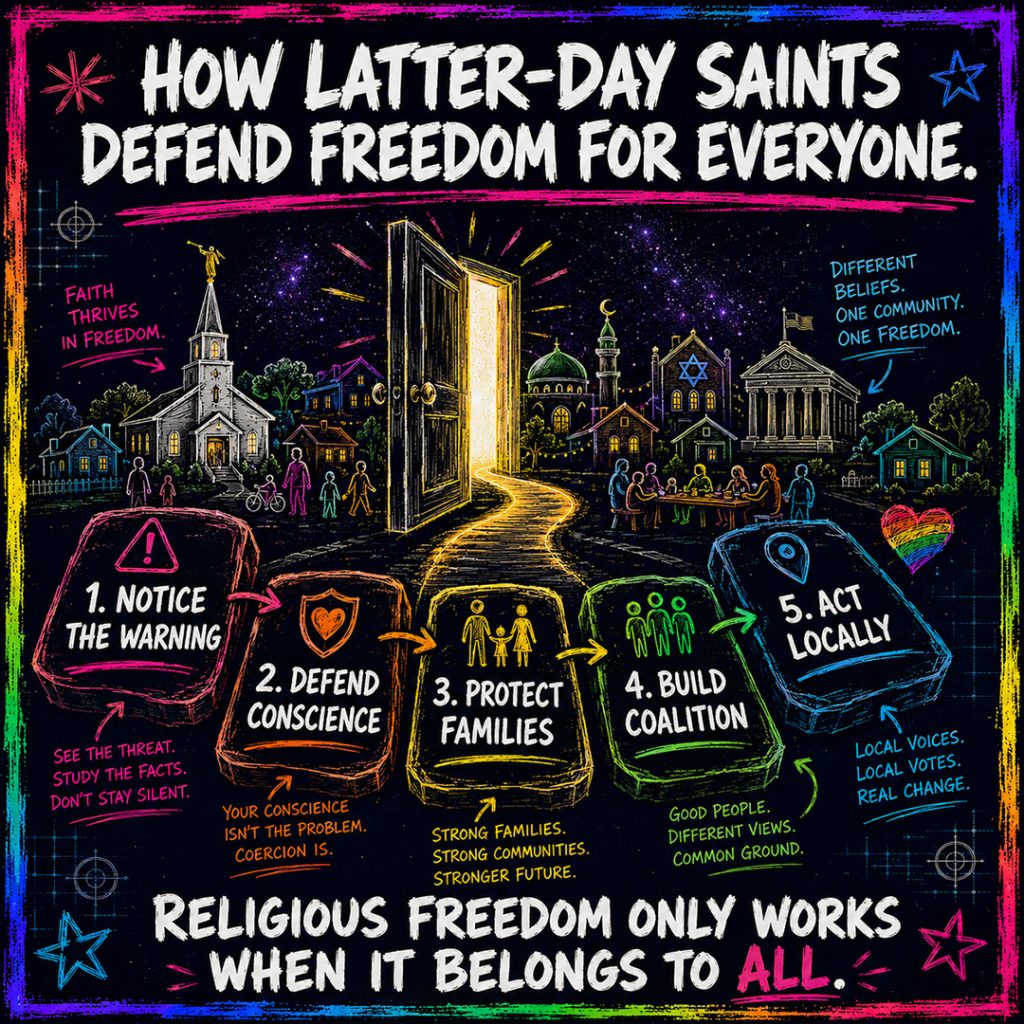
A coalition against fascism should be plain, local, and practical: defend due process, protect religious freedom for every belief and no belief, refuse dehumanizing language, support targeted communities, and build relationships before the next crisis. We do not need perfect agreement. We need shared commitments strong enough to stop cruelty.
We’re not going to agree on everything.
Latter-day Saints, LGBTQ people, immigrants, atheists, agnostics, Muslims, Jews, Hindus, Catholics, Protestants, Evangelicals, people of color, secular liberals, classical conservatives, libertarians, socialists, and exhausted moderates will not suddenly share the same theology or politics. That’s fine.
We just need a foundation on which we can support and build democracy back up.
Here is what that foundation can look like:
- Ask federal leaders to fix the religious affiliation system. The Pentagon should restore clear, detailed faith and belief categories, including nonreligious identities. Latter-day Saints should ask for accurate categorization without ignoring everyone else who was dropped.
- Defend due process in immigration enforcement. Local and state leaders should reject racial profiling, warrantless raids, family separation as a default practice, and dragnet enforcement that sweeps up people with no criminal convictions.
- Replace culture-war bills with family-stability bills. If a bill does not make housing, food, education, health care, child care, public safety, or family life better, we should ask why it deserves priority. It’s well past time to stop legislating who gets to use which bathroom or receive which healthcare or enjoy which benefits — we never should have done this to begin with.
- Build local interfaith relationships before crisis. Wards, mosques, synagogues, churches, temples, community centers, LGBTQ groups, immigrant organizations, and secular mutual-aid groups should know each other by name before someone is targeted.
- Practice better family conversations. When someone says, “They are only deporting criminals,” answer with Cato and TRAC data. When someone says, “Mormons aren’t Christian,” defend religious freedom for everyone rather than only pleading our own case. When someone says, “LGBTQ rights threaten families,” defend the legitimacy of LGBTQ people and families — and highlight the evidence that shows recognition improves safety, stability, and suicide prevention.
- Make belonging visible. Put immigrant dignity, LGBTQ civil safety, religious pluralism, and democratic norms into public statements, sermons, neighborhood meetings, city councils, school board comments, prayers, and social posts.
This does not require every person to become an activist, but it may mean attending a local interfaith event. It may mean using better conversations to keep curiosity alive. It may mean showing up to community events where people outside our normal circle are trying to build something better. It may mean supporting journalism, music, art, and civic work that gives neighbors language for what they already feel.
We need to stop being performative in our righteousness and start becoming authentic in our compassion. We need to build the kind of trust and community that prevents fear from governing us and tearing us apart.
Frequently Asked Questions About Latter-Day Saints, Christian Nationalism, And Religious Freedom
Are Latter-Day Saints Still Recognized On The Pentagon’s Religious Affiliation List?
Yes. Reporting indicates The Church of Jesus Christ of Latter-day Saints remains on the shortened Pentagon list. The dispute is that Utah senators say it was not categorized under the broader Christian designation. The Pentagon says the change is administrative, not a judgment on the legitimacy of any faith. But it should still raise alarm bells for anyone who has been paying attention to the ever-narrowing circle of belonging the Trump Administration has been pursuing on multiple fronts.
Is Christian Nationalism The Same As Christianity?
No. Christianity is a faith centered on Jesus Christ. Christian nationalism is a political project that links national identity, government power, and a narrow version of Christianity. It becomes dangerous when citizenship and belonging depend on passing someone else’s religious purity test.
Can Latter-Day Saints Oppose MAGA And Still Be Conservative?
Yes. Latter-day Saints can oppose MAGA from conservative principles: limited government, rule of law, fiscal responsibility, religious freedom, family stability, and constitutional restraint. No political movement owns those values. A faithful conservative can reject authoritarianism, cruelty, corruption, and state-sponsored religious favoritism.
What Should LDS Legislators Do For Immigrants And LGBTQ People?
LDS legislators should protect due process, family unity, civil rights, health care access, housing stability, and public safety. They do not need to abandon their doctrine to defend the legal dignity of neighbors. In a pluralistic republic, religious liberty and civil equality must be built together.
What Scriptures Support Religious Freedom For Everyone?
Doctrine and Covenants 134:4 warns against civil government controlling conscience or suppressing freedom of the soul. Doctrine and Covenants 134:9 rejects mingling religious influence with civil government. Second Nephi 26:33 teaches that all are alike unto God. Matthew 25 teaches that Christ is found among the hungry, stranger, sick, and imprisoned.
Should Church Leaders Risk Political Backlash By Speaking More Clearly?
Yes. Church leaders should speak clearly and unequivocally about democracy, conscience, immigration, pluralism, and human dignity. If fear of political backlash keeps religious leaders from defending religious freedom for everyone, the Church itself stands to be threatened down the line by ever-increasing purity tests.
So, What Should Latter-Day Saints Do About Christian Nationalism?
Latter-day Saints should treat the Pentagon’s reclassification as a warning about what happens when government and religious identity start merging. The answer is not to beg for a better seat inside someone else’s purity circle. The answer is to defend religious freedom, due process, civil dignity, and family stability for everyone. That is both the safer democratic strategy and the more faithful Christian one.
If you’re a Church member, send this to a trusted Latter-day Saint and ask: “How can we defend the freedoms of LGBTQ+ people? How can we make sure immigrants remain safe and loved inside our communities?”
If you’re a ward, local, or state leader, write a sermon, lecture, or press release that unabashedly defends due process, immigrant dignity, LGBTQ civil safety, and religious freedom for every faith and no faith.
If you are a legislator, replace a culture-war bill with a family-stability bill.
And if you’re not sure where to start: call a representative, support an immigrant or LGBTQ mutual-aid group, attend an interfaith gathering, or invite someone outside your usual circle to dinner.
Then keep going.
Share this article far and wide. Send it to those who need to hear truths that may be uncomfortable at first, but are critical for them to understand. Religious freedom has to protect everyone — not just “us.”