A profit-first economy treats medicine, housing, food, and work as revenue streams instead of human needs. We can shift toward people-first systems — universal basic services, worker co-ops, and shared commons — that already work somewhere today.
TLDR – How Profit Is Hurting Us & How To Fix It
- Profit-first systems treat people as revenue — instead of the purpose.
- The metric is the problem: GDP and stock prices ignore well-being.
- Essentials get redirected: medicine, food, housing chase margins.
- Short-term gains create long-term pain for nearly everyone.
- Even the rich lose — to isolation, instability, and hollow status.
- Money can’t buy trust, community, safety, or lasting purpose.
- Systems shape behavior; better metrics build a better world.
- Decommodify essentials: healthcare, food, and housing first.
- Democratize business through co-ops and worker-owned models.
- Act this month: shift one purchase, join one mutual aid group.
I’m debt-free, I sit on an 800 credit score, and in a good year I clear six figures. I still cannot work out how a regular family covers rent, groceries, and childcare at the same time. When someone in my position feels the squeeze, the problem isn’t a personal budgeting failure. Something larger is bending underneath all of us.
Corporate profits and stock indexes keep setting records. At the same time, roughly 14% of U.S. households reported food insecurity through most of 2025 — up from 12.5% the year before, per Purdue University’s Center for Food Demand Analysis. In New York City, 40% of families can’t cover their weekly groceries, according to data from Robin Hood and Columbia University reported by CBS News. The machine is running fine. It’s just pointed at the wrong target.
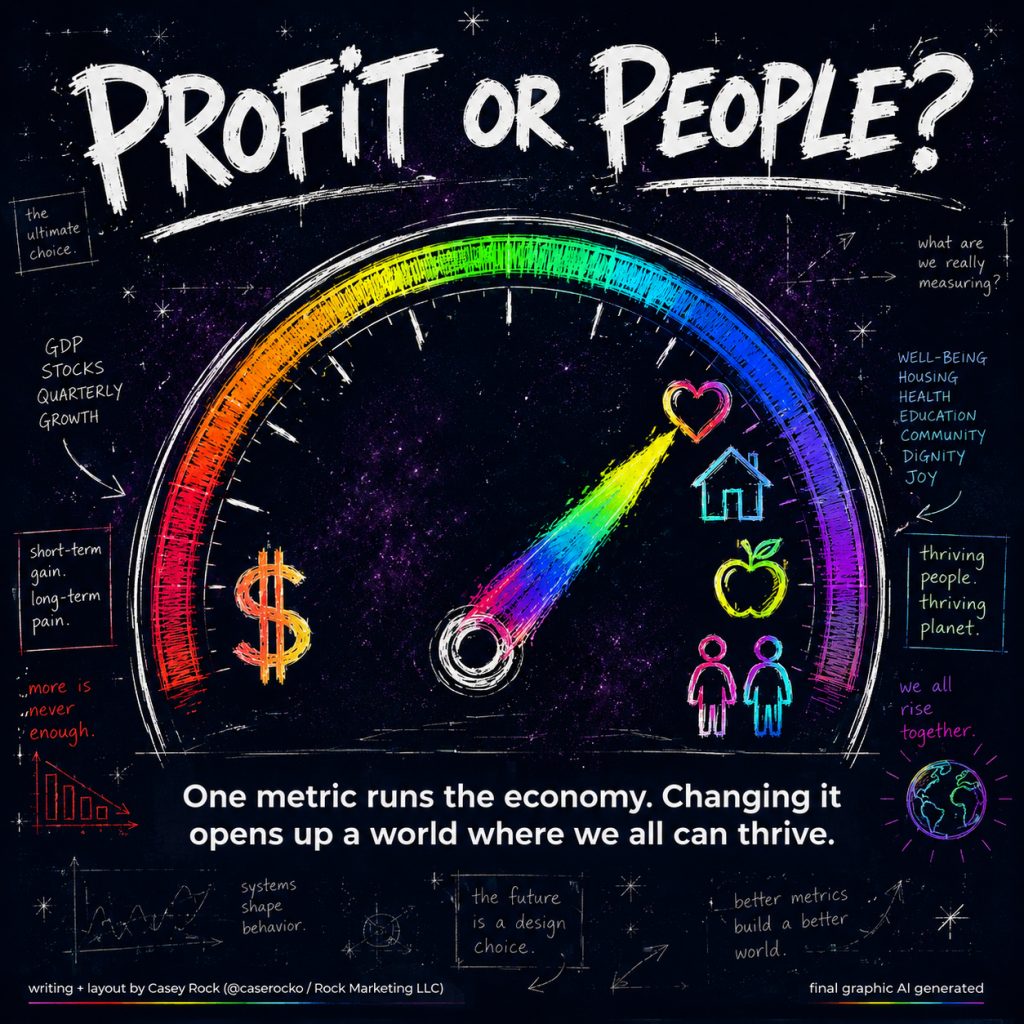
When profit becomes the one metric that matters, the systems meant to serve us start treating us as revenue instead.
Once you see that pattern in medicine, food, housing, work, and even your relationships, you can’t unsee it. The good news hiding inside that discomfort: if we built these systems around one metric, we can always build them around another one — a better one.
Let’s walk through how profit hurts everyday people, why it backfires even for the rich, and which people-first alternatives already exist — plus what you can do about it from where you sit.
Who Is Our Economy Actually For — People Or Profit?
On paper, our economy exists to help us live well. In practice, it optimizes for one number: profit. When a single metric runs everything, medicine, housing, food, and work get pulled toward returns for owners — and away from the people those systems were built to serve. That gap between the stated purpose and the real one drives most of what feels broken.
None of this means markets are evil or that everyone chasing a paycheck is greedy. I’ve made six figures some years and scraped by on $24,000 in others, and I promise you the difference was rarely about how hard I worked.
But it points toward a hard truth: a system designed around shareholder returns will reliably produce shareholder returns, even when our health, time, and communities pay the bill.
Change the target, and you change the results.
How Does A Profit-First System Hurt Everyday People?
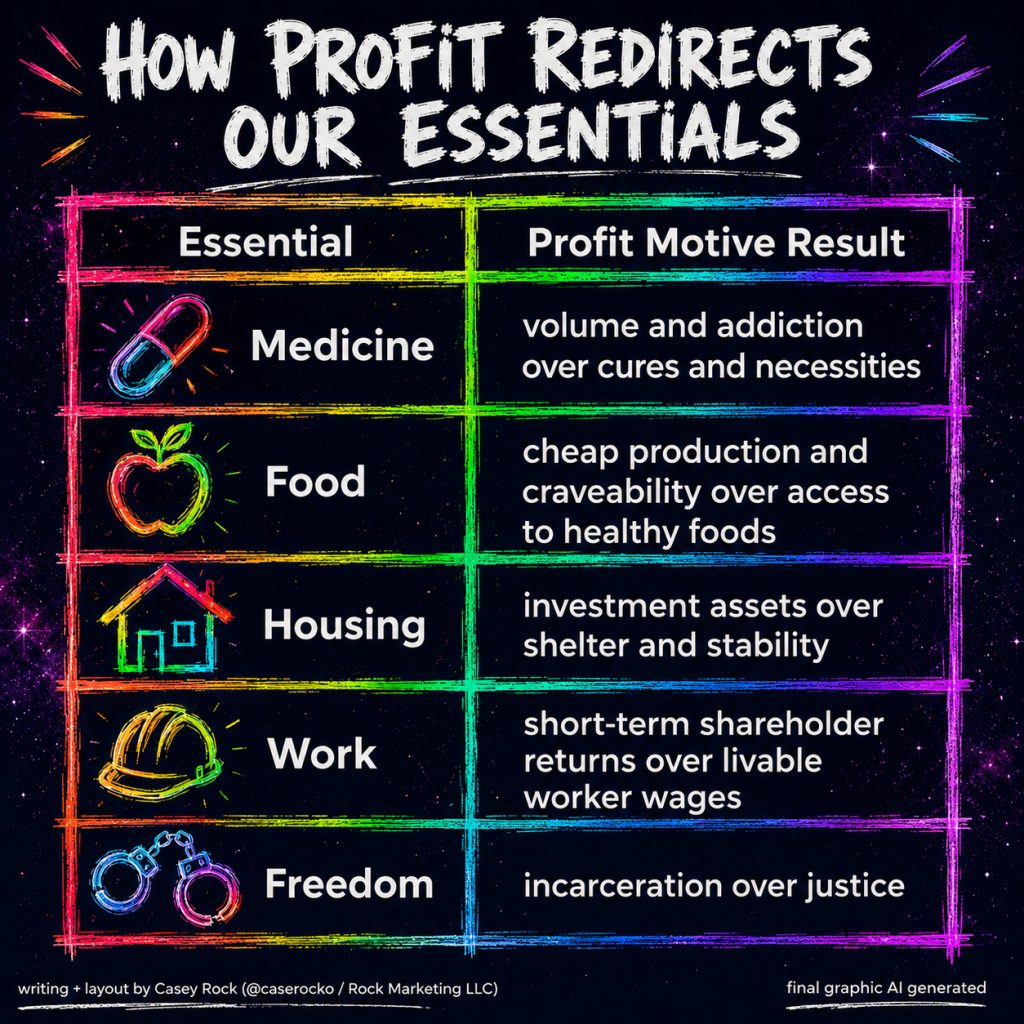
It turns necessities into revenue streams. Instead of asking what keeps us healthy, housed, and secure, a profit-first system asks what people will pay for — and what keeps them paying. That logic reshapes medicine, food, housing, and work, so the cheap, profitable option rarely lines up with the healthy, humane one. You feel it in your body, your grocery bill, and the way your boss talks about the company’s headcount.
Why Is Healthcare So Expensive And Sometimes So Harmful?
Because volume pays better than health. A profit-first system rewards high prices, chronic treatment, and repeat prescriptions — not cures or prevention. The opioid crisis shows the cost: companies marketed addictive painkillers as safe, turning addiction into recurring revenue while families and communities absorbed the damage.
Investigations into firms like Purdue Pharma document years of aggressive marketing, misleading safety claims, and high-pressure sales tactics that expanded prescriptions and profits together. Regulators, as the AMA Journal of Ethics has detailed, lagged or bent under pressure in ways that made over-prescribing easier. This wasn’t a handful of bad actors. It was the logic of shareholder value doing exactly what it does — addiction becomes repeat business, and the harm lands on the public.
The same logic explains where medicine does not invest. New antibiotics are risky and, as Nature has reported, far less profitable, because you want people using them rarely, not daily for life. Large companies have mostly abandoned antibiotic research, leaving a fragile pipeline to smaller firms and nonprofits while resistant infections kill tens of thousands every year. A health-first system would pay for outcomes over prescription volume, fund low-profit research publicly, and make deceptive marketing a career-ending move rather than a line item.
Why Are Unhealthy Foods Cheaper And Everywhere?
Because ultra-processed foods are cheap to make and highly profitable. They’re engineered for craveability, marketed heavily (often to kids), and defended by lobbying. The result: the most available, affordable calories are often the ones most likely to harm our long-term health.
A 2024 study in The BMJ found that each 10% rise in ultra-processed foods in the diet tracked with about a 3% increase in premature death — and in some countries those foods may be tied to up to 14% of early deaths. Cohort research links heavy consumption to higher all-cause mortality and greater risk of heart disease and type 2 diabetes.
Meanwhile, as work published in The Lancet describes, the industry lobbies hard to block labeling, marketing limits, and taxes. In a people-first food system, the easy choice would also be the healthy one: strong limits on junk-food marketing to children, rules that make ultra-processed business models less profitable, and public investment in fresh, local food.
Why Is Housing So Unaffordable?
Because homes have become financial products first and shelter second. Large investors, funds, and private equity buy up housing for returns, raise rents, and sometimes leave units empty as safe assets. Local wages can’t keep pace with prices set by global capital, rather than community need.
The UN Special Rapporteur on adequate housing calls this the “financialization of housing” — homes treated as vehicles for global capital rather than places to live. At street level, it looks like a family spending half its income on rent, young people locked out of ownership, and neighborhoods hollowed into portfolios.
Treating housing as a human right instead of a speculative bet would mean expanding public, non-profit, and cooperative housing where rents reflect costs, plus vacancy taxes, ownership caps for large investors, and community land trusts that anchor neighborhoods in place.
Why Do Good Jobs Feel Harder To Find And Keep?
Because “shareholder value” often means moving money away from workers. When ownership concentrates in powerful investors, firms tend to cut jobs and suppress wages while boosting returns — without growing the real economy. Add gig work and constant monitoring, and people become interchangeable cost centers.
Research summarized by UCLA’s Anderson Review and analysis from the Chicago Fed point the same way. When institutional ownership concentrates, firms tend to shrink payrolls and depress workers’ long-term earnings while lifting shareholder returns — with no real gain in productivity. Layer on gig platforms and algorithmic management that, as work indexed in the National Library of Medicine documents, erode autonomy and dignity.
Many of us have felt this directly: shifting expectations, opaque decisions, and the sense of being treated as a line item rather than a person. A people-first model would give workers real power in governance, rein in exploitative monitoring, and reward firms for stable, humane jobs.
Worker cooperatives already prove this works — evidence suggests they can match or beat conventional firms on productivity while narrowing wage gaps.
Does Chasing Money Actually Make Us Less Happy And Connected?
Evidence points that way. When people focus on money, studies find they help others less and prefer more distance from them. Higher inequality tracks with weaker trust, worse health, and more anxiety. A money-first culture leaves nearly everyone breathing the same air of comparison and “never enough.”
Studies on “money priming” — subtle reminders of money — have found people become less helpful and more socially distant, though researchers still debate how strong the effect is. Other work suggests that when we make time feel more important than money, people spend more hours with friends and family and report stronger connection.
Research by UC Berkeley psychologist Dacher Keltner and social psychologist Paul Piff of UC Irvine also finds that higher social class can blunt empathy and attunement to others. A 2025 study covered by The Guardian went further, linking high regional inequality to measurable changes in children’s developing brains and higher rates of anxiety and depression.
Profit-first systems don’t only hurt the poor. They warp the shared world of meaning the rest of us live inside.
How Does Profit Threaten Our Freedom And Privacy?
When attention and confinement become revenue lines, freedom takes the hit. Tech platforms profit by harvesting personal data and maximizing engagement, which rewards outrage over truth. Private prisons and prison labor can reward high incarceration.
Monetize someone’s minutes or their cell, and you’ve effectively monetized their lost freedom. The more a platform knows about you, the more valuable you are as an advertising asset.
Research in the journal Social Sciences argues this pushes companies to maximize engagement and addiction over our well-being. On the carceral side, studies in journals like Criminology & Public Policy show how private contracts and cheap incarcerated labor can reward longer sentences and fuller cells.
Zoom out, and concentrated wealth erodes democratic control itself: surveys reported by The Guardian and analysis from the UN Department of Economic and Social Affairs find majorities across several countries believe the very rich hold too much sway over politics.
A freedom-first approach would treat core information systems as regulated commons, enforce strict data-minimization rules, and pull the profit motive out of prisons and policing.
Here’s the through-line across every one of those domains, laid side by side:
| Domain | Profit-first logic | People-first logic |
| Medicine | Reward volume, high prices, chronic treatment | Pay for outcomes, cures, and prevention |
| Food | Sell cheap, craveable, high-margin calories | Make the healthy option the easy option |
| Housing | Treat homes as assets to trade | Treat homes as a right to protect |
| Work | Cut wages to lift shareholder returns | Share ownership, power, and stability |
| Freedom | Monetize attention and incarceration | Guard privacy and liberty as public goods |
Doesn’t Profit And Competition Drive Innovation?
Sometimes — but only a narrow slice of it. Profit funds innovation that’s quick, ownable, and monetizable, while neglecting anything slow, shared, or hard to patent. That’s why companies abandoned antibiotics, funded climate disinformation, and built patent thickets. Real breakthroughs often need collaboration, not just competition.
To be clear, markets have coordinated staggering advances in medicine, food production, and technology, and they’ve helped lift billions out of extreme poverty over two centuries. In 2019, even the Business Roundtable — an association of major U.S. CEOs — publicly walked back decades of pure shareholder-first dogma and said companies should serve employees, customers, and communities too.
The instinct behind “profit drives progress” isn’t stupid. It’s just incomplete.
Look closely and the innovation story frays. Big pharma retreated from antibiotics precisely because a drug you use sparingly makes a weak business case, and several firms that did develop new ones went bankrupt. Major fossil fuel companies, as a Harvard study documents, knew the climate risks of their products for decades and funded disinformation anyway. Dense “patent thickets” in smartphones and biotech raise costs and scare off smaller innovators.
Short-term profit pressure, as business reporting in outlets like Forbes describes, pushes firms to underinvest in long-term research and people. And rather than unleashing competition, concentrated profit tends to buy up, wall off, or crush rivals. What we actually get is a very specific kind of progress — fast, lockable, and salable — while basic science, climate resilience, and open knowledge get starved.
If Profit Backfires, Why Do We Still Build Everything Around It?
Because profit does two useful jobs: it motivates effort and signals what people want. Those signals help millions coordinate without a central plan. The problem starts when one metric — shareholder profit — overrides all others, recreating the blind spots and gamed numbers of the central planning it claims to beat.
The Austrian-British economist Friedrich Hayek made the serious version of this case: prices and profit signals let strangers cooperate across a vast economy without any central committee. He wasn’t wrong. But that wasn’t necessarily the whole story either.
Make shareholder profit the master metric, and you rebuild the failures of central planning in a new costume — which is easier to see when you put the two side by side.
| Failure mode | Central planning | Profit-first markets |
| Blind spots | Planners can’t see enough, fast enough | Executives only “see” what hits the balance sheet |
| Gamed numbers | Factories fake quotas | Firms game quarterly earnings and KPIs |
| Concentrated power | One party captures the state | Wealth captures law, media, and policy |
The kicker is that this system doesn’t even win on its own terms. Evidence gathered by groups like the Washington Center for Equitable Growth suggests aggressive shareholder-value strategies cut wages and jobs without raising long-term productivity or sustainable growth.
“Maximize profit at all costs” often ends up leaving profit on the table too.
What Are Realistic Alternatives To A Profit-First Economy?
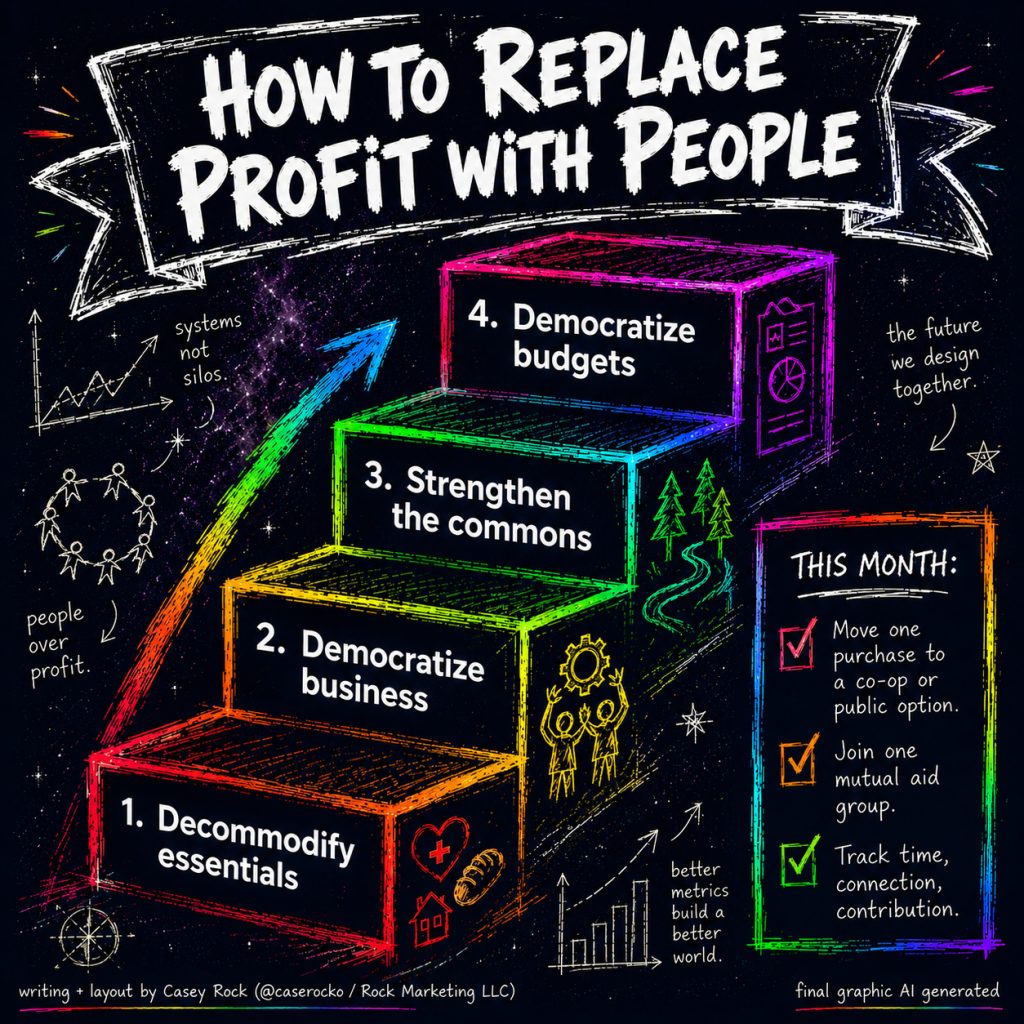
We don’t need to abolish markets — we need to bound them. Take essentials out of the profit game, share ownership more widely, protect the commons, and let people shape public budgets directly. Each of these already works somewhere today, and each can grow from where you live. Here’s the practical middle ground, minus the ideology:
- Decommodify essentials to cut everyday precarity. The idea behind universal basic services is simple — guarantee healthcare, education, housing, transit, utilities, and internet based on need, not ability to pay. Run them through public and non-profit providers with real democratic oversight, funded by outcomes rather than revenue growth. You get fewer bankruptcies, steadier neighborhoods, and more freedom to leave a bad job or relationship.
- Democratize firms to keep wealth local. Worker cooperatives and employee-owned companies often match or beat conventional productivity while shrinking internal wage gaps and keeping surplus in the community. Support them with financing for employee buyouts, “public interest” corporate structures with baked-in missions, and tax advantages for broad ownership. Profit still exists — it just flows to the people who create it.
- Strengthen the commons to speed up shared progress. Commons-based peer production — think Linux, Wikipedia, open-source tools — shows large groups can build complex systems on curiosity and shared purpose instead of paychecks. Public funding for open science and open infrastructure lowers costs, reduces lock-in by giant vendors, and keeps key tools out of any single owner’s hands.
- Democratize budgets to rebuild trust. Participatory budgeting lets residents directly decide how to spend part of public funds. Evidence suggests it boosts civic engagement, aligns spending with real community needs, and builds the muscle of collective problem-solving. Scale it up with citizen assemblies chosen by lottery, and you get democratic planning without a politburo.
If Not Profit, What Actually Motivates People?
Autonomy, mastery, and purpose. Decades of research on motivation show people do their best, most creative work when they feel in control, can grow real skills, and serve something beyond a number. We already run huge parts of life — care, friendship, art, mutual aid — on exactly these motives, no profit required.
Self-Determination Theory, one of the most tested frameworks in psychology, keeps landing on those three drivers. Look around and you’ll notice how much of the world already runs on them: parenting and care work, volunteerism, open-source software, citizen science.
The Nobel-winning economist Elinor Ostrom spent a career documenting communities that sustainably managed shared forests, fisheries, and irrigation for generations — governed by clear rules and shared stewardship, not private ownership.
And, speaking truthfully, I think we already live in a post-scarcity, post-labor world and simply haven’t caught up to it yet, partly because manufactured scarcity keeps the old story running.
Profit is not what makes people love, build, protect, or grow. More often, it gets in the way.
Would A People-First World Actually Help The Wealthy Too?
In many ways, they’d gain the most. The current system traps wealthy people in endless “number go up” pressure, legal and reputational risk, and relationships shadowed by suspicion. Guarantee everyone’s basics and root status in contribution, and even the rich get to be fuller, less anxious human beings.
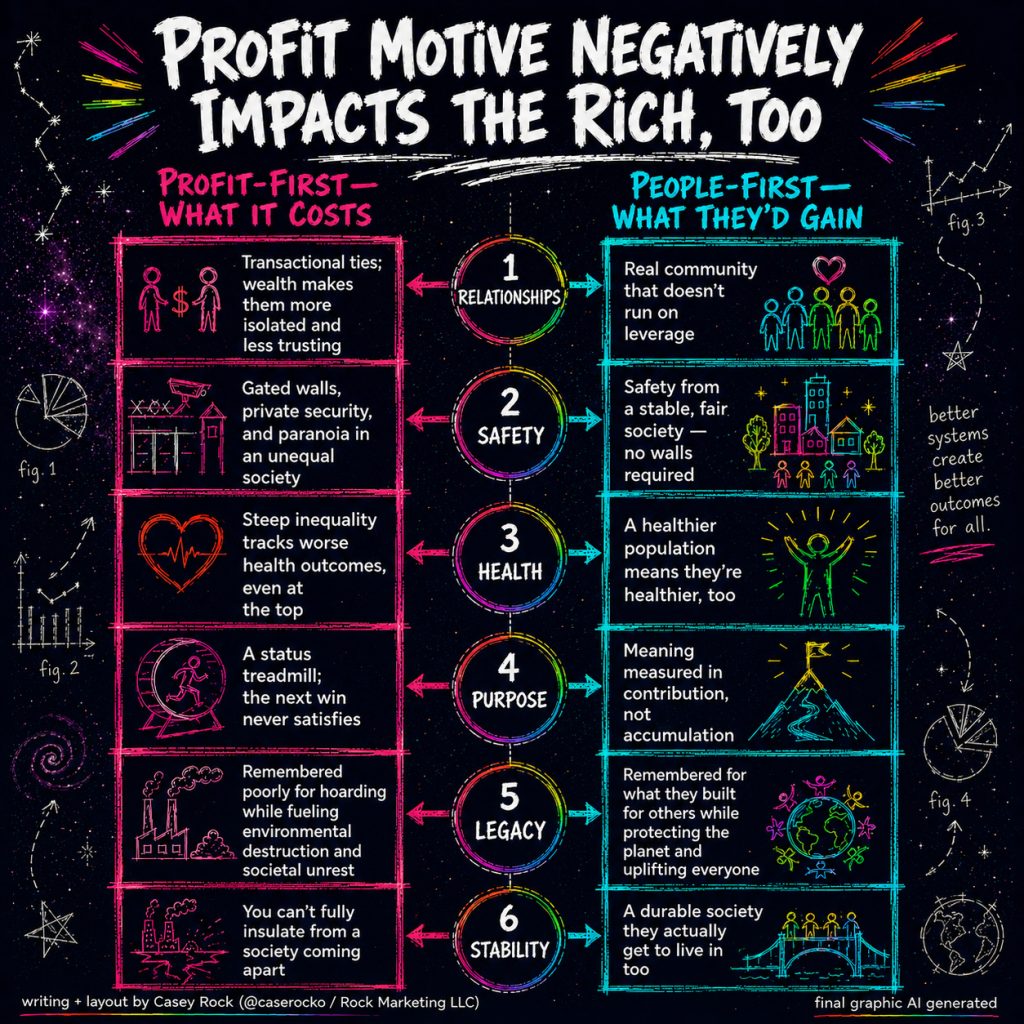
I’m not interested in demonizing anyone here — wealth hoarding is a system problem far more than a character flaw. But that same research on class and empathy suggests a money-centric life can starve the connection that makes people happy.
The ultra-rich live under constant pressure to keep the numbers climbing, real legal and political exposure, and a nagging question behind every relationship: would they still be here without the money?
In a world where basics are guaranteed, work is more democratic, and status comes from what you contribute, the wealthy would be less trapped by dynastic fear and image management — and freer to pursue curiosity, care, and beauty without optimizing every minute.
That’s not a loss. That’s what makes life worth living.
How Do You Start Putting People Before Profit In Your Own Life?
Start small and local. Shift a bit of your spending and support toward co-ops, public options, and mutual aid. Join or seed community efforts where you live. And retrain your own scoreboard — measuring time, connection, and contribution instead of income alone. None of it requires a revolution. Here’s a plan you can act on this month:
- Shrink profit’s role where you can. Back candidates and policies that decommodify essentials and rein in harmful profit models. When you have a real choice, pick the co-op, the public option, or the mission-driven org over the extractive one.
- Expand non-monetary coordination. Join or support mutual aid networks, time banks, and community projects. I put my money where my mouth is with a local music community — the Open Door Collective runs on suggested donations that cover costs, with the band taking little or nothing. Small, repeatable acts of kindness and solidarity build real resilience.
- Show up for public decisions. If your city, school, or state runs any participatory budget or open planning process, get in the room. If it doesn’t, that’s a thing worth asking for.
- Retrain your own instincts. Track time, connection, and contribution the way you’d track a bank balance. Practice gratitude for what you have instead of always seeking more — and celebrate the people building community rather than just wealth.
Money and profit won’t vanish overnight. As these pieces grow and link up, though, they stop being the center of the story — and start being one tool among many.
Frequently Asked Questions About Profit Motive (And Alternatives)
Why Does Everything Feel Like It Serves Profit Instead Of People?
Because it does — by design. We organized our laws, corporate charters, and cultural stories around shareholder value and GDP growth, so systems predictably serve those numbers even when leaders talk about “purpose.” Higher bills, more precarity, and less control are what that design feels like once applied to the real world we live in.
How Can We Fix Capitalism Without “Going Full Socialism”?
Keep the useful parts of markets, but take essentials and core infrastructure out of the profit game. That means running healthcare, basic housing, education, and utilities as public or non-profit services, growing worker co-ops and employee ownership, protecting shared knowledge as a commons, and using participatory budgeting so people shape public spending directly. It’s a bounded market, not a banned one.
Are There Real People-First Models That Actually Work Today?
Yes — many building blocks already exist. Worker cooperatives match or beat conventional firms on productivity with less inequality. Open-source software and Wikipedia-style projects run on shared purpose. Communities sustainably manage forests and fisheries under shared rules, and public libraries, parks, and transit deliver enormous value with no profit motive at all.
Does Inequality Really Affect Our Health And Happiness?
The pattern is consistent. People who prioritize money and possessions report lower life satisfaction on average, and higher inequality tracks with lower trust, worse health outcomes, and more anxiety. Research even links high regional inequality to changes in children’s brain development. Markets aren’t the villain — centering profit and accumulation as the goal is where the damage starts.
What Is One Thing I Can Do This Week To Push Back?
Pick a single lever and pull it. Move one recurring purchase to a co-op or public option, join one local mutual aid group, or attend one community meeting. Then start measuring your own week by time, connection, and contribution instead of income alone. Small, repeated choices compound faster than you’d think.
Isn’t Moving Beyond Profit Just Unrealistic?
We don’t need a finished blueprint — only a direction backed by real evidence. Every alternative here already operates somewhere in the world right now. The unrealistic move is expecting a system built entirely around profit to keep producing health, stability, and connection it was never designed to prioritize.
So What Does Profit Really Serve? And How Can We Fix These Problems?
A profit-first economy converts medicine, food, housing, work, and even our relationships into revenue streams — which is why life can feel harder even as stock indexes climb. That harm isn’t a glitch; it’s what happens when one number outranks every other. The fix isn’t a single grand revolution but a direction: take essentials out of the profit game, share ownership and power more widely, protect the commons, and measure success in health, time, connection, and ecological stability. Every piece of that already works somewhere today. Put people before profit, and the world starts to become ours again.
Everything above folds into one question you can carry into any policy debate, work meeting, or personal decision: what does this metric serve — and what kind of world does it build? If the answer is “profit, and a world that’s more stressed, unequal, and lonely,” you’ve found a KPI worth replacing.
If you do just one thing after reading this, make it this: pick a single system in your own life this week — where you bank, shop, work, or give — and move it one notch toward people over profit. Then share this piece with someone you love and use it to start an honest conversation about who our systems are really for.
Casey Rock is a writer, podcaster, and organic-growth strategist based in Logan, Utah. A journalist by training, he spent fifteen years building content and community for media, tech, and B2B brands — while turning that same systems-thinking toward the questions he actually cares about: why the structures meant to serve us so often don’t, and what it would take to build ones that do. He writes about the intersection of science, technology, politics, mental health, and relationships. He hosts the Rock Your Curiosity podcast, where he interviews subject-matter experts about the things he’s curious about, and fronts the band Open Door Policy. He’s most interested in finding the root causes to our individual and collective ills and supporting mutual aid. He stubbornly believes that we could wake up tomorrow and have a better world, if we all chose to do so together.