Fidelity Month is a June observance focused on fidelity to God, family, country, and community. However, real fidelity means keeping faith with our neighbors through honesty, care, freedom, stewardship, accountability, and public service that protects every person’s dignity. The last thing people with true fidelity to God, family, country, and community would do is sow division by pitting these concepts against other people.
TLDR – What Real Fidelity Means
- Fidelity means keeping faith with every neighbor.
- We should not pit Fidelity Month against Pride Month.
- Family values should help families survive.
- Freedom must protect unfamiliar lives, too.
- Community care must reach beyond our circle.
- Measure the economy by human flourishing.
- Public servants owe people truth and accountability.
- Democracy needs more everyday public input.
- Truth requires evidence, humility, and compassion.
- Real fidelity means listening, repairing, and acting.
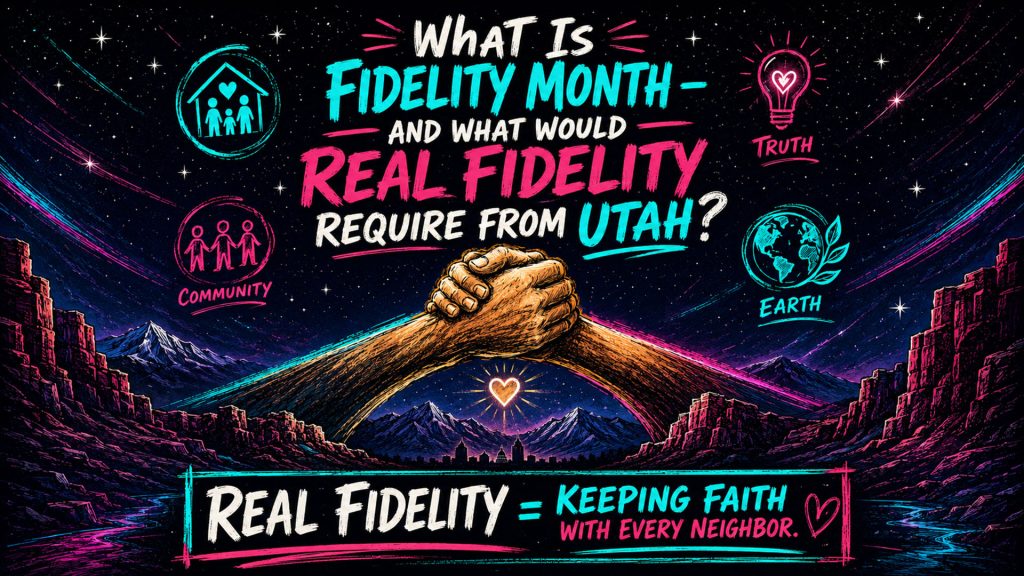
Is “Fidelity Month” Another Meaningless Slogan?
Are we really going to declare June “Fidelity Month” and then make fidelity small enough to fit inside one kind of family, one kind of faith, one kind of love, and one kind of Utah?
Fine. Let’s talk about fidelity. Because fidelity is not just about sex or marriage. It’s not just a poster about faith, family, and country.
Sure, fidelity has a lot to do with faithfulness. But if we’re going to elevate fidelity as a public virtue, then it’s important to ask: faithful to whom, faithful to what, and faithful at whose expense?
If “Fidelity Month” only means loyalty to tradition, it’s a slogan as meaningless as “Disagree Better.” If it means loyalty to God, neighbor, family, community, country, truth, creation, and the people our systems keep pushing to the edge, then it becomes something much more meaningful and exceptional — but also demands much more from people like Governor Cox, our other elected leaders, each other, and ourselves.
Real fidelity isn’t a virtue signal. Nor should it shrink anyone’s life. Real fidelity is the grand social contract — the promises — we make with each other.
What Is Fidelity Month?
Fidelity Month is a June observance promoted by Princeton professor Robert P. George and recently recognized in Utah by Gov. Spencer Cox. Supporters frame it around fidelity to God, family, country, and community. While these values are laudable, the problem is in using them to imply some people stand outside them.
According to KSL and the Deseret News, Gov. Spencer Cox declared June 2026 “Fidelity Month,” calling for a return to America’s “core values.” The movement’s own website describes Fidelity Month as a rededication to God, spouses and families, communities, and country. On paper, that sounds broad enough to include almost everyone.
But context matters. June is already Pride Month. In Utah, Cox’s declaration follows years of public tension over whether the state would fully recognize LGBTQ+ Utahns in June. So even when leaders say “this is about unity,” many LGBTQ+ people hear something else: our month, our visibility, our families, and our place in the community have been pushed aside for a more “traditional” moral symbol.
And here is the thing many of us from Latter-day Saint culture should be able to understand immediately: belonging is not fluff, indulgence, or caving to “identity politics.” Belonging is the soil people grow in. When the soil turns hostile, people do not flourish. They survive, hide, leave, or break.
The first act of fidelity is telling the truth. So, let’s be honest with ourselves about what “Fidelity Month” really is: Another attempt to label us, divide us, and ultimately conquer us. Because, especially under the charged political climate of Utah’s latest data center, there’s nothing more that our elected leaders want than to see us divided.
We should not let them have that satisfaction. We should run with the concept of “fidelity” by making room for LGBTQ+ people — and all Utahns — instead of speaking over them.
What Does Fidelity Actually Mean?
Fidelity means faithfulness to a duty, relationship, truth, or trust. In public life, fidelity is not just about private morality. It is about whether we keep faith with our neighbors, tell the truth accurately, protect the vulnerable, and honor the obligations that come with power.
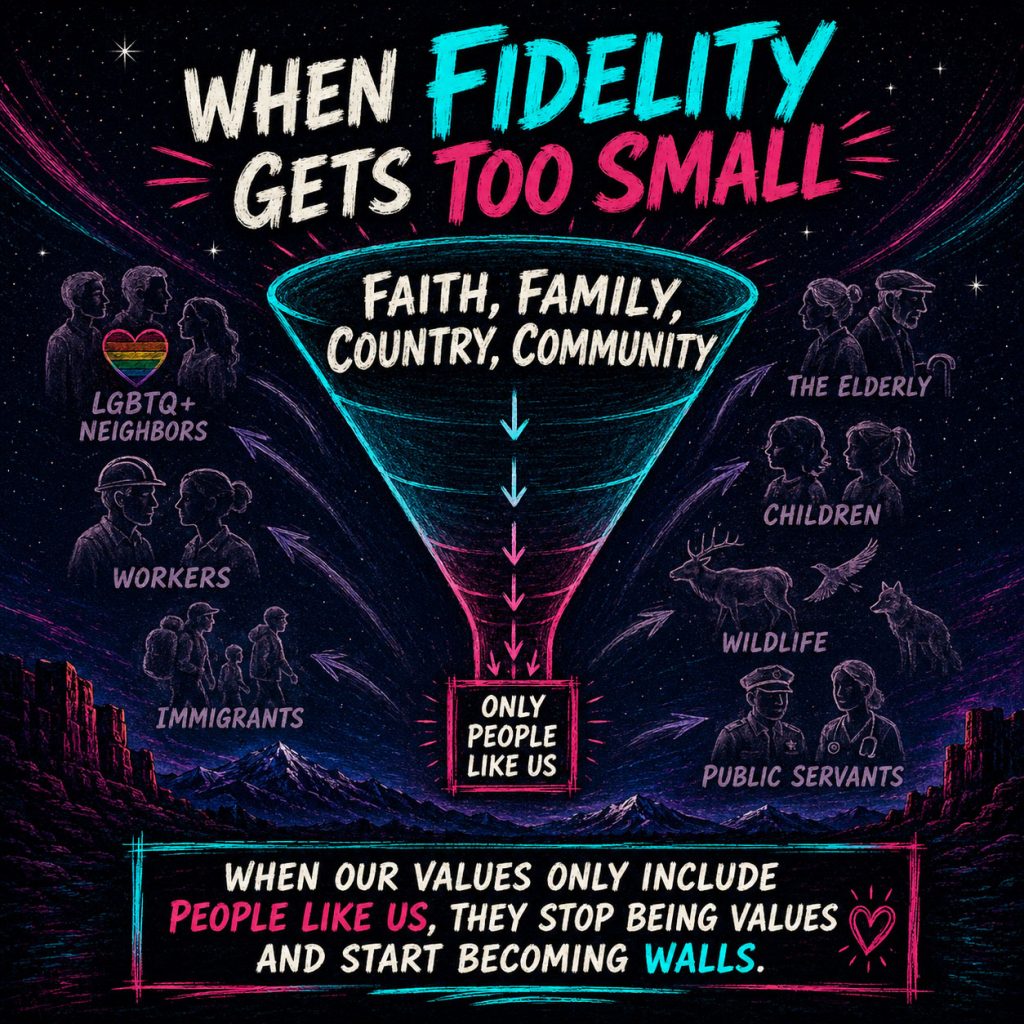
Public leaders have a tendency to flatten moral words until they become meaningless slogans. “Family.” “Freedom.” “Faith.” “Country.” These are all great things that can and do include straight people, gay people, white people, black people, immigrants, citizens, criminals, executives, and everyone in between.
If we say we value family, do we mean every family trying to stay housed, fed, healthy, and loved? Or only families that match our preferred structure?
If we say we value freedom, do we mean bodily autonomy, conscience, speech, movement, worship, rest, and honest selfhood? Or only the freedom to preserve what feels familiar?
If we say we value country, do we mean the people who live here, work here, raise kids here, clean buildings here, pick food here, teach here, nurse here, build here, and worship here? Or do we mean an aesthetic of country that disappears anyone who complicates the picture?
And if we say we value truth, do we mean truth even when it challenges us? Or only truth when it confirms what we already wanted to believe?
This is why fidelity has to include accuracy. A low-fidelity speaker distorts the music. A low-fidelity politics distorts the people. It takes the full sound of a community — queer people, straight people, single people, married people, parents, nonparents, immigrants, workers, business owners, believers, doubters, experts, laypeople, the sick, the elderly, the resting, the striving — and compresses it into one acceptable note.
Utah is bigger than that. Humanity is bigger than that. God, if God exists, is certainly bigger than that.
What Would Fidelity To Family Really Require?
Fidelity to family means helping families become stable, safe, loving, and whole. That includes strong marriages, yes. It also includes single parents, blended families, LGBTQ+ families, chosen families, interfaith families, child-free adults, widows, caregivers, and people rebuilding after harm.
We can honor marriage without turning it into a weapon. We can honor children without pretending every adult should have them. We can honor parents without ignoring how impossible parenting has become for many working families.
The family crisis we should worry about is not that other people’s families look different from ours. It is that too many families cannot afford rent, groceries, childcare, healthcare, transportation, college, therapy, or time together. That is where fidelity should begin.
If we are faithful to families, we should ask:
- Can parents spend time with their children without losing income?
- Can sick people get care before the emergency room?
- Can children learn in small enough classes to be known?
- Can workers afford the communities they serve?
- Can a teenager come out at home without losing love?
- Can a person leave an abusive relationship without becoming homeless?
- Can elders age with dignity instead of fear?
This is where values become practical. A pro-family society would separate basic survival from employment as much as possible. Housing, food, healthcare, and education should not depend entirely on whether a boss keeps us on payroll. That does not destroy work. It makes work more honest. People can contribute from stability instead of desperation.
That is not laziness. That is soil.
A tomato plant does not grow because we shame it hard enough. It grows because it has light, water, space, nutrients, and care. And people are not less sacred than tomato plants.
What Would Fidelity To Freedom Really Require?
Fidelity to freedom means protecting people’s ability to live honestly, worship freely, speak openly, make decisions about their own bodies, form consenting relationships, and build lives that do not harm others. Freedom cannot only belong to the people whose choices feel familiar.
Utahns understand conscience. We understand what it means to be misunderstood by outsiders. We understand the fear of a distant majority deciding our beliefs are strange, backward, or dangerous.
That memory should make us more protective of minority freedom, not less.
So yes, religious freedom matters. Deeply. A church should not be forced to perform religious rites that violate its doctrine. A believer should not be mocked for living by sincere covenants. Parents should be able to teach their children their values.
But that same freedom has to extend outward. LGBTQ+ people should not have to live under public shame. Trans people should not have their lives turned into annual legislative theater. Polyamorous people, single people, child-free people, and people who do not fit the expected mold should not be treated like threats to civilization simply because they reveal that life has more than one faithful shape.
Freedom is not fragile because someone else lives differently. Freedom is fragile when the state starts choosing which harmless differences deserve dignity.
What Would Fidelity To Community Really Require?
Fidelity to community means we stop outsourcing care to institutions alone and start rebuilding real local support. That includes mutual aid, neighborhood trust, safer public spaces, better civic listening, and relationships strong enough to catch people before they fall.
Many Utahns already know how to do this. We bring casseroles. We help people move. We organize meal trains. We shovel walks. We watch kids. We donate anonymously. We show up when someone’s house floods or burns.
That instinct is sacred. Now we need to widen it.
Real community care cannot stop at people who attend our church, vote like us, look like us, or live in the “right” kind of household. The Good Samaritan did not ask whether the wounded man had the right family structure before binding his wounds.
He helped because the man was wounded.
That should be the model. Local-first care. Mutual aid. Co-ops. Worker-owned businesses. Community fridges. Tool libraries. Tenant support. Recovery networks. Sober social spaces. All-ages music venues. Neighborhood assemblies. Practical systems that make love visible.
I wrote about this same need in Utah’s music scene because scenes do not survive on talent alone. They survive on trust. They survive when people speak up, own harm, share resources, and refuse to let the most vulnerable people carry the cost of everyone else’s comfort.
That is true for music scenes. It is true for wards. It is true for cities. It is true for countries.
What Would Fidelity To Working Families Require?
Fidelity to working families means measuring our economy by whether people can live, not merely by whether wealth grows somewhere above them. A faithful economy should increase health, housing, literacy, time, safety, family stability, civil liberty, and human flourishing.
For years, we have treated profit like the scoreboard for everything. If profit goes up, we call it success. But what if rent goes up faster? What if wages do not keep pace? What if parents work two jobs and still cannot see their kids? What if teachers burn out? What if nurses leave? What if young couples want children but cannot imagine affording them?
Then the scoreboard is broken.
In Robots, AI, and the End of Work as we Know It, I put it plainly: “distribution — not production — is broken.” That is the deeper issue. We have enough brilliance, technology, labor, land, food, and shelter to care for people far better than we do. We just keep organizing the world around extraction.
Fidelity asks a different question: What do we owe each other because we are human?
Here is a better scoreboard:
| If We Value Fidelity To People | We Should Measure |
|---|---|
| Family stability | Housing costs, childcare access, time at home |
| Community health | Mental health care, addiction recovery, loneliness |
| Education | Class size, literacy, curiosity, critical thinking |
| Work | Living wages, safety, schedule control, dignity |
| Freedom | Bodily autonomy, speech, movement, privacy |
| Stewardship | Clean air, water, soil, energy, biodiversity |
| Trust | Transparency, public participation, accountability |
This is pro-human. Work should help us contribute. It should not decide whether we deserve medicine, food, shelter, or dignity. Especially in favor of more profit for the ruling class.
What Would Fidelity To Public Service Require?
Fidelity to public service means elected leaders must keep faith with the people they represent. That requires honesty, transparency, humility, evidence, and real public input. A leader is not faithful when they use public power to symbolically elevate some residents while making others feel erased.
This is where “Fidelity Month” becomes a mirror.
If a governor declares fidelity to family and country while LGBTQ+ Utahns experience the declaration as exclusion, the faithful response is not defensiveness. It is listening. It is repair. It is asking why the message landed that way and what harm could be prevented next time.
Public service is a trust. It is not a branding exercise.
That is why I keep coming back to public trust in local government. People can handle hard decisions when leaders explain them clearly, invite real feedback, and show how that feedback changed the outcome. What people cannot handle forever is being managed, messaged, and morally lectured by institutions that do not seem to hear them.
A faithful public servant should be able to say:
- Here is what we are doing.
- Here is who it affects.
- Here is the evidence.
- Here is who we consulted.
- Here is what we changed after listening.
- Here is how you can hold us accountable.
- Here is when we will revisit the decision.
That is not weakness. That is stewardship.
What Would Fidelity To Democracy Require?
Fidelity to democracy means trusting everyday people with more than a vote every few years. We need deeper public participation, including citizens’ assemblies, where representative groups of residents learn from experts, deliberate together, and help shape policy.
Most people do not feel represented because, in many practical ways, we are not. Elections reward money, charisma, ambition, tribal messaging, and constant conflict. They do not always reward humility, wisdom, care, listening, or lived experience.
That is why citizens’ assemblies matter. Sortition sounds strange at first, but the idea is simple: randomly select a representative group of everyday people, give them time, balanced information, expert input, and facilitation, then ask them to recommend policy.
In other words, stop pretending the loudest public meeting voices represent everyone.
The OECD has documented hundreds of representative deliberative processes around the world. The National Civic League describes citizens’ assemblies as a way to bring people across differences together to learn, deliberate, and recommend solutions. This should appeal to anyone tired of performative politics.
It is also deeply compatible with a Latter-day Saint civic instinct: councils. We already understand the idea that people should sit together, listen, weigh, pray, reason, and seek a better answer than any one person brought into the room alone.
Now imagine doing that with renters, homeowners, business owners, teachers, students, disabled residents, parents, nonparents, LGBTQ+ residents, immigrants, farmers, scientists, faith leaders, and workers all in the same process.
That is fidelity to the whole body.
What Would Fidelity To Truth Require?
Fidelity to truth means we go where the evidence leads, even when it unsettles us. Experts should speak with humility and compassion. Laypeople should stay open to learning. Public policy should honor both credible research and the lived experience of people affected by the policy.
We have developed a bad habit of treating expertise like elitism. Sometimes experts earn that distrust by speaking down to people. But the answer to arrogant expertise is not proud ignorance. It is better relationship between knowledge and lived reality.
Experts should not rule over us. They should inform us. They should explain clearly. They should admit uncertainty. They should listen when real-world impacts do not match the model.
Laypeople should not have to become specialists to be heard. But we do have a responsibility to take evidence seriously, especially when policies affect medicine, climate, education, housing, public safety, and civil rights.
The better model is simple: “experts on tap, not on top.” We listen to doctors about medicine. We listen to teachers about classrooms. We listen to climate scientists about climate. We listen to LGBTQ+ people about what LGBTQ+ policies do to their lives. We listen to workers about work. We listen to parents about parenting. We listen to the poor about poverty.
Then we make decisions with fidelity to the full picture.
What Would Fidelity To The Earth Require?
Fidelity to the earth means treating land, water, air, animals, and future generations as sacred trusts. We cannot claim faithfulness to God’s creation while organizing society around endless extraction, pollution, waste, and short-term profit.
Latter-day Saint teaching has strong language for this. Elder Gérald Caussé taught that stewardship is a sacred responsibility to care for what belongs to God. Elder Marcus B. Nash wrote that the better we care for this world and all in it, the better it will sustain and gladden us.
That should change how we talk about climate, energy, water, housing, transportation, and growth.
Utahns love the outdoors. We love mountains, canyons, rivers, red rock, farms, trails, lakes, snow, deer, elk, birds, gardens, and quiet mornings outside. But love without protection is sentiment. If we love this place, we have to stop treating it like a warehouse.
Polycentric stewardship gives us a practical way forward. That just means we do not wait for one distant institution to solve everything. Families, cities, counties, churches, schools, businesses, farms, utilities, and state leaders all act at their own level. We conserve water. Build cleaner energy. Protect open space. Improve transit. Grow food closer to home. Make homes more efficient. Restore habitats. Plan cities where people and nature can breathe.
Fidelity to creation is not abstract. It is what we build, buy, protect, repair, and refuse to sacrifice.
What Would Fidelity Require After Harm?
Fidelity after harm requires more than punishment or denial. It requires listening, apology, changed behavior, repair, and a real path back into community. Accountability should protect people from repeated harm while still leaving room for redemption.
We need to stop swinging between two broken instincts.
One instinct says harm does not matter if the person who caused it is powerful, familiar, talented, religious, wealthy, or one of us. That protects abusers and corrodes trust.
The other instinct says people are only the worst thing they have ever done. That destroys the possibility of growth.
Fidelity chooses a harder path: restorative accountability.
Here is the practical version:
- Name the harm clearly. Do not hide behind vague language.
- Listen to the people harmed. Do not force them to comfort the person who hurt them.
- Apologize without self-defense. Explain less. Own more.
- Make repair where possible. Money, access, safety, correction, public clarity, or changed policy may be needed.
- Change the conditions that allowed harm. Private regret is not enough.
- Create a path back. Redemption should be earned through action, not granted through status.
This matters in families. It matters in churches. It matters in music scenes. It matters in government. It matters in movements. It matters in our own lives.
Fidelity does not mean pretending harm never happened. It means refusing to let harm have the final word.
What Would Fidelity To LGBTQ+ Neighbors Require During Pride Month?
Fidelity to LGBTQ+ neighbors requires us to stop treating Pride as the opposite of faith, family, or community. LGBTQ+ people are already inside our families, wards, schools, workplaces, friend groups, and neighborhoods. Fidelity means making life safer and more honest for them, not less visible.
The Church of Jesus Christ of Latter-day Saints says identifying as gay, lesbian, or bisexual, or experiencing same-sex attraction, is not a sin and does not prevent full and worthy participation in the Church. Many of us would go further than the Church does on LGBTQ+ equality. But even within that official framework, there is no excuse for treating LGBTQ+ people as outsiders to faith, family, or community.
They are not an issue. They are people.
They are our kids. Our siblings. Our cousins. Our coworkers. Our students. Our friends. Our neighbors. Our musicians. Our nurses. Our teachers. Our ward members. Our former ward members. Our exhausted ex-Mormons. Our faithful Latter-day Saints. Our dead. Our living. Our loved.
Family acceptance is not just morally better. Research from the Family Acceptance Project and other public health groups has linked acceptance and support with better mental health outcomes for LGBTQ+ youth. We do not have to agree on every doctrine to agree on this: a child should not have to choose between honesty and being loved.
When Pride Month comes around, can we say to LGBTQ+ people, “You are part of us. Your life matters. Your safety matters. Your joy matters. Your family matters. Your future matters”? And then actually enact public policies and social frameworks that show that?
If we can’t say that, then we should be careful about calling ourselves faithful.
How Can We Practice Real Fidelity This Month?
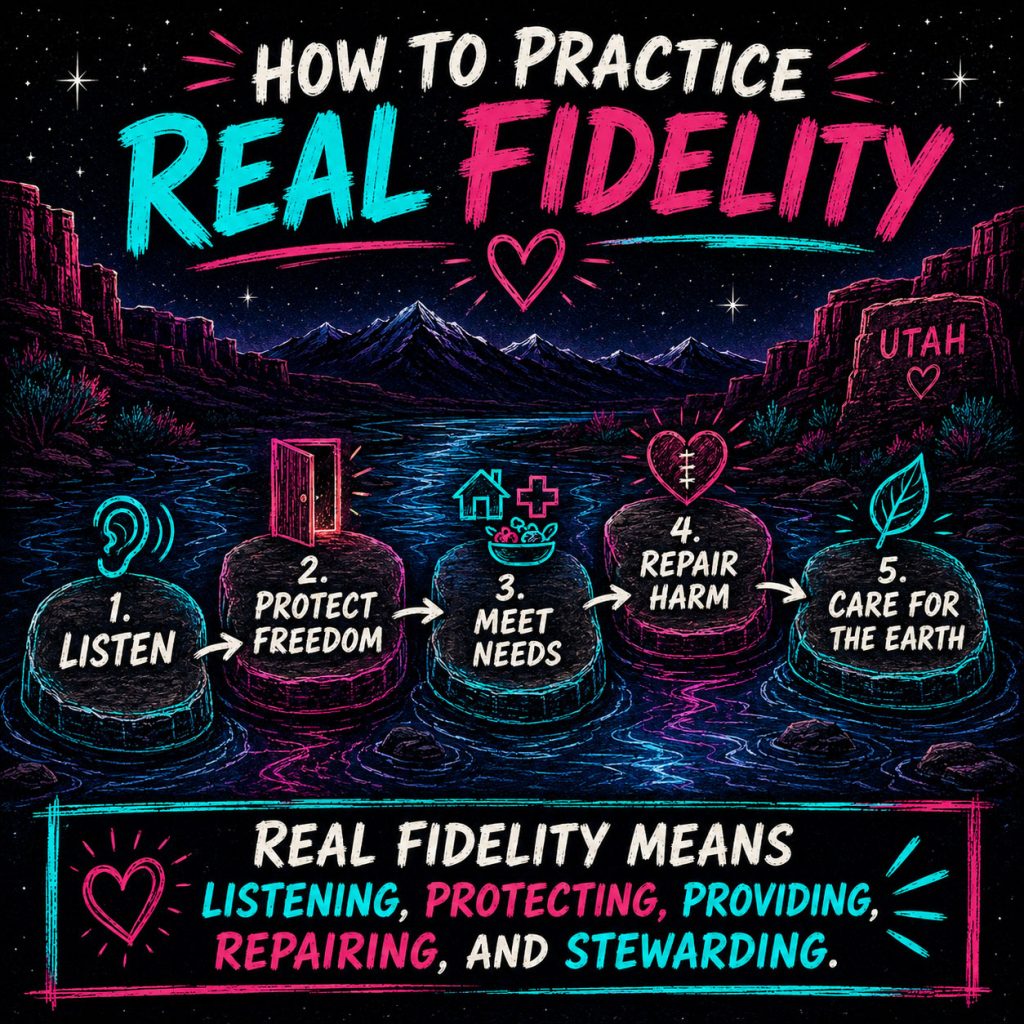
We practice real fidelity by choosing one relationship, one institution, and one public issue where we can keep faith more honestly. The goal is not to win a culture war. The goal is to make life safer, freer, kinder, and more sustainable for people around us.
Here is a simple Fidelity Month practice that actually means something.
Step 1: Make One Relationship Safer
Ask one person in your life, “Is there any way I could show up better for you right now?” Then listen without correcting them. This is especially powerful with a child, spouse, sibling, LGBTQ+ loved one, aging parent, coworker, or friend who has withdrawn.
Step 2: Make One Local System More Trustworthy
Pick one institution you care about — a ward, workplace, school, venue, nonprofit, city council, or neighborhood group. Ask what would make its decision-making more transparent, safer, and more representative. Then suggest one concrete change.
Step 3: Make One Public Value Measurable
Choose one value you talk about often. Family. Freedom. Faith. Community. Stewardship. Then ask what number or lived outcome would prove we are honoring it. If we value family, track housing and childcare. If we value life, track healthcare and food security. If we value freedom, track civil liberties.
Step 4: Support One Person Outside Your Usual Circle
Give time, money, attention, or practical help to someone who does not mirror your life. That might mean supporting an LGBTQ+ youth group, a refugee family, a mutual aid pantry, a sober event, a teacher supply fund, a local artist, or a neighbor behind on rent.
Step 5: Tell The Truth In One Place You Usually Stay Silent
Speak with warmth. Speak with humility. But speak. Silence is not always peace. Sometimes it is just fear wearing church clothes.
Frequently Asked Questions About Fidelity Month
What Is Fidelity Month In Utah?
Fidelity Month in Utah is Gov. Spencer Cox’s June 2026 declaration calling Utahns to recommit to faith, family, and country. Supporters describe it as a unity effort. Critics see it as a substitute for Pride Month that risks erasing LGBTQ+ Utahns during a month already tied to their visibility.
Is Fidelity Month Against Pride Month?
Fidelity Month is not always described by supporters as anti-Pride, but its timing and public framing make the comparison unavoidable. If leaders want it to be truly inclusive, they should say clearly that LGBTQ+ people are part of faith, family, country, and community.
What Does Fidelity Mean Outside Of Marriage?
Outside marriage, fidelity means faithfulness to a duty, truth, relationship, promise, or trust. In civic life, that includes public honesty, care for neighbors, respect for freedom, stewardship of the earth, and accountability from leaders who hold power over others.
How Can Christians Practice Fidelity During Pride Month?
Christians can practice fidelity during Pride Month by loving LGBTQ+ neighbors without contempt, listening before judging, protecting children from shame, honoring family bonds, and refusing to use faith as a reason to make others less safe, less free, or less welcome.
What Should Public Leaders Do If They Value Fidelity?
Public leaders who value fidelity should tell the truth, listen to affected communities, use evidence, explain decisions, protect minority rights, and measure success by human outcomes. Fidelity in office means serving the whole public, not just the voters or donors easiest to please.
How Do We Teach Fidelity To Children?
We teach fidelity to children by modeling honesty, repair, loyalty, courage, and care. Children learn fidelity when adults keep promises, apologize after harm, protect people who are different, care for the earth, and show that love is more than words.
So, What Is The Real Meaning Of Fidelity Month?
The real meaning of Fidelity Month should be faithfulness to the full human family. That means protecting freedom, telling the truth, honoring diverse families, supporting working people, listening to experts, caring for the earth, and making public power accountable to the people it serves.
If Fidelity Month becomes a way to counter Pride Month, it will fail its own name. But if it becomes a month where we ask whether we are keeping faith with every neighbor, then it can become useful. Not because a governor declared it, but because we made it that way.
So, if “Fidelity Month” makes you feel defensive, pause and ask who feels pushed aside by it. If it makes you feel angry, turn that anger into one concrete act of care, protection, repair, or public accountability. And if we are going to use the word “fidelity” in public, let’s make it big enough to include every neighbor we have been called to love.