TLDR – How Can Utahns Stop The Box Elder Data Center?
- Approval is not completion — the project still needs people.
- Every unmet need is leverage Utahns can organize around.
- Track water rights, permit filings, meetings, and hearings.
- Watch every deadline so nothing slips through without a challenge.
- Map every contractor, vendor, supplier, and logistics company.
- Ask companies to refuse to work on the data center in any way.
- Get verbal commitments confirmed clearly and in writing.
- Publish who commits, who refuses, and who stays silent.
- Keep pressure lawful, factual, public, and nonviolent.
Can Utahns Still Stop The Box Elder Data Center After County Approval?
Utahns still have leverage over the Box Elder data center because approval is not the same as completion. The project still needs water rights, permits, contractors, vendors, workers, materials, logistics, and public legitimacy — and every one of those is a pressure point.
A data center does not get built by a vote alone. Ultimately it gets built by the hands of working people. Utahns need to remember that more than ever right now, because I cannot think of one thing that has brought Utah together more than this data center.
Yes, the Box Elder County Council has signed off on this. Yes, the hearing many Utahns hoped would happen on water rights has been subverted. But approval is not completion. And this is not all inevitable. Much like Rome, a hyperscale data center can’t be built in a day.
And that is critical for what Utahns need to do next.
See also:
- What Should Cache Valley Residents Do If We See ICE?
- The Conservative Christian Case Against Trumpism
- The Conservative Case for Immigration Reform
What’s Happening In Box Elder County?
The Box Elder data center fight is moving quickly. Commissioners approved the Stratos project area after a chaotic public meeting, the water-right change application was withdrawn after thousands of protests, and a Utah State University physicist warned the project’s heat load could equal “23 atomic bombs” per day.
To provide a bit more context:
On May 4, 2026, hundreds of Utahns gathered at the Box Elder County Fairgrounds for the commission vote. KUTV reported that after commissioners announced there would be no public comment, the crowd began booing and shouting “shame.” One commissioner warned that law enforcement could remove people and said the meeting could move to a private setting if disruptions continued. Then the commissioners stood up, walked into a back room, and cowardly approved the agreement with MIDA over Zoom.
Then came the water-rights fight. KUER reported that the proposed mega data center needs a water-right change from agricultural to industrial use, and more than 3,700 people filed protests with the Utah Division of Water Rights. KUER later updated the story to report that the owner of the water rights withdrew the change application on May 7, while intending to refile later. KUER noted that the withdrawal had “no overall effect on the project at the moment.”
And now there is the heat warning. FOX 13 reported that Dr. Rob Davies, a Utah State University physics professor, claimed the proposed data center could release heat equal to “23 atomic bombs” per day. Grow the Flow, the nonprofit that shared Davies’ preliminary analysis, said he estimated the combined thermal load of the data center and associated natural-gas power plant at about 16 gigawatts — 9 gigawatts to power the data center and another 7–8 gigawatts of waste heat.
And throughout all of this, Utahns have never been more unified. Throughout the state and across the political spectrum, it seems that literally nobody in Utah wants this — except, apparently, for the people who are supposed to be representing Utahns.
Why Are Utahns So Angry About The Box Elder Data Center?
Utahns are angry because the Box Elder data center concentrates several public concerns into one project: water, power, land, the autonomy of local people and communities, data privacy, and the continuing spread of AI.
And that was all before the behavior of local and state leadership in response to those concerns. Now people aren’t just upset or worried — they’re furious.
That’s because, despite the fact that Utahns have never been more unified against something (at least, not that I can recall in recent memory), elected leaders and other public servants have never shown more disregard or contempt for Utahns’ voices.
For it’s part, Box Elder County says it reviewed more than 2,500 public comments, including about 300 from Box Elder County residents, and negotiated guardrails such as a 55-decibel noise limit, dark-sky compliance, height restrictions, agricultural leaseback provisions, and a local landowner on the development review committee.
But this has understandably not been enough to alleviate the very real concerns and dangers this data center poses. And the fact that Utah’s leaders are afraid to hear public comment in any form speaks to how much they know they are screwing everyday Utahns over.
How Big Is The Stratos Data Center Project?
The Stratos project is a proposed 40,000-acre development in western Box Elder County, with large-scale energy generation and a data center as major components. Axios reported that the project would occupy about 60 square miles and could eventually reach 9 gigawatts of power demand. That scale is why residents are asking for more than assurances.
To put things in context, 9-gigawatts is more than twice Utah’s average statewide electricity use, based on 2024 electricity sales data from the Utah Geological Survey. It would also equal nearly 90% of Utah’s total 2024 net summer generation capacity, according to the U.S. Energy Information Administration.
Axios also reported that MIDA is advancing the project and that its executive director, Paul Morris, said the rush was tied to competition for the project. Axios also reported that MIDA sought Box Elder County’s approval before environmental or traffic studies were even complete.
Utahns have near-universally found this to be unacceptable given the scale and potential fallout of such a massive project. At the very least, the potential impacts to Utahns and the surrounding environment should be exhaustively researched, shared with the public, and given a public comment period before any approvals are made or work is done.
The fact that Utah’s leaders are shoving this down the throats of everyone in Box Elder County and beyond is a huge reason for the friction between them and Utah’s residents.
Why Does The Data Center Water Fight Matter So Much?
KUER reported that the proposed mega data center needs to change a water right from agricultural to industrial use, and more than 3,700 people filed protests against that change with the Utah Division of Water Rights — forcing developers back to the drawing board for fear of having to go through a public hearing on the matter. This highlights one of the ways that this massive project can be derailed, or at least stalled.
More than 3,700 people were willing to pay a $15 filing fee to become part of this process and apply pressure to Utah’s leaders and the data center’s developers. While this is far from a nail in the coffin, it does show what solidarity can achieve. That’s a critical lesson for what comes next.
What Is The Real Leverage Utahns Still Have?
The project still needs water rights, environmental permits, capital, contractors, subcontractors, suppliers, logistics providers, workers, customers, and public legitimacy. That means residents can keep using civic, legal, economic, and reputational pressure long after a commission vote.
The first mistake people make after a bad public decision is assuming the fight is over. That is exactly what those in power want us to think. But the project currently has several unmet needs that Utahns will be required to fill. Every one of those needs is a pressure point Utahns can organize against.
The five practical levers are:
- Water Rights Pressure: Track every water-right filing, protest deadline, hearing notice, and appeal path.
- Permit Pressure: Watch air quality, drinking water, and water quality permits. Request hearings when allowed.
- Contractor And Vendor Nonparticipation: Ask companies to commit, verbally and in writing, not to help build the project — and to encourage others to do the same.
- Customer Choice: Support companies that protect the community, and withhold support from those that help bypass it.
This is not about one big march or a single political action. It is about pressure stacking. One protest can be ignored. One comment period can be managed. One angry meeting can be dismissed. But water protests, permit scrutiny, contractor refusals, public pledge lists, customer pressure, and local organizing together become impossible to wave away.
What Is The Clear Plan Of Attack For Utahns Who Want To Stop The Data Center?
Utahns need an organized, disciplined campaign that turns public frustration into visible nonparticipation. Someone needs to take the reins, identify the companies the project would need, contact them directly, ask them to commit publicly and in writing not to work on the data center, and then invite others to do the same.
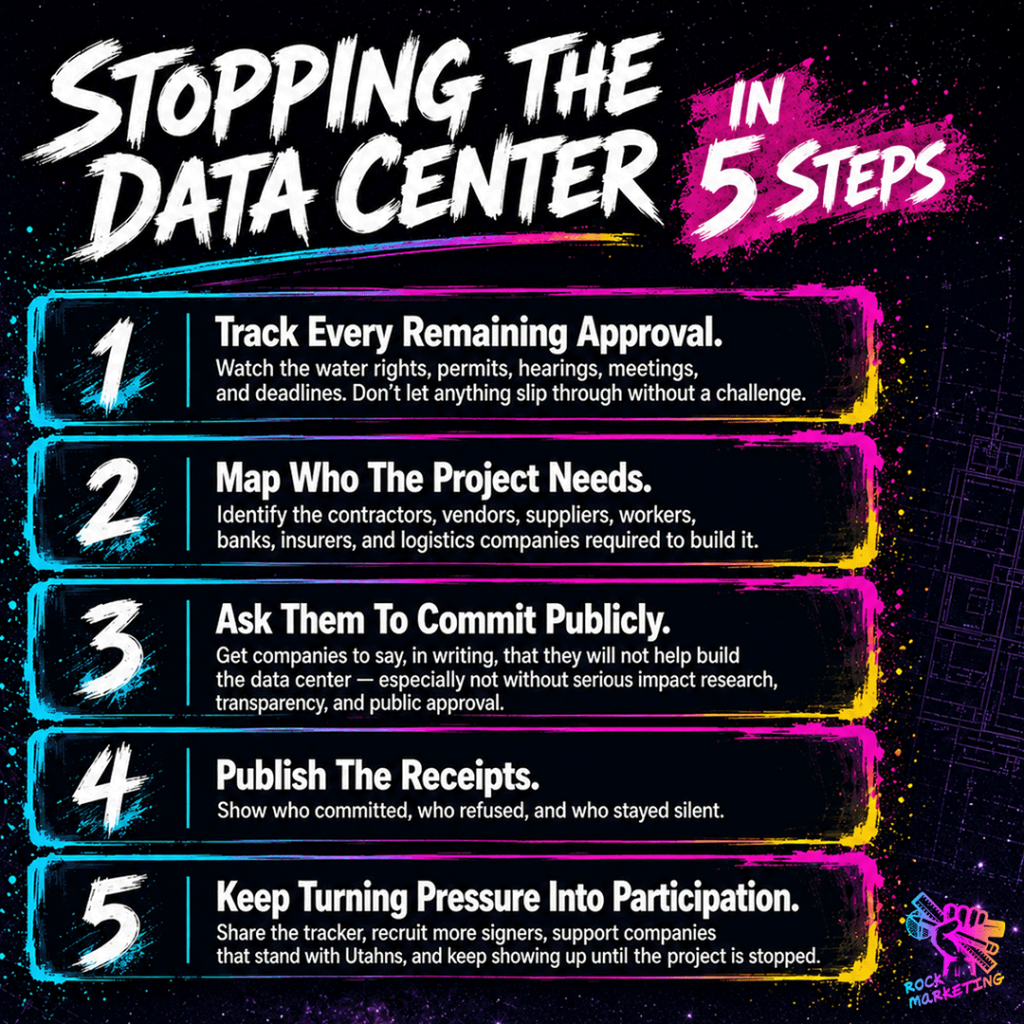
This should be one of the easiest wins for working class Utahns. It doesn’t require a complete shutdown of one or more industries, nor does it require anyone to stop working. It just requires everyone to refuse to work for one single customer.
Here is the plan.
1. Build The Project Dependency List
Start by naming every category of company the project would likely need: construction firms, excavation crews, concrete suppliers, electricians, plumbers, welders, trucking companies, fuel suppliers, road contractors, security firms, temp agencies, staffing firms, equipment rental companies, waste services, legal vendors, consultants, banks, insurers, food vendors, and local subcontractors.
This should become a shared spreadsheet or public tracker. Keep it factual. List company name, category, public contact, date contacted, response status, and whether the company has made a written commitment.
The goal is not to smear anyone. The goal is to make participation visible.
2. Create A Simple Public Consent Pledge
Use language that is short, firm, and easy to sign.
A working version could be:
We will not knowingly provide labor, services, materials, financing, logistics, consulting, public-relations support, or other direct assistance for the Box Elder data center and encourage other Utah individuals and businesses to do the same.
3. Ask Companies To Commit Verbally And In Writing
Use two direct questions:
- “Will you commit not to work on the Box Elder data center under current conditions?”
- “Will you put that commitment in writing so residents know where you stand?”
That is the whole ask.
Volunteers should stay calm, respectful, and specific. A company can say yes. A company can say no. A company can refuse to answer. Then the public can decide what that means.
4. Publish The Commitment List
Create three public categories:
- Committed Not To Participate
- No Response Yet
- Declined To Commit
Keep the language neutral. Do not invent motives. Do not accuse companies of corruption unless there is evidence. Do not publish personal phone numbers or private information. Use public business contacts only.
A clean public tracker is more powerful than a messy callout campaign. It lets residents, customers, workers, and other businesses see the landscape for themselves.
5. Spread The Word
Ask every committed signer to contact three more people or businesses.
That gives the campaign a simple growth loop. One contractor signs, then asks three peers. One worker signs, then asks three coworkers. One local business signs, then asks three vendors.
The ask should remain independent and voluntary. No one should be pressured into making a commitment they do not understand. But people should be invited to stand with the community in public.
6. Pair Nonparticipation With Clear Demands
The campaign should also clearly state what would have to change before anyone reconsiders.
Those demands should include:
- Full public water accounting.
- Independent environmental review.
- Power-generation and emissions disclosure.
- Tax-incentive transparency.
- Permanent jobs analysis.
- Emergency-services impact review.
- Noise, light, heat, and wildlife mitigation.
- Binding community benefit agreement.
- Public reporting schedule.
- Meaningful consent from affected communities.
Could the data center ever be built in a way that Utahns might be okay with? Maybe. There’s no way to actually know until state leaders and developers do the work required to meet Utahns where they are. That requires all of the above.
What Would a Dedicated Movement Opposing Utah’s Data Center Look Like?
An organized movement would include four core groups: a permit segment to track water rights, DEQ permits, MIDA meetings, county meetings, public-comment windows, and hearing deadlines; a company outreach segment to identify needed contractors and ask local businesses for written nonparticipation commitments; a public tracker segment to publish who has committed, who has not responded, and who declined; and a community education segment to turn technical details into clear posts, flyers, scripts, meeting comments, and neighbor-to-neighbor conversations.
The Permit Segment should track water rights, DEQ permits, MIDA meetings, county meetings, public-comment windows, and hearing deadlines. Their job is to make sure nothing slips through quietly.
The Company Outreach Segment should build the dependency list and contact local businesses. Their job is to ask for verbal and written commitments.
The Public Tracker Segment should maintain the pledge list. Their job is to publish who has committed, who has not responded, and who declined.
The Community Education Segment should explain the stakes in plain language. Their job is to turn technical details into posts, flyers, scripts, meeting comments, and neighbor-to-neighbor conversations.
Nobody needs to do everything, but everyone should be doing something specific.
Can Workers, Contractors, And Local Businesses Refuse To Help Build It?
Workers, contractors, and businesses may have real leverage, but they should use it carefully. Individuals and companies can often make values-based choices about the work they accept. Coordinated action, employment status, contracts, union rules, and antitrust law can change the risks, so people should get qualified legal advice before formal organizing.
The Federal Trade Commission says any company may independently refuse to do business with another firm. But the FTC also says an agreement among competitors not to do business with targeted people or businesses may be an illegal boycott, especially if the competitors have market power.
That means the cleanest path is public, voluntary, values-based commitment. A business can say, “We do not want this work.” A worker can say, “I do not want to help build this.” A resident can say, “I will support companies that refuse to participate.”
Workers also have rights, but those rights are not unlimited. The National Labor Relations Board says private-sector employees have the right to act together, with or without a union, to improve wages and working conditions.
So the guidance is simple: be public, be factual, be peaceful, be values-based, and talk to a labor lawyer or qualified organizer before asking workers to take job-risking action.
But that shouldn’t stop us from getting organized.
What Should Utahns Demand Before Any Data Center Moves Forward?
Utahns should demand a complete public accounting of water use, power generation, emissions, tax incentives, permanent jobs, emergency-service impacts, and community benefits.
Every public official, developer, vendor, and contractor should be asked the same basic questions:
- How much water will the project use at each phase?
- Where will that water come from?
- What happens during drought years?
- How will groundwater, agriculture, wetlands, wildlife, and Great Salt Lake risks be measured?
- What power source will be used?
- What emissions will come from on-site power generation?
- What tax breaks, rebates, or public incentives are involved?
- Who pays for roads, fire protection, emergency response, and long-term infrastructure?
- How many permanent local jobs will actually exist after construction?
- What binding community benefits will residents receive?
- What public reporting will be required each year?
If Utahns don’t like the answers to these questions, such a massive and region-impacting project should not be built. If state leaders and developers still want some semblance of a data center in Box Elder County, they should work earnestly with Utahns to find some common ground — if any exists.
Can The Box Elder Data Center Still Be Stopped Or Changed?
The Box Elder data center has cleared an important local step, but it is not finished. Reporting shows water-right questions, environmental permitting, state review processes, and project implementation still remain. The practical goal is to keep pressure on every remaining decision point until the project is stopped, changed, or forced into real accountability.
KUER reported that even after Box Elder County Commission approval, the project still has to clear more obstacles before construction can begin. KUER identified water rights as one major obstacle, and also reported that parties can appeal after a state engineer decision.
Box Elder County itself says residents should continue providing input as additional phases, state regulatory permitting processes, and development details are considered.
The next phase will probably be slower, more technical, and less emotionally satisfying than a public meeting. But this is exactly why organized people have an advantage. Developers and agencies expect the public to burn out. Residents should do the opposite.
Create calendars. Track deadlines. Divide tasks. Assign permit watchers. Assign company outreach volunteers. Assign records-request volunteers. Assign meeting attendees. Assign writers. Assign social media leads. Assign legal liaisons.
Together, I truly believe Utahns can keep this data center from happening.
Frequently Asked Questions About The Box Elder Data Center
Why Are Utahns Opposing The Box Elder Data Center?
Utahns are opposing the Box Elder data center because they have serious concerns about water, power, land use, public process, tax incentives, environmental impact, heat, and local consent. The anger is not just about one project. It is about whether communities get a meaningful say before major infrastructure reshapes shared resources.
How Much Power Would The Stratos Data Center Use?
The Stratos project has been discussed as a 9-gigawatt project at full capacity. Axios reported that Utah’s annual average electricity consumption is about 4 gigawatts, meaning the proposed data center campus could require more than twice the amount of the entire state.
Could The Data Center Really Release Heat Equal To 23 Atomic Bombs Per Day?
Dr. Rob Davies, a Utah State University physics professor, estimated in a preliminary analysis shared by Grow the Flow that the project could create about 16 gigawatts of thermal load. FOX 13 reported Davies’ comparison that this could equal “23 atomic bombs” of heat per day.
Does The Utah Data Center Still Need Water Rights?
Yes. KUER reported that the proposed data center needs to change a water right from agricultural to industrial use. More than 3,700 people filed protests against that change, and the owner later withdrew the application with an intent to refile.
Can Local Businesses Refuse To Work On The Data Center?
Local businesses can often make independent choices about what work they accept. The safer path is a public, voluntary, values-based refusal. This is because agreements among competitors not to do business with a target can raise antitrust concerns. Regardless, formal organizing should involve qualified legal guidance.
What Should Residents Ask Before A Data Center Is Approved?
Residents should ask for full public disclosure on water use, power generation, emissions, tax incentives, permanent jobs, emergency services, infrastructure costs, environmental review, heat impacts, and binding community benefits.
Is Opposing A Data Center The Same As Opposing Technology?
No. Communities can support technology while still demanding transparency, consent, and enforceable protections. Technology should serve people. It should not become a shortcut around democratic process, water stewardship, environmental review, or public accountability.
So, What Can Utahns Do About The Box Elder Data Center?
Utahns can act wherever the project still needs permission, participation, labor, materials, water, permits, financing, and legitimacy. The strongest path is civic pressure, legal pressure, and social pressure: track every filing, support public hearings, demand full disclosure, ask contractors where they stand, and build a public pledge campaign around nonparticipation without consent. The project is not built. People still need to participate to make that happen. Together, we can simply opt not to participate and it will not happen.
What Should We Do Next?
If you have 5-60 minutes, share this article with one Utah worker, contractor, small-business owner, neighbor, or local official. Ask one local company: “Will you commit not to work on the Box Elder data center unless the public gets full transparency, enforceable protections, and meaningful consent?” Start the Public Consent Pledge tracker. Add company categories, public contact information, outreach dates, and response status.
And keep on keeping on.
Not every powerful decision happens in a commission room or public hearing. Important decisions that will impact whether this data center becomes reality could be happening right now in the dispatch office, the job trailer, the supply yard, the boardroom, the invoice queue, the equipment rental desk, the trucking route, and any moment when someone can say, “No, we are not helping build that.”