Loving an ADHD, solo-poly person means building a reliable baseline without turning love into obligation. That means regular connection, clear answers, shared everyday life, and room for spontaneous affection. Commitment means repeatedly choosing each other through plans, care, repair, invitations, and earnest check-ins while protecting each other’s independence and autonomy.
TLDR – How To Love An ADHD Solo-Poly Partner
- Make needs concrete enough to act on.
- Build a predictable baseline, then leave room for surprise.
- Put important connection moments on the calendar.
- Make plans flexible enough to match real capacity.
- Share ordinary life instead of relying only on dates.
- Say “no” clearly instead of leaving requests unanswered.
- Keep inviting each other into the lives we already have.
- Treat commitment as repeated choice, not exclusivity.
- Hold regular relationship check-ins before problems become crises.
- Protect independence without letting autonomy become disconnection.
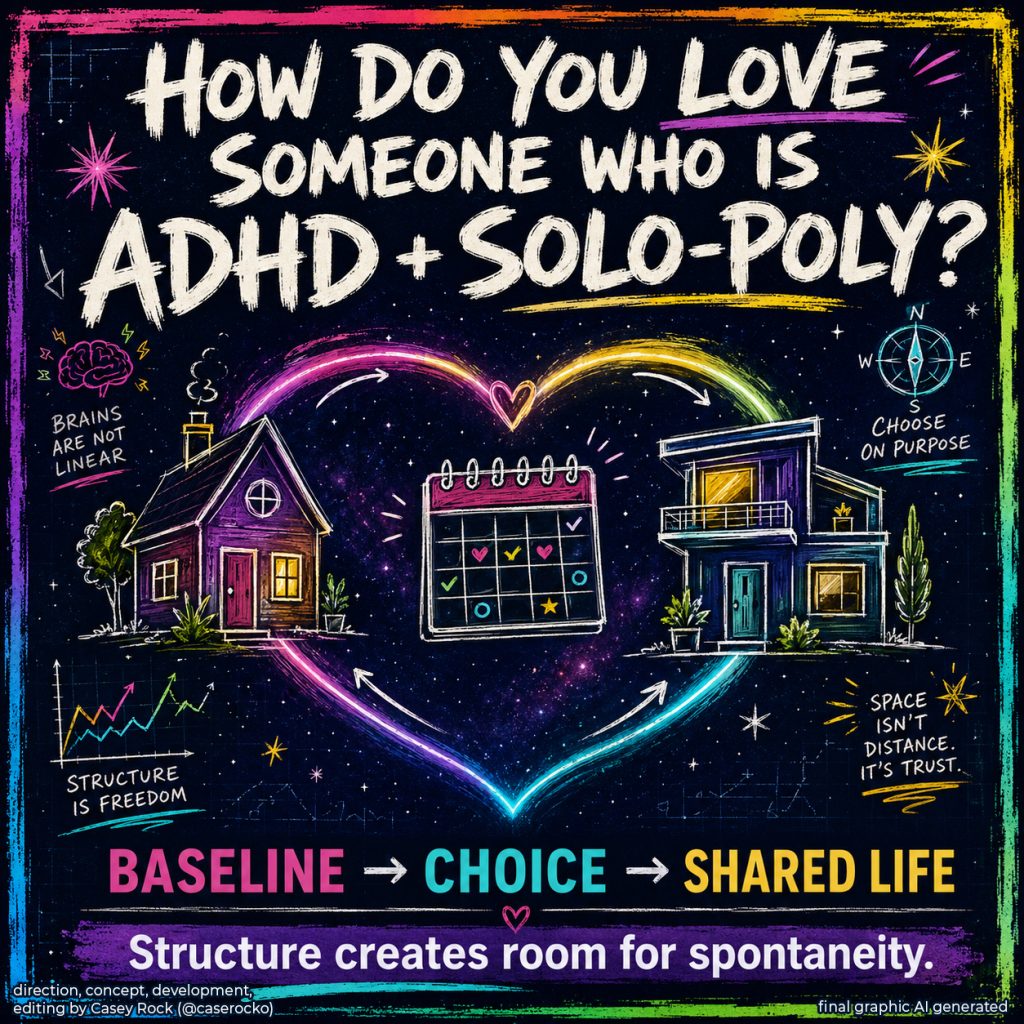
Is Spontaneity The Opposite Of A Schedule?
One of the strangest things about being ADHD and solo-poly is the fact that independence, autonomy, and spontaneity can be enhanced and fostered by a scheduled calendar.
That might sound counter-intuitive. Scheduling and committing to things seem like they would limit one’s autonomy and freedom, right? And spontaneity seems to be completely at odds with a pre-determined schedule.
But there’s a concept here that I’m going to keeping coming back to throughout this article: The idea of a firm container with soft contents.
Growing Love Organically
I want love to grow organically. I want someone to text because they genuinely miss me, climb into bed because they want my body beside them, or suddenly say, “Screw it. Let’s go somewhere.” I also know what happens when two busy people leave everything to spontaneous desire: we can spend weeks or even months waiting for the stars to align.
I’ve described myself to partners as super independent and fairly introverted. I need generous amounts of solitude. Routine matters to me. Sometimes I have to mentally shift into “social mode” before I want company. At the same time, prolonged uncertainty can light up my nervous system. I can want enormous freedom and still need connection to remain visible.
This tug-of-war has shaped how I now think about relationships.
For me, the healthiest relationship has a predictable baseline that makes spontaneity easier, commitment visible, and shared life possible without requiring either of us to surrender our independence.
I’ve written elsewhere about how ADHD can collide with systems built for neurotypical attention. Relationships deserve the same kind of systems-aware thinking. If our relationships matter, we should build conditions that help them thrive.
What Do Solo-Poly, Baseline Connection, And Shared Life Mean Here?
For me, and maybe for you, these terms describe how closeness works without assuming exclusivity, cohabitation, or constant access. Solo-poly is a relationship model of polyamory that protects individual autonomy by more or less seeing one’s self as one’s primary partner. A baseline keeps connection from disappearing between spontaneous moments. A shared life allows spontaneous moments to happen and creates meaningful overlap through time, people, routines, care, and ordinary tasks while each partner keeps an independent life.
In one of my dating profiles, I put it more simply: “I don’t need to become your entire life, and I don’t necessarily want you to become mine. But I do want to matter.”
Why Does An ADHD Relationship Need Routine And Structure?
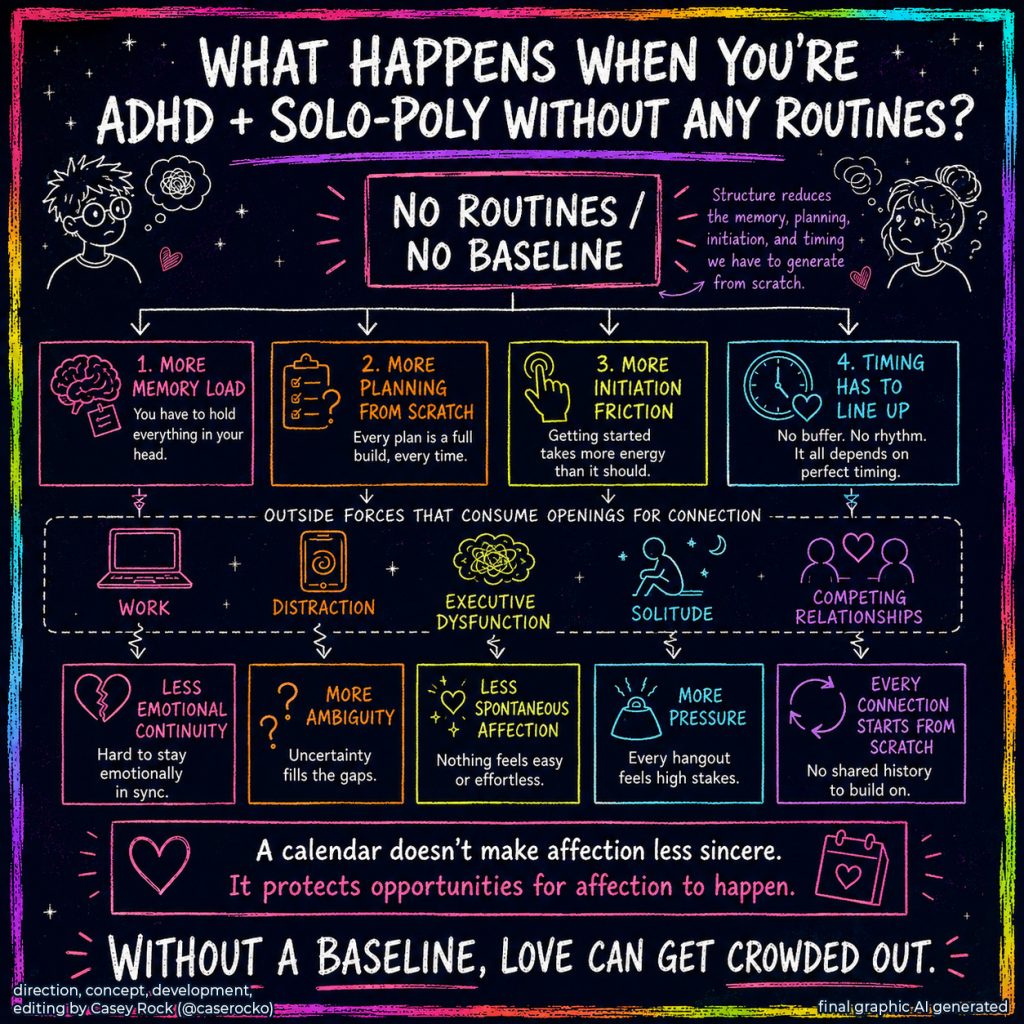
Structure reduces the amount of memory, planning, initiation, and timing our brains must generate from scratch. For me, predictable connection also creates emotional continuity. A calendar does not make affection less sincere. It preserves opportunities for affection to happen when work, distraction, executive dysfunction, solitude, and other relationships could otherwise consume every opening.
The National Institute of Mental Health recommends consistent routines, written reminders, time management, and scheduled activities with supportive people as practical ADHD strategies. NICE likewise emphasizes structure in daily activities and environmental modifications that reduce the impact of ADHD symptoms.
That tracks very closely with my lived experience.
I’ve explained before to partners how important routine is for me. As a part of that, I’ve also shared my calendar with them because when we’re looking at each other’s lives, it’s easier to find moments to connect with each other. It may sound trite, but I think this is a meaningful way to connect with people who may not always have a lot of bandwidth.
And sharing a calendar matters because ADHD can turn every unscheduled interaction into a cold start. First we have to remember each other at the right moment. Then both have to possess enough executive function to initiate. Then our schedules have to overlap. Then we need enough energy.
Somehow we still need to make the actual plan. And this is all doubly true when you don’t actually live together, because then you can’t have spontaneous moments of connection throughout the day.
A baseline removes several of those gates.
Maybe Tuesdays are usually available. Maybe we stay overnight together twice a month. Maybe Sunday morning we always have coffee unless one of us opts out. Maybe there is a standing invitation to work beside each other on Thursdays.
None of these promises dictate what we must feel or do that day. They simply keep a door open for each other to walk through.
This is the model of a firm container with soft contents in action.
Ultimately, spontaneity needs to be fostered. That has to start somewhere. And I think a baseline of planned engagement makes sense. Otherwise, you’re basically trying to light a fire without a spark.
How Can Routine And Spontaneity Coexist In An ADHD Relationship?
We can schedule the opportunity for connection without scheduling the emotion. A standing block can become dinner, sex, errands, a couch nap, a concert, parallel work, or nothing at all. The structure protects access to each other. Choice determines what we actually do once the moment arrives.
This concept of a firm container with soft contents is increasingly my ideal model for a polyamorous relationship where two (or more) partners may run up against all sorts of neurodivergences, lived experiences, and conflicting lifestyles.
A reserved evening does not have to become A Date™. If we are exhausted, we can order food and lie on the couch. If someone needs to clean, we can clean. If there’s a feeling of desire, and it explodes into passion, wonderful. If one of us needs solitude, we can cancel the date without it feeling like rejection.
This is also why small contact matters. A meme can maintain continuity. So can a photograph, an emoji, a song, a simple reminder that you’re thinking of each other, or an invitation for a quick 30-minute hangout.
Personally, I want room for organic desire. But, especially in this capitalist hellscape, I don’t think any of us can depend on generating it from nothing. Again, just like that fire I mentioned: It needs a spark. Or, if you prefer another metaphor, a garden needs nutrients and care before its spontaneous bloom.
What Does Commitment Look Like When We Are Solo-Poly?
Solo-poly commitment becomes visible through behavior instead of default relationship milestones. We make time for each other. We schedule plans together. We show up during hard moments. We invite each other into our lives, communicate changing capacity, repair hurt, learn each other’s needs, and repeatedly choose the relationship while leaving room for other relationships and independent lives.
Polyamory does not make relationships weaker. In fact, a 2026 meta-analysis in The Journal of Sex Research pooled 35 studies involving 24,489 people and found no significant difference in relationship or sexual satisfaction between monogamous and consensually non-monogamous people. Results also held across relationship dimensions including commitment and intimacy.
I’ve argued before that relationship longevity is not a sign of success. I’ve also written that life can be lived in a variety of ways. Commitment, to me, is much more active than occupying a recognized relationship category.
I once wrote in a dating questionnaire that “I want to choose each other — repeatedly, freely, because we genuinely want to.” Repeatedly being the key word there.
Here’s a quick look at the different ways commitment can manifest.
| Commitment Signal | What It Looks Like | Why It Matters |
|---|---|---|
| Time | Plans keep appearing | We remain part of each other’s lives |
| Care | Food, rides, help, comfort | Love becomes tangible |
| Clarity | Yes, no, or “later” | Ambiguity shrinks |
| Repair | We name and solve problems | Conflict becomes workable |
| Initiative | Both people invite and reach out | Each person feels chosen |
As you can see, exclusivity need not be a component of commitment.
In fact, one of the most loving things a partner did for me recently happened after another partner of mine broke up with me. I was sad, numb, and barely thinking about food. They sent me dinner without even having to ask because they correctly guessed that I wouldn’t want to manage feeding myself.
That is commitment to me.
Even saying no can be a form of commitment. Personally, I do better when a “no” is verbalized instead of insinuated. Providing clarity shows care. And respecting a “no” also shows care. A “no” doesn’t have to be a moment of hurt. It can be something that actually reinforces commitment and care both ways within the relationship.
What Does A Shared Life Look Like Without Living Together?
A shared life means enough ordinary overlap that we stop experiencing each other mainly through special occasions. We might sleep together, meet friends and family, cook, run errands, work side by side, attend events, share chores, help during difficult weeks, or simply sit next to each other in silence doing our own things. Separate homes can still contain enormous togetherness.
At one point, frustrated by how difficult it had become to “carve out” relationship time, I wrote to one of my partners:
“The only way we succeed, as partners and as a community, is if we’re sharing the lives we already have with each other. We need a shared life of sorts.”
And I honestly believe that now more than ever.
I love waking beside someone, making breakfast, taking a morning stroll together, and then moving into the day side by side. Don’t get me wrong, though. I also love waking up alone, having full control of my own space, and moving at my own pace.
To be honest, I genuinely don’t know whether I ultimately want a nesting partner.
But that uncertainty does not mean I am uncertain about intimacy.
My ideal relationship has sleepovers, errands, dinner, adventures, sex, dumb memes, difficult conversations, and time where we’re side-by-side doing our own things (often known as body-doubling).
Body doubling is popular in ADHD communities, although research on its effectiveness remains limited. Regardless, in my experience, folding laundry beside someone I love still turns an hour of maintenance into an hour of something far more meaningful.
A shared life also means letting our social worlds overlap. That means going to each other’s clubs, engaging in each other’s hobbies, meeting each other’s friends, and maybe even enjoying family dinners or holidays together with each other’s parents and siblings.
Obviously, a partner doesn’t need to, and shouldn’t, attend everything. And invitations should flow both ways. But this is how two independent lives become intertwined without either being swallowed by the other.
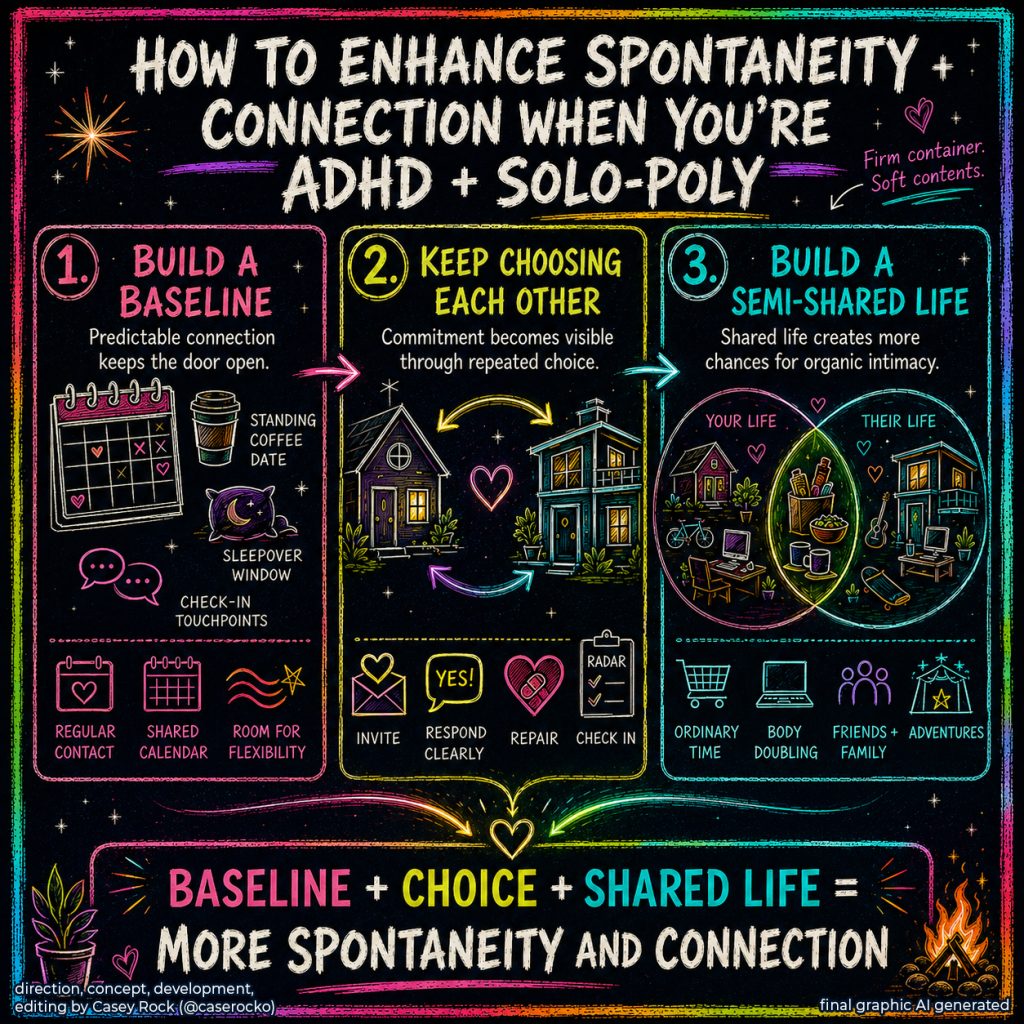
How Do We Build A Consistent ADHD Solo-Poly Relationship In Practice?
Start in small ways that allow both people to feel connected to each other without making either feel managed or obligated. Use ordinary life to create more overlap. Keep refusals easy, expectations explicit, and recurring check-ins protected. Review everything together. The relationship should adapt as capacity, desire, work, health, and other relationships change.
If you’re familiar with RADAR, I consider this a great foundation for any relationship. If you aren’t familiar with RADAR, the most important takeaway is to have a regularly recurring time set aside where you and your partner can work together on issues in the relationship.
This prevents anything from bottling up and exploding, plus it really reinforces the idea that it’s both of you against the problem, not you vs. them.
On that foundation of regular communication and review, you can build out the schedules and shared life that foster spontaneity and connection — tweaking and adjusting wherever needed as you go.
Frequently Asked Questions About ADHD And Solo-Poly Relationships
Does Solo-Poly Mean I Only Want Casual Relationships?
No. Solo-poly describes how I organize autonomy, housing, and partnership. It does not determine how deeply I love. I want emotional, mental, physical, and practical intimacy. I want commitment and consistency. I simply don’t believe these things require exclusivity, merged finances, marriage, or automatic movement up a traditional relationship escalator.
How Much Contact Does An ADHD Partner Like Me Need?
There is no universal ADHD number, and I would rather talk about it than give a flat number — because it can honestly fluctuate day to day, week to week. For me, prolonged ambiguity is harder than low-frequency contact with clear expectations. A tiny response can carry surprising weight. The important question is whether the actual rhythm of the relationship lets both people feel connected, wanted, and free.
What If We Scheduled Time Together And One Of Us Is Burned Out?
Lower the stakes or cancel the time together, if needed. Dinner can become takeout. An adventure can become a walk. A date can become folding laundry beside each other. But when someone really does need time alone, that should be respected. The goal is flexible continuity — connection that can bend without becoming another obligation.
Do I Eventually Want A Nesting Partner?
I genuinely don’t know. I love my space, independence, routines, and control over my environment. I also love waking up beside someone, sharing breakfast, doing chores together, and feeling our lives knit together over time. I would rather discover the answer together than proscribe something in advance that may not be right for either of us.
Does Body Doubling Actually Work For ADHD?
Some ADHD people report that another person’s presence helps them start or sustain tasks, and qualitative research documents people using the strategy. Evidence remains limited, but I find it to be a valuable tool for turning mundane tasks or chores into moments of connection with loved ones.
What Is The Best Way To Love An ADHD Solo-Poly Person Like Me?
Love with enough structure that both people do not have to rediscover each other every time you connect. Provide enough autonomy and freedom that the relationship still feels chosen. Build a few joint routines and rituals so that there is a sense of a shared life. Provide enough communication and clarity that neither person has to guess what silence means. The goal should be a relationship that fosters breathing room without creating distance.
Also: Take it easy. Love everything.
Casey Rock is a writer, marketer, musician, and lifelong systems nerd based in Logan, Utah. A former journalist, he writes about politics, science, technology, mental health, relationships, culture, and the systems shaping everyday life. He hosts the Rock Your Curiosity podcast and plays in Open Door Policy. His work is grounded in curiosity, evidence, compassion, autonomy, and a belief that we can build better relationships, communities, and systems together.