If Fidelity Month means faithfulness to faith, family, country, and community, Utah’s immigrant communities already model it. They build families, businesses, schools, job sites, faith communities, and local support systems that make Utah stronger.
TLDR – How Utah’s Immigrants Exemplify Fidelity Month
- Fidelity Month should include and celebrate immigrant Utahns.
- Utah immigrants model fidelity through family, work, faith, and community care.
- Immigrant families practice family values through sacrifice, stability, and resilience.
- Utah’s economy depends on immigrant workers, taxpayers, and entrepreneurs.
- Immigrant communities strengthen neighborhoods with food, worship, and service.
- Real patriotism includes building a future here, not just displaying symbols.
- Supporting immigrants is a family issue, workforce issue, and moral issue.
- Churches can turn “love thy neighbor” into resource sheets, rides, meals, and translation.
- Employers and schools can practice fidelity through access, fairness, and language support.
- Utah fidelity becomes real when we protect every neighbor’s dignity and belonging.
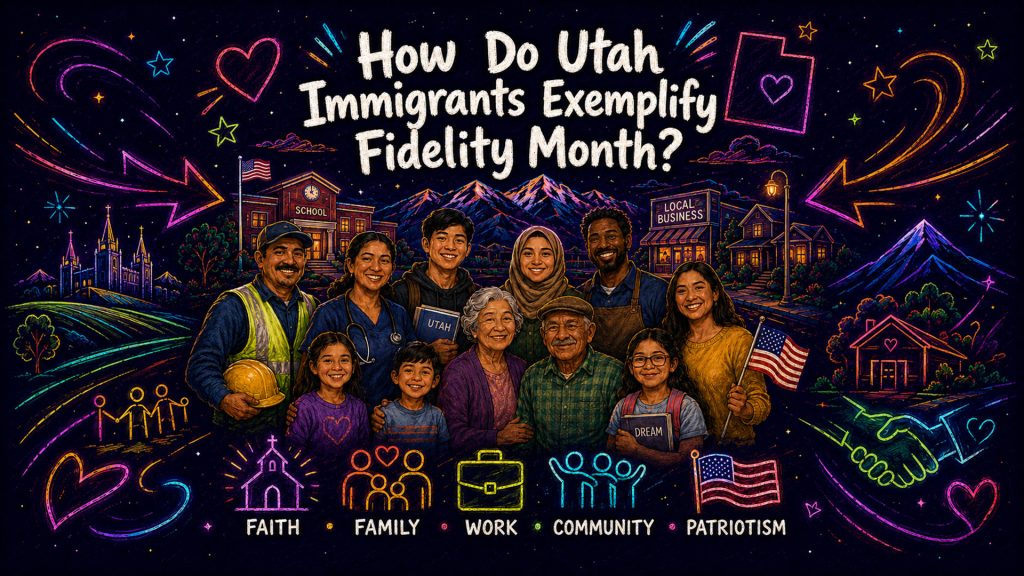
Fidelity In Utah Runs Deep For Its Immigrants
If Fidelity Month is going to be something we actually celebrate in Utah and use to encourage fidelity, then it makes sense to point to those who already exemplify fidelity as guiding lights. And Utah’s immigrant families have been preaching it in work boots, prayer rooms, classrooms, restaurants, farms, job sites, and minivans for years.
When Utah Gov. Spencer Cox declared June 2026 “Fidelity Month,” the framing centered on faith, family, country, and community. And those are all great values that are worth highlighting any time of year. But if we shrink fidelity down until it only protects one kind of family, one kind of faith, one kind of patriotism, or one kind of Utah neighbor, then we aren’t honoring fidelity — we’re desecrating it.
So, let’s talk about a Utah group that truly practices fidelity:
The immigrant parent who works a night shift, then gets a child to school. The refugee family rebuilding a life after violence, grief, and impossible choices. The business owner who opens a restaurant, hires locally, pays taxes, and feeds strangers. The student translating government forms for their parents before they are old enough to drive. The entrepreneur who creates new patents and build new industries. The doctors, lawyers, and other highly trained professionals contributing their skills to Utah’s excellence. The workers building homes, caring for elders, serving food, cleaning buildings, making products, and keeping Utah alive and thriving.
If we want to be serious about Fidelity Month, all Utahns deserve to be treated like the critical part of Utah’s makeup that they are — and that includes Utah’s immigrant communities.
What Does Fidelity Month Mean In Utah?
Fidelity Month in Utah is Gov. Spencer Cox’s June 2026 declaration asking Utahns to recommit to faith, family, country, and community. But that can’t be reserved for one kind of family or one kind of neighbor. They must include all Utahns, including immigrants.
According to reporting from KSL and the Deseret News, Utah joined Arkansas in recognizing Fidelity Month as a conservative alternative to Pride Month, with the movement promoted nationally by Princeton professor Robert P. George. The official Fidelity Month website frames the month as a positive, grassroots, multifaith, nonpartisan effort centered on rededication to God, spouses and families, communities, and country.
But those do not belong to one group, political party, church, household structure, or birthplace. Faithfulness to family does not become less faithful because a family speaks Spanish, Arabic, Swahili, Mandarin, Portuguese, Farsi, Ukrainian, or Navajo at home. Faithfulness to country does not become less real because someone is still navigating the maze of immigration law. Faithfulness to community does not become less meaningful because someone arrived here after crossing a border, fleeing danger, pursuing work, joining family, or chasing a better future.
If Fidelity Month is about faith, family, country, and community, then immigrant Utahns are not outside the story. They are one of the clearest examples of it.

How Do Utah’s Immigrant Communities Exemplify Fidelity Month?
Fidelity is less about what we profess or believe and more about how we act and what we do. Utah’s immigrant communities exemplify Fidelity Month by keeping faith with family, work, faith communities, neighborhoods, and the future. They care for children and elders, build businesses, pay taxes, fill essential jobs, worship, volunteer, and help keep local economies running.
The Utah Center for Global Talent, housed in the Governor’s Office of Economic Opportunity, describes Utah’s immigrant population as more than 304,000 people — almost 9% of the state’s population. It also says immigrants contribute about $1.2 billion in state and local taxes, $1.9 billion in federal taxes, and represent more than 13% of entrepreneurs in Utah.
USAFacts, using 2024 Census data, reports that immigrants made up 12.7% of employed workers in Utah. That is roughly one in eight workers.
Voices for Utah Children estimated that immigrants contributed about $23 billion to Utah’s gross domestic product in 2023, with major contributions in education, health care, social assistance, manufacturing, construction, hospitality, and food production.
Our elected leaders act like fidelity lives in speeches, sermons, flags, and family photos. But fidelity also lives in payroll taxes. It lives in 5 a.m. shifts. It lives in the restaurant where your family eats dinner every week. It lives in the worker framing a home, the aide caring for an elder, the student becoming the first in their family to graduate, and the neighbor who brings food when someone dies.
The question is not whether immigrant communities belong in a conversation about fidelity, but whether Utah is faithful enough to recognize fidelity in all its diversity.
How Do Utah Immigrants Show Fidelity To Family?
Immigrant families show fidelity by doing the daily work that keeps families together: working, raising children, translating systems, caring for elders, worshiping, studying, and rebuilding stability after upheaval. Utah should honor that family fidelity by protecting family unity, reducing fear, and making community help easier to reach.
We are a state that talks constantly about family. We build politics around family. We build church life around family. We build identity around family. So when immigrant families sacrifice to stay together, work together, worship together, and build a future for their children, our first instinct should not be suspicion or alienation. It should be recognition and acceptance.
The Church of Jesus Christ of Latter-day Saints has said immigration principles should include obeying the law, loving neighbors, feeding and clothing people regardless of immigration status, and showing special concern for keeping families together. Its broader statement on immigration says forced separation of working parents from children “weakens families and damages society.”
We cannot say “family first” and then treat immigrant family separation as background noise. We cannot say children matter and then shrug when children are scared their parents may not come home. We cannot say we believe in strong households while making basic systems impossible to navigate for households that do not speak English fluently nor have the time to handle mountains of paperwork.
If we mean family fidelity, then we need to practice family fidelity.
For churches, that might mean creating a trusted resource sheet with local legal aid, food help, translation support, school contacts, and emergency childcare options. For schools, it might mean making sure forms, meetings, and parent-teacher communication are actually accessible. For neighbors, it might mean offering rides, sharing meals, or checking in without asking anything in return.
And for policymakers, it means remembering that immigration law is not just a border issue. It is a family issue. It is a child development issue. It is a workforce issue. It is a public trust issue.
A faithful society does not treat families as disposable.
How Do Utah Immigrants Show Fidelity To Work And The Economy?
Utah immigrants show fidelity to work by filling real labor needs and building real local value. In 2024, USAFacts reported that immigrants made up 12.7% of employed workers in Utah. State and nonprofit data also show billions in taxes, GDP contributions, and entrepreneurship tied to immigrant communities.
Utah benefits materially from immigrant labor, immigrant businesses, and immigrant tax contributions.
To be clear, people do not need to earn human dignity through productivity. But in a state that often talks about hard work, self-reliance, family provision, entrepreneurship, and fiscal responsibility, it matters that immigrant Utahns are already contributing in ways those values should recognize.
| Utah Value | What Immigrant Communities Contribute | Why It Matters |
|---|---|---|
| Work | USAFacts reports immigrants were 12.7% of employed workers in Utah in 2024. | That means immigrant workers help keep Utah’s schools, hospitals, job sites, factories, restaurants, and service systems moving. |
| Fiscal Responsibility | The Utah Center for Global Talent says immigrants contribute about $1.2 billion in state and local taxes and $1.9 billion in federal taxes. | Taxes fund roads, schools, public safety, infrastructure, and services everyone uses. |
| Local Prosperity | Voices for Utah Children estimated immigrants contributed about $23 billion to Utah’s GDP in 2023. | Immigrant communities are part of the engine of Utah’s economy, not a drain on it. |
| Entrepreneurship | The Utah Center for Global Talent says immigrants represent more than 13% of Utah entrepreneurs. | Immigrant-owned businesses create jobs, services, food, culture, and neighborhood life. |
| Community Rebuilding | USA for UNHCR reported that immigrant entrepreneurs in the Salt Lake City metro contributed billions to the local economy. | Refugee and immigrant communities do not just receive support. They build new support systems. |
We often say immigrants “come here for opportunity,” as though that is somehow suspect. But what is more faithful to the American story than that? What is more aligned with Utah’s pioneer mythology than leaving what is known, crossing distance, enduring hardship, building community, and trying to give your children a better life?
The difference is that some of us romanticize migration when it is safely in the past. We grow uncomfortable when it arrives in the present.
That discomfort is worth examining. Because if we talk about fiscal responsibility, limited government, strong communities, and healthy families, immigrant communities are not an obstacle to those values. They are part of how those values become real.
This is also why our immigration conversation should connect to our bigger economic conversation. The problem in America is often not production. It is distribution. We have enough labor, enough intelligence, enough food, enough housing capacity, enough technology, and enough human creativity to build a better world. The question is whether our systems distribute stability and opportunity well enough for people to live with dignity.
Immigrant workers are not the reason wages are too low. Exploitative systems are. Immigrant families are not the reason housing is expensive. Policy choices, speculation, underbuilding, and inequality are. Immigrant children are not the reason schools are strained. Underfunding, large class sizes, and weak support systems are.
If we want fidelity to work, we should protect workers. All of them.
How Do Utah Immigrants Show Fidelity To Faith And Community?
Immigrant Utahns show fidelity to faith and community by bringing worship, service, food, language, music, mutual aid, and neighbor-care into Utah life. Many come from cultures where family and faith are not slogans. They are survival systems. Utah becomes more faithful when it receives those gifts instead of fearing them.
One of the strangest things about anti-immigrant politics in a Christian-heavy state is that many immigrant communities are deeply religious, family-oriented, and community-centered.
To be clear, that doesn’t mean Utah should only welcome immigrants who fit a conservative religious ideal. We need not create another narrow test for human worth. But it does mean there is a painful irony in watching people invoke faith and family against communities that often practice both with remarkable seriousness.
For Utah churches, this is a moment to be very practical. Sermons about loving the stranger matter less if the church bulletin has no resource list. Family values matter less if immigrant families sit alone in fear. Missionary experience matters less if returned missionaries use a language they learned abroad for nostalgia, but not for service at home.
If we have people in our wards, parishes, mosques, temples, schools, and neighborhoods who can translate, organize, cook, drive, advocate, teach, or listen, then we should be leveraging those meaningfully for everyone in our communities.
How Do Utah Immigrants Show Fidelity To Country?
Immigrants show fidelity to country by choosing to build a future here, even when the system makes that difficult. Patriotism is not only flag display. It is contribution, care, sacrifice, public trust, and a belief that this place can become more worthy of the people who live in it.
Too often, patriotism gets flattened into symbols. Flags. Songs. Military language. Red, white, and blue merchandise. Certainly, symbols and shared rituals matter. But a country is not made strong by symbols and celebrations alone. It is made strong by the people who keep choosing responsibility to one another.
By that measure, immigrant communities show fidelity to country all the time.
They pay taxes into systems they can’t benefit from. They build businesses in cities where they may still face suspicion. They send children to schools and trust those schools with their future. They learn new laws, new languages, new customs, and new civic expectations. Many pursue citizenship. Many serve in the military. Many organize mutual aid long before institutions notice a need.
The Utah Center for Global Talent lists Mexico, Peru, India, Venezuela, and China among the top countries of origin for Utah immigrants. That should remind us that Utah is not one story. It is many stories sharing streets, schools, workplaces, trails, neighborhoods, and grocery aisles.
Fidelity Month is a great time to consider the conservative case for immigration reform. We do not have to choose between order and compassion. In fact, a chaotic, backlogged, punitive immigration system fails on both of those counts. It fails families who need stability. It fails employers who need clear legal pathways. It fails communities who need connection. It fails conservatives who say they value limited government and strong families. It fails progressives who say they value human dignity.
A faithful country should want laws that are clear, humane, enforceable, and aligned with reality. That’s not open-border fantasy, but basic governance.
If we’re serious about fidelity to country, we should speak truth to power when the country’s systems are not keeping faith with the people who hold it together.
What Does Fidelity Toward Immigrants Require From Utahns?
Fidelity toward immigrants requires us to keep faith with our neighbors, not just recite abstract values. That means celebrating immigrant contributions, protecting due process, pushing back against dehumanizing language, supporting families before and after enforcement actions, and building institutions that people can actually navigate.
If Fidelity Month is all about celebrating and promoting fidelity, then here is a practical fidelity checklist for Utahns this month:
- Verify Immigration Claims Before Sharing. Before reposting a claim about crime, taxes, jobs, benefits, or border policy, check it against credible sources. Fidelity to truth is important.
- Support Immigrant-Owned Businesses Or Community Organizations. Eat at a local restaurant. Hire a local service provider. Donate to a refugee support organization. Choose one concrete act of local economic solidarity.
- Make Your Spaces More Accessible. If we help run a church group, school meeting, workplace, city event, or neighborhood gathering, we can add translated materials, interpretation, childcare, or clearer instructions.
- Protect Families From Isolation. Offer a ride, meal, emergency contact, school pickup plan, or trusted referral. Fear grows in isolation. Community care shrinks it.
- Ask Leaders For Family-Supporting Policies. City, county, school, and state leaders can strengthen language access, wage enforcement, legal navigation, due process, and community trust.
- Know What To Do If You See Immigration Enforcement. Panic helps no one. A calm, rights-aware response can matter. Learning how to respond to ICE actions can help people stay safe and protected.
Values are meaningless until they become actions and habits.
If we believe in family, we should build family-supporting systems. If we believe in community, we should create community access points. If we believe in country, we should acknowledge who helps sustain it. If we believe in faith, we should allow people to worship freely.

How Can Churches, Employers, Schools, And Neighbors Practice Fidelity This Month?
Churches, employers, schools, city leaders, and neighbors can practice Fidelity Month by making care concrete. That means translating information, scheduling meetings at accessible times, protecting wages, offering safer reporting channels, and building infrastructure and relationships that can actually help people during crisis.
The strongest communities don’t have slogans. They have clear pathways for care.
In Utah, our civic life often depends on informal networks. Wards. Parent groups. Workplaces. Music scenes. Schools. Outdoor communities. City meetings. Family networks. Friend circles. These can either become closed systems that protect insiders, or they can become bridges.
A faithful Utah chooses bridges.
| Group | Do This This Month | Why It Works |
|---|---|---|
| Churches | Build a simple immigrant-family resource sheet with legal aid, food support, translation help, school contacts, and emergency childcare options. | It turns “love thy neighbor” into something a family can actually use. |
| Employers | Provide multilingual onboarding, safety training, wage transparency, and no-retaliation reporting channels. | It protects workers and reduces exploitation, confusion, and fear. |
| Schools | Offer translated forms, family navigators, and flexible parent meeting options. | It helps parents participate in their child’s education instead of being locked out by language or scheduling. |
| Neighbors | Share rides, meals, trusted information, and become emergency contacts. | It reduces isolation and builds the kind of trust institutions cannot create alone. |
| City Leaders | Strengthen language access, public transparency, and community feedback channels. | It builds public trust, which is the foundation of safe communities. |
Local democracy is critical here. Public trust does not appear out of thin air. It is built through transparent systems, accessible meetings, representative leadership, and real listening. People trust communities that make room for them.
So, if Fidelity Month is going to mean anything beyond a proclamation, let’s measure it by access. Who can get help? Who can participate? Who knows where to go? Who feels safe enough to speak? Who is still invisible?
That is where the real work is.
What About Those Worried About Immigration?
Good-faith concerns about immigration usually center on law, wages, safety, and cultural cohesion. We should take those concerns seriously without accepting scapegoating. No matter what, the answer is not cruelty. It is a clearer legal system, targeted enforcement against real harm, labor protections, and community integration that reduces fear.
Not every person worried about immigration is hateful. Some people are worried about the rule of law. Some are worried about wages. Some are worried about housing. Some are worried about safety. Some are worried about cultural change. We do not build trust by pretending those concerns do not exist.
But we also should not let broad concern become a permission slip for dehumanization.
So let’s take the strongest objections seriously.
“But laws matter.” Yes, laws matter. But law is an inhumane machine without proportionality, due process, family unity, and human dignity. The question is not whether we should have laws, but whether our laws are clear, humane, realistic, and aimed at actual harm.
“But what about jobs and wages?” Workers should not be pitted against workers. If employers exploit immigrant labor to suppress wages, the target should be exploitation. Raise standards. Enforce wage laws. Protect workers from retaliation. Make legal pathways clearer. Do not blame the family trying to survive inside the system.
“But what about safety?” Safety matters. That is exactly why trust matters. Communities are safer when people can report crime, cooperate with law enforcement, seek help, and participate in public life without fearing that any contact with institutions could destroy their family.
“But what about culture?” Culture is not a museum display. It is alive. Utah culture has always changed through migration, religion, language, food, industry, music, family, and land. Culture is ever-evolving. The question is whether it will remain something that represents all the people its comprised of, treats everyone with dignity, and unifies communities and countries.
We do not need open border ideals to oppose cruelty. We do not need to agree on every immigration policy to protect children. Laws can exist that are humane and considerate of people’s actual lived experiences. And it shouldn’t take an ethics degree to understand that scapegoating immigrant families is morally lazy.
Practicing fidelity means supporting and uplifting all of our neighbors and community members — and standing beside them when they’re being persecuted.
Frequently Asked Questions about Fidelity Month and Utah Immigration
What Is Fidelity Month In Utah?
Fidelity Month in Utah is a June 2026 declaration by Gov. Spencer Cox encouraging recommitment to faith, family, country, and community. The national Fidelity Month movement describes itself as multifaith and nonpartisan, though Utah’s declaration has also been discussed as a conservative alternative to Pride Month.
How Do Immigrants Exemplify Fidelity Month?
Immigrants exemplify Fidelity Month by practicing faithfulness to family, work, community, and future generations. In Utah, immigrant communities contribute through labor, taxes, entrepreneurship, caregiving, faith communities, neighborhood support, and family sacrifice. Their lives show that fidelity is not just belief. It is daily responsibility.
Do Immigrants Contribute To Utah’s Economy?
Yes. Utah’s immigrant communities contribute substantially to the state economy. The Utah Center for Global Talent reports billions in state, local, and federal taxes from immigrants. USAFacts reports immigrants made up 12.7% of Utah’s employed workers in 2024. Voices for Utah Children estimated about $23 billion in immigrant contributions to Utah GDP in 2023.
How Can Latter-Day Saints And Other Christians Support Immigrants?
Latter-day Saints and other Christians can support immigrants with love, family unity, due process, and practical neighbor-care. That can include food, clothing, legal referrals, translation help, emergency family support, and advocacy for immigration policies that are clear, humane, and family-supporting. It also includes loudly condemning inhumane and unjust immigration laws, policies, and actions.
What Should We Do If We See Immigration Enforcement In Utah?
If we see immigration enforcement in Utah, we should stay calm, avoid interference, document only from a safe and lawful distance, avoid spreading unverified rumors, and connect affected families with trusted legal and community support. The goal is to reduce harm, protect rights, and avoid escalating danger.
Is Supporting Immigrant Communities Political?
Supporting immigrant communities can have political implications, but the basic act is moral and civic — not partisan. Feeding a family, translating a form, protecting due process, opposing exploitation, and acknowledging immigrant contributions are acts of neighborliness. Caring for people and building a healthy community should be non-partisan. If it’s not, then we must work toward a political system where it becomes non-partisan by electing ethical, compassionate, considerate leaders.
So, How Do Utah’s Immigrant Communities Exemplify Fidelity Month?
Utah’s immigrant communities exemplify Fidelity Month by practicing faithfulness to family, work, community, faith, and the future. They contribute billions in economic value, fill essential jobs, build businesses, pay taxes, strengthen neighborhoods, and keep families together through enormous sacrifice. If Utah wants Fidelity Month to mean more than a slogan, we should recognize immigrant Utahns as living examples of the values the month claims to honor.
If Fidelity Month means anything this week, let’s make it practical. If we have ten minutes, share this article with one Utah neighbor who still hears “immigration” as an abstraction. If we have one hour, support an immigrant-owned business or mutual-aid group. If we have a voice, use it to state unequivocally that immigrant families are Utah families — and Utah fidelity should be big enough to hold them.