Real fidelity in Utah would mean more than a slogan supporting faith, family, and country. It would mean actually supporting those things. That means protecting vulnerable neighbors, speaking truth to power, and building a political culture where no party can ignore the people it claims to serve. On all counts, Utah Governor Cox fails. Utahns don’t have to fail alongside him, however — if they stand up for their neighbors, speak out against injustice, and vote their values instead of their default party.
TLDR – What Real Fidelity Requires From Utah Leaders And Voters
- Fidelity means protecting vulnerable Utahns — not erasing them.
- LGBTQ+ Utahns should be included in any celebration of “Fidelity.”
- Pride Month is not a threat to faith, family, or country.
- Cox’s Fidelity Month framing feels like moral retreat.
- Box Elder’s data center needs real public consent.
- Data centers raise surveillance concerns, not just AI concerns.
- “Trust us” is not accountability from powerful institutions.
- Utah Republicans must prove their stated values again.
- Voters should choose values over straight-ticket loyalty.
- Real fidelity means making power listen to the people.
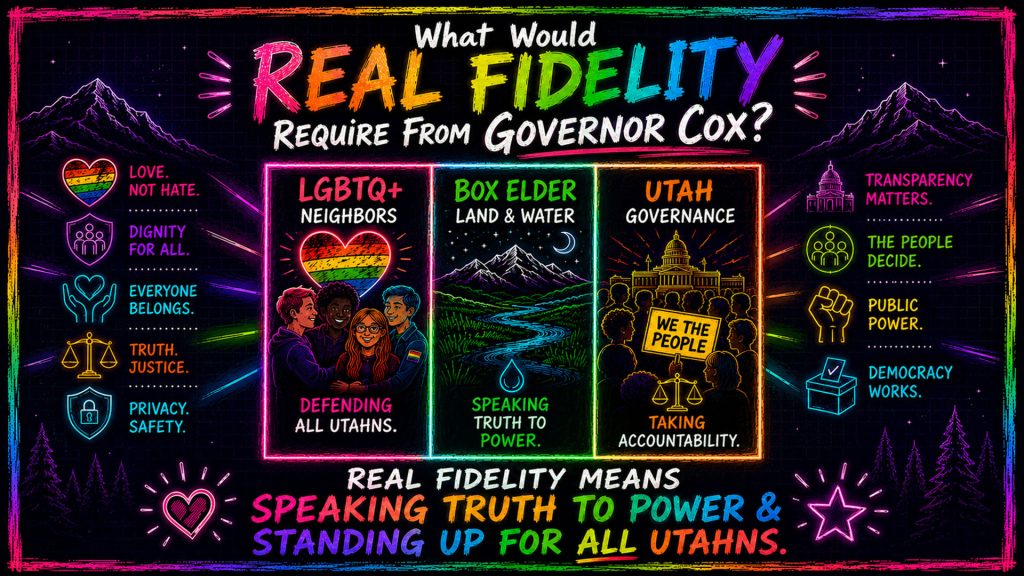
What Does Real Fidelity Require of Gov. Cox And State Leaders?
Real fidelity from a governor and other state leaders would mean keeping faith with the whole public — especially people who have less power. It would mean defending LGBTQ+ Utahns clearly, telling the truth about the Box Elder data center, and using your office to protect local consent instead of smoothing the road for concentrated power.
Governor Cox, if June is Fidelity Month, the question is not whether Utah can praise faith, family, and country. The question is whether you will keep faith with people who now have reason to feel erased.
You’ve declared June 2026 “Fidelity Month” — alongside several other Republican leaders across the United States who are gravitating toward supposedly “conservative” alternatives to Pride Month. Supporters describe the declaration as a return to faith, family, patriotism, and community.
On paper, those are not bad values. Many of us were raised with them. Many LGBTQ+ Utahns still live them every day.
But context matters. June is Pride Month. Utah already has a painful history around whether LGBTQ+ people get welcomed in public life and treated as equals. And you, specifically, have not been neutral in that history.
You were once praised nationally for your remarks after the Pulse nightclub shooting. You apologized for how you had treated gay people. You said your heart had changed. You later issued Pride Month declarations that directly supported LGBTQ+ Utahns, including the 2021 declaration on your own governor’s website. But then your 2023 declaration came without LGBTQ+ references, a 2024 “bridge building” declaration felt forced, 2025 had no formal Pride declaration, and now, in 2026, we get “Fidelity Month.”
That is not just a branding change. It is a public moral retreat.
And if we are going to use a word as serious as fidelity, then we should be honest about what it requires. Fidelity is not loyalty to whichever coalition can keep you in office. Fidelity is not silence when vulnerable people become politically inconvenient. Fidelity is not abandoning people and making excuses.
Why Does Cox’s Fidelity Month Declaration Hurt LGBTQ+ Utahns?
Cox’s Fidelity Month declaration hurts many LGBTQ+ Utahns because it arrives after years of shrinking public recognition during Pride Month. Even if the declaration never says “anti-LGBTQ,” its timing and history make the message clear: traditional values get elevated, while LGBTQ+ families and communities get pushed out of frame.
Too many public leaders and everyday Americans treat recognition like decoration. They act as if simply saying “I love [insert group here]” merits an award or pat on the back. But it’s not. It needs to be followed with real solidarity and support — both parts of fidelity — for it to mean anything at all.
The Trevor Project’s 2025 national survey reported that 36% of LGBTQ+ young people seriously considered suicide in the past year, and 90% said recent anti-LGBTQ+ laws, policies, and debates caused them stress or anxiety. The CDC’s 2023 Youth Risk Behavior Survey also found serious disparities for LGBTQ+ students, including higher rates of sadness, poor mental health, and suicide attempts.
So when a governor declares that June is “Fidelity Month” instead of “Pride Month,” people feel it in their bodies, hearts, and souls.
Governor Cox, this is especially painful because you know better. You have shown that you know better. You once seemed to understand that LGBTQ+ people did not need vague kindness. They needed concrete belonging. They needed leaders willing to say, out loud, that they were part of Utah’s families, faith communities, schools, neighborhoods, and future.
This is why “Fidelity Month” lands so badly. It does not sound like a bigger moral tent. It sounds like a smaller one.
And the problem is not faith. The problem is not family. The problem is not country. The problem is defining those words in a way that marks some people as less faithful, less familial, less patriotic, or less worthy of public honor. Despite the fact that they exemplify these things.
That is not fidelity. In fact, it’s the antithesis of fidelity.
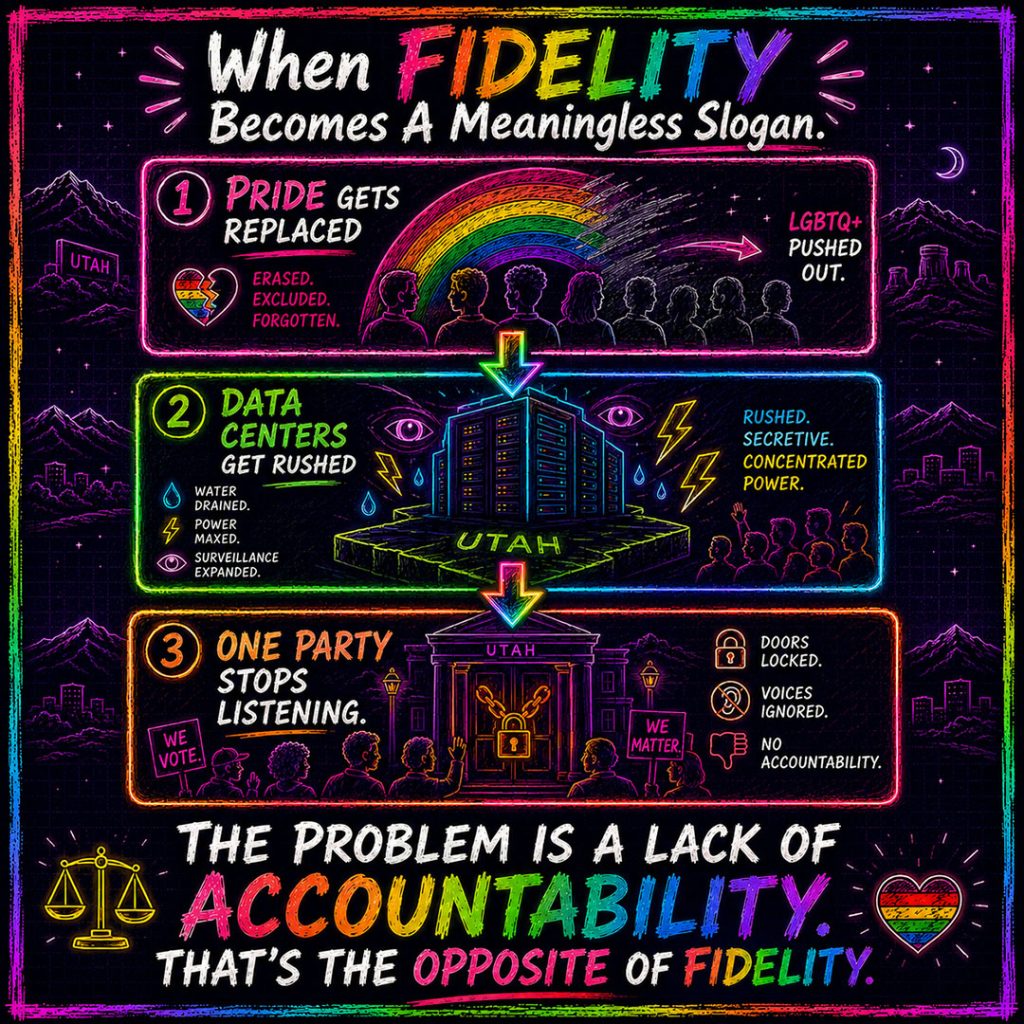
How Do LGBTQ+ Utahns Exemplify Fidelity Better Than Governor Cox?
LGBTQ+ Utahns exemplify fidelity by keeping faith with truth, chosen family, biological family, community care, and survival under pressure. Many have stayed committed to Utah even when Utah has not stayed committed to them. Truthfully, they are one of the clearest examples of fidelity our state has.
If we want to talk about fidelity, we should start with the people who keep loving families that do not always love them back.
We should start with queer kids who still show up at Thanksgiving after years of side comments, sermons, shame, and conditional acceptance. We should start with trans Utahns who keep trying to receive health care in a state that turns their bodies into campaign material. We should start with LGBTQ+ couples who build marriages, raise children, support aging parents, pay taxes, coach teams, teach classes, serve missions, volunteer in neighborhoods, and keep making community in places that keep questioning whether their love belongs.
That is fidelity.
Fidelity is the gay son who keeps calling his mom because he believes repair is still possible. Fidelity is the lesbian couple building a home in a county where their neighbors may vote against their rights and still borrow their tools. Fidelity is the trans teenager staying alive long enough to become the adult someone else needs. Fidelity is the queer Latter-day Saint who leaves the church and still keeps the parts of faith that taught them to love, serve, forgive, and care for the poor.
That kind of fidelity carries an immense weight. It is exhausting. It requires discipline. And it demands immense faith in one’s self and one’s community.
Governor Cox, this is why the declaration feels so backward. LGBTQ+ people are not the threat to fidelity. They are often the evidence of it.
They keep faith with themselves when systems pressure them to disappear. They keep faith with community when politics turns them into a wedge. They keep faith with love when people reduce their relationships to culture-war talking points.
If Fidelity Month means anything worth keeping, LGBTQ+ Utahns should not be erased by it. They should be acknowledged as some of its strongest teachers.
But it’s not just LGBTQ+ Utahns you’re letting down these days. It’s all Utahns. I’m talking about the proposed data center in Box Elder county.
What Would Fidelity Require On The Box Elder Data Center?
Fidelity on the Box Elder data center would require full transparency, local consent, independent environmental review, public water accounting, power and emissions disclosure, and enforceable limits before the project moves forward. Cox’s executive order is a useful step, but it does not erase the rushed process or answer the deepest surveillance and governance concerns.
The Box Elder data center fight is not just a land-use dispute. It is a test of whether Utah’s leaders still believe ordinary people deserve meaningful power and say over shared resources.
Box Elder County announced on May 4, 2026, that commissioners authorized the Military Installation Development Authority, or MIDA, to initiate the Stratos project area. The county described the project as a possible “state-of-the-art data center” in an unzoned area of western Box Elder County and said commissioners reviewed more than 2,500 comments.
While that might sound like doing due diligence on paper, for most Utahns it felt like anything but.
Residents have raised concerns about water, power, air quality, wildlife, noise, heat, taxes, local autonomy, and whether the public had enough time to understand a project of this scale. Business Insider reported that the project was initially discussed around 40,000 acres and up to 9 gigawatts of power demand. KSL later reported that opponents sued after their referendum effort was blocked.
During all of this upheaval, you, Governor Cox, first defended the process — accusing Utahns of operating off “really bad information” (i.e. mistaken and misinformed). Finally, after an uncomfortable length of time — and only amid growing public backlash — you signed an executive order setting a “higher bar” for data centers.
That executive order is certainly appreciated. And it’s good to know that an insane amount of public pressure across the political spectrum can still get state leadership to act. (Though this actually raises more concerns about Fidelity Month — as it really seems like you’re trying to drive a wedge between Utahns at a time when they seem universally united on something.) It does matter that water, air quality, wildlife, ratepayer impact, and public engagement are now officially part of the dialogue.
But Governor Cox, it still does not go far enough.
A higher bar is not the same as meaningful consent. A phased process is not the same as accountability. A developer shrinking a proposal after backlash does not resolve whether this project should exist in the first place.
If fidelity means anything in public office, it should mean we do not treat rural Utah as an empty staging ground for investors, military infrastructure, and political ambition. It should mean we do not ask communities to trust a process after the most important choices already appear to be moving.
Utahns do not need to be soothed. We need to be empowered. That means no approval without public, independent, plain-English answers to basic questions:
| Fidelity Test | What Utahns Deserve Before Approval |
|---|---|
| Water | Full water-rights accounting and Great Salt Lake impact analysis |
| Power | Transparent generation plans, emissions projections, and ratepayer protections |
| Local Consent | Public hearings before major decisions, not after momentum is built |
| Surveillance | Disclosure of defense, intelligence, policing, and data-broker use cases |
| Taxes | Clear public explanation of incentives, rebates, and opportunity costs |
| Jobs | Independent analysis of permanent jobs, wages, and automation risks |
| Environment | Wildlife, heat, air quality, dark sky, and emergency-response review |
| Accountability | Binding community benefits and public reporting requirements |
This is what democracy and a government by the people, for the people, looks like in action. Technology should serve the public — not special interests or a growing surveillance state.
Why Is The Stratos Data Center A Surveillance Concern, Not Just An AI Concern?
The Stratos data center raises surveillance concerns because official and media descriptions connect the project to AI, cloud computing, national security, and military competitiveness. Consumer AI use is not the real purpose of this and other data centers that are springing up. The deeper demand comes from institutional compute — defense, policing, intelligence, data brokerage, and corporate control.
One of the most frustrating parts of the data center debate is how quickly it gets reduced to individual consumer behavior. People say, “Well, stop using ChatGPT.” Or, “You use AI, so you cannot oppose a data center.” That misses the actual structure of the problem.
A 40,000-acre data center campus does not get built because a few Utahns ask an AI tool to write emails or summarize an article. That may be part of the broader compute ecosystem, but it is not the decisive demand signal. The decisive demand comes from institutions with money, contracts, permits, land, and state backing.
Box Elder County’s own Stratos project fact sheet says the project would support next-generation technologies like cloud computing and artificial intelligence, including helping American businesses and the U.S. military improve global competitiveness. Business Insider described it as an AI and defense data center campus. That should raise alarm bells for American citizens and Utahns.
The questions we should be asking are not about consumer AI usage but whether Utah is being asked to host infrastructure that could expand surveillance power faster than democratic accountability can catch up.
The Brennan Center for Justice has warned that military AI can combine location information, social media posts, and other data to recreate people’s movements, associations, and habits at scale. EPIC has warned that government AI can analyze Americans’ information obtained through data brokers and other warrantless or weakly controlled channels.
That should get American citizens in the street. It should have them doing sit-ins in front of the Capitol Building and White House.
Because if we already know government and corporate actors can buy, combine, and analyze massive streams of data, then a hyperscale AI and defense data center is not morally neutral infrastructure. It is power. It is capacity. It is the machinery that can make surveillance broader, faster, cheaper, and harder to see.
Utah should understand this better than most states because we have already lived with the tradeoffs of secret federal data centers in our own backyard. The NSA’s Bluffdale facility did not merely bring jobs or technical capacity. It brought a model of power where water, electricity, land, and local trust were converted into surveillance infrastructure — and where even basic questions about public resource use could be treated as national-security threats. The harm was not only that Americans’ records were collected. The harm was that a democratic public was asked to host, fund, cool, and normalize a black box it could not meaningfully inspect.
So no, Governor Cox, this is not just about whether the project uses too much water. It is not just about whether the lights are too bright. It is not just about whether Kevin O’Leary can promise jobs and patriotic innovation.
It is about whether Utah is helping build the backbone of a surveillance state.
And if that sounds too strong, then state leaders and developers should have no problem proving otherwise with binding limits, public contracts, transparent use cases, and enforceable prohibitions on policing, immigration enforcement, domestic intelligence, data-broker pipelines, and military targeting systems.
But asking us to trust you, or our other elected leaders, is the opposite of fidelity. Trying to downplay the potential impacts and ramifications of this data center is the opposite of fidelity. Real fidelity would be standing with Utahns and speaking truth to power.
What Should Governor Cox Do If He Actually Means Fidelity?
Governor Cox, if you really want to exemplify fidelity during Fidelity Month, you should return to standing up for LGBTQ+ Utahns, apologize (again) for the harm you’ve caused, pause data center expansion until affected communities have real consent, disclose surveillance risks, and support reforms that reduce one-party control over public decisions.
Announce unequivocally that LGBTQ+ Utahns are part of faith, family, country, and community. Say their marriages are families. Say their children are Utah children. Say trans Utahns deserve dignity, safety, and health care. Say Pride Month is not a threat to fidelity, but a perfect example of fidelity in action.
Then go further and back up your words with action.
That means not signing or enabling laws that make LGBTQ+ people less safe. It means not hiding behind process when the process harms people. It means admitting that a bridge-building declaration can become a burden when it asks the wounded to meet their wounders halfway without first requiring accountability from the people with power.
It also means you should stop treating the Box Elder data center as a communications problem. Utahns are not confused because we lack talking points. We are angry because the process has been rushed, opaque, and tilted toward powerful interests.
A real Fidelity Month agenda would include:
- A Public LGBTQ+ Repair Statement: Name what changed from 2021 to 2026, acknowledge the harm, and recommit to protecting LGBTQ+ Utahns by name.
- A Data Center Moratorium: Pause major approvals until independent review, water accounting, emissions modeling, and public hearings are complete.
- A Surveillance Disclosure Requirement: Require developers to disclose defense, intelligence, policing, immigration, and data-broker use cases.
- A Binding Community Consent Process: Give affected communities real procedural power, not symbolic listening sessions.
- A One-Party Power Audit: Review how concentrated partisan control affects MIDA, land use, tax incentives, public comment, transparency, and citizen referendums.
- A Citizen Assembly Pilot: Use sortition — a representative group of ordinary Utahns selected by lottery — to review major infrastructure proposals before state-backed entities advance them.
And, in this, I will level with my fellow Utahns and you, Governor Cox. You are not the problem in this state. You are a symptom of the problem. Just like the data center. And just like LGBTQ+ discrimination. The real issue is that Utah’s governance is a system where too few people hold too much power — and can seemingly act with near-impunity and no accountability, despite the facade of elections and representation.
Fidelity requires changing that system.
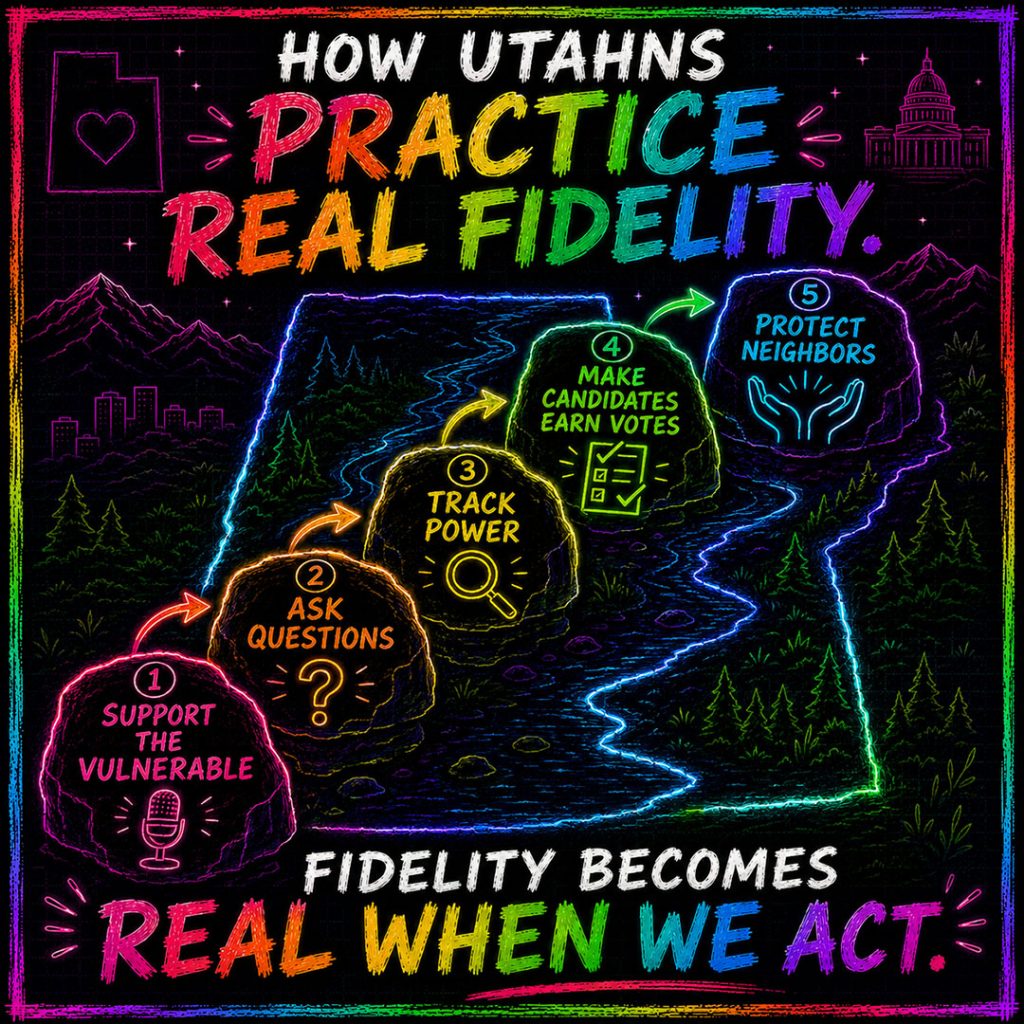
What Would Fidelity To Conservative Values Require From Utah Republicans?
Fidelity to conservative values would require Utah Republicans to defend limited government, local control, fiscal responsibility, family stability, privacy, civil liberties, and moral leadership — especially when Republican officials violate those values. Party loyalty is not conservatism. Accountability is.
I’m addressing all the Republicans of Utah here — but especially the working class Republicans. I truly believe we have much more in common than we do different.
Many of you do believe in real values. You believe in family. You believe in faith. You believe in local control. You believe the government should not be too big, too expensive, too intrusive, or too distant from the people it governs. You believe public leaders should be moral, humble, restrained, and accountable.
Those are all excellent values. Many of us grew up with them and still share them, even if our policy conclusions have changed a bit.
But we have to be honest about the current Utah Republican Party’s behavior.
When the state bans Pride flags from government spaces while claiming to defend free expression, that is not limited government. When state-backed development authorities help move massive infrastructure projects through communities that feel unheard, that is not local control. When public leaders use faith-and-family language while refusing to protect LGBTQ+ families, that is not family values. When data infrastructure expands without serious privacy guardrails, that is not civil liberty. When officials praise patriotism while concentrating power away from ordinary people, that is not republicanism.
It’s power attempting to protect itself.
And to be clear, Democrats are not saints. No party deserves blind loyalty. Money, ego, careerism, donor pressure, and institutional rot can corrupt any political organization. But in Utah, the immediate structural problem is one-party dominance. When one party has too much control for too long, it stops needing to persuade. It stops needing to listen. It starts treating public input as an annoyance instead of a duty.
That is bad for liberals. It is bad for moderates. It is bad for conservatives. It is bad for Republicans themselves.
Healthy competition is not betrayal. It is the foundation of a healthy political framework and representative governance.
If Utah Republicans want their party to return to fiscal responsibility, local control, privacy, public morality, and restrained government, then the party needs to feel real competition again. Not symbolic competition. Not the kind of competition where they can claim to listen and then move forward with whatever they want. They need actual competition for power.
That does not require every Republican to become a Democrat. But it does require Republican voters to stop voting Republican when they haven’t earned that vote.
How Can Utah Voters Practice Fidelity Without Falling Into Straight-Ticket Loyalty?
Utah voters can practice fidelity by voting according to values, not team identity. That means comparing candidates in every race, asking who protects local control and civil liberties, and supporting political competition where one-party dominance has made leaders complacent. Fidelity in voting means making power earn our votes again.
No party owns morality. No party owns truth. No party owns Utah. And no party should be able to assume our vote before it has been earned.
So we should absolutely not trade one straight-party ballot for another. That just repeats the same failures in a different color. Instead, we need to stop voting tribally and start voting critically.
Look at each race. Look at each candidate. Look at what power structure they strengthen. Look at whether they defend local control when money is on the line. Look at whether they protect vulnerable people when doing so is politically inconvenient. Look at whether they will challenge their own party when their own party is wrong.
That means voters should take seriously every credible option available in their district — Democrats, Libertarians, Greens, Forward Party candidates, socialists, independents, and, yes, maybe the occasional Republican who shows actual independence from one-party entitlement.
The goal is not to sweep one party out of power and sweep another party into power. The goal is to level the playing field.
Utah needs a political environment where no caucus can govern by default. We need a legislature where real compromise and collaboration is required. We need public servants who know they can lose power if they stop listening. We need a state where rural residents, LGBTQ+ people, teachers, immigrants, workers, small business owners, parents, childfree adults, religious people, nonreligious people, and everyone in between can shape the future together.
That is what fidelity looks like in a democracy. It is not loyalty to a party. It is loyalty to ourselves and each other.
What Is The Practical Fidelity Checklist For Utahns This Month?
The practical Fidelity Month checklist is simple: support who is being erased, follow the money and permits, ask leaders for specific commitments, compare every candidate by values, and take one concrete action that protects someone else. Fidelity becomes real only when it moves from language into behavior.
Here is what that actually looks like in action.
Step 1: Ask Who Is Missing From The Moral Language
When a leader says “faith, family, and country,” ask who is being excluded. Are LGBTQ+ families supported? Are immigrant families included? Are nonreligious Utahns still part of the public? Are disabled people, renters, workers, and rural residents treated as stakeholders with inherent value?
Step 2: Convert Outrage Into One Public Question
Pick one question and ask it to your elected officials. For example: “Will you publicly commit that the Box Elder data center will not be used for domestic surveillance, immigration enforcement, predictive policing, or warrantless data analysis?”
Step 3: Track Power, Not Just Personalities
Personalities matter, but systems matter more. Track MIDA meetings, county commission agendas, water-rights filings, air-quality permits, tax incentives, campaign donations, and referendum barriers. Follow the process until it becomes clear who benefits.
Step 4: Make Candidates Earn Your Vote
Do not ask only whether a candidate shares your party label. Ask whether they will protect local consent, civil liberties, LGBTQ+ safety, public schools, clean water, and constitutional limits on state power. Ask what they will do when their own party is wrong.
Step 5: Practice One Act Of Neighborly Fidelity
Support one person or group being pushed to the edge. Donate to an LGBTQ+ youth group. Show up for Box Elder residents. Learn what to do if you see immigration enforcement in Cache Valley. Help a neighbor get to a public meeting. Give a tired teacher supplies. Share accurate information instead of ragebait.
Fidelity is not complicated. But it does require effort.
Frequently Asked Questions About Fidelity Month, Governor Cox, And Utah Politics
What Is Fidelity Month In Utah?
Fidelity Month in Utah is Governor Spencer Cox’s June 2026 declaration calling Utahns to recommit to values such as faith, family, country, and community. Supporters frame it as positive moral renewal. Critics see it as a conservative alternative to Pride Month that risks erasing LGBTQ+ Utahns.
Why Are LGBTQ+ Utahns Upset About Fidelity Month?
Many LGBTQ+ Utahns are upset because the declaration came during Pride Month and followed several years of Cox reducing or removing direct LGBTQ+ recognition from June statements. The concern is not that faith or family are bad, but that those words are being used to exclude Utahns.
What Would Real Fidelity Require From Governor Cox?
Real fidelity would require Governor Cox to protect LGBTQ+ Utahns by, tell the truth about state-backed data center development, defend local consent, disclose surveillance risks, and make public power accountable to the people most affected by it.
Is The Box Elder Data Center Just About Consumer AI?
No. Consumer AI use is not the main issue. The deeper concern is institutional compute demand from cloud infrastructure, defense, policing, intelligence, corporate data systems, and AI platforms. A project tied to military competitiveness deserves public scrutiny around privacy, surveillance, water, energy, and local control.
How Can Conservative Utahns Respond Without Abandoning Their Values?
Conservative Utahns can respond by applying their values consistently: limited government, local control, fiscal responsibility, civil liberties, privacy, family stability, and moral leadership. If current leaders violate those values, fidelity may require competition, accountability, and voting by principle rather than party identity.
What Can Utahns Do Right Now?
Utahns can ask public questions, track permits and meetings, support affected communities, compare candidates by values, and share accurate information with neighbors. The most useful next step is one concrete act: attend a meeting, contact a representative, help a local organizer, or ask a candidate where they stand.
So, What Would Real Fidelity Require From Utah?
Real fidelity in Utah would require standing up for all our neighbors, not just the neighbors who fit a preferred story about family, faith, country. That means naming LGBTQ+ Utahns directly, pausing massive infrastructure until communities have real consent, and refusing to let one-party dominance replace democratic accountability.
Governor Cox, if you want Fidelity Month to mean something, make it bigger than a culture-war counterprogram. Make it a standard you are willing to be judged by. Defend the vulnerable. Empower the disenfranchised. Speak truth to power, even when that power is your party, your donors, your allies, or your own office.
And Utahns, our work is not to swap one blind loyalty for another. Our work is to build a state where power has to listen to the people it impacts.
If Fidelity Month made us angry, then let’s turn that anger into one act of public care. If the data center upsets us, let’s ask one concrete question in a public forum. If one-party control has exhausted us, let’s compare every candidate by values, not team color.
Then share this with one Utah voter and ask the only question that really matters: Who is actually keeping faith with the people of Utah?