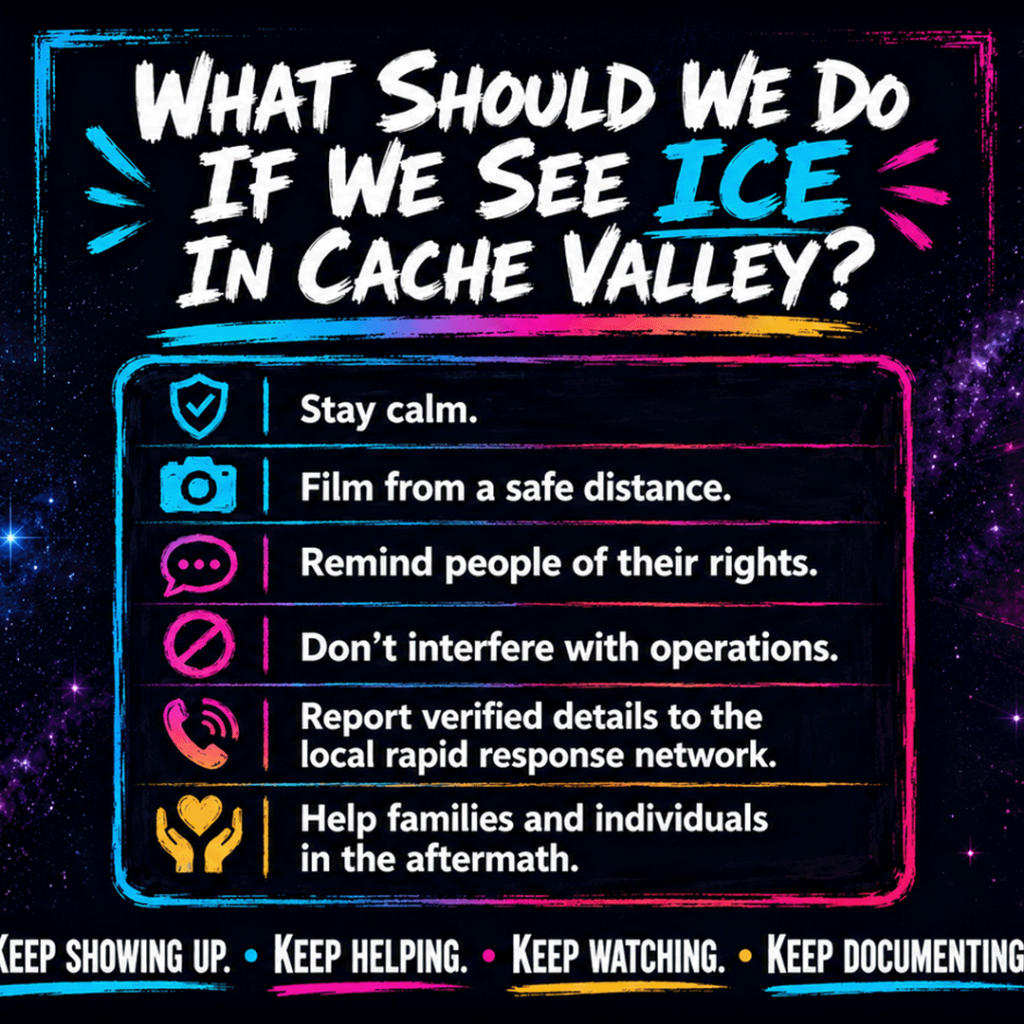
Cache Valley residents can help during immigration enforcement by staying calm, filming from a safe distance, not interfering, reminding people of their rights, and reporting verified details to the local rapid response network. The goal is not confrontation — it is harm reduction, accountability, and care.
TLDR – Critical Insights For Dealing With ICE In Cache Valley
- Stay calm, stay back, and observe first.
- Film from 10–15 feet away when safe.
- Use SALUTE to document the key details.
- Report suspected ICE activity: (435) 441-4433.
- Do not interfere, obstruct, lie, or escalate.
- Remind detained people of their basic rights.
- Ask for name and contact info when safe.
- Know judicial warrants vs. ICE paperwork.
- Don’t post unverified footage on social media.
- Support families after agents leave the scene.
- Ways to support local initiatives:
- Lazos de Cache Valley / Cache Valley Community Defense Rapid Response Network
- Instagram: @lazozdecachevalley
- Fundraiser: https://givebutter.com/NKXwMc
- Get Involved: forms.gle/iPjJC6o3GwJFdv1M9
- Cache Valley Mutual Aid for food and housing support.
- Our Community Cache Valley for democracy and protest organizing.
- Cache Valley Umbrella Group, for fundraising and coordination.
- Meets every second Tuesday at CVUU.
- Lazos de Cache Valley / Cache Valley Community Defense Rapid Response Network
What Should We Do First If We See ICE In Cache Valley?
If we see suspected ICE activity in Cache Valley, our first job is to stay calm, stay back, start documenting, and report what we can verify. We shouldn’t try to be heroes — but simply useful, lawful, and calm enough to reduce harm instead of adding chaos.
At a recent Cache Valley Community Defense / Lazos de Cache Valley training, the framing was direct: “We need help patrolling, documenting, reporting, and also supporting the impacted peoples behind the scenes.” The training’s goal was for every attendee to leave knowing at least one thing they could do if they saw a raid happening.
The trainers put the broad goals this way: “Document” and “Reduce harm.”
It’s important to emphasize — just as it was emphasized at the training — that none of this constitutes legal advice. The trainers are not lawyers, and, ultimately, we’re all responsible for our own actions. Immigration law changes quickly, and people facing detention should speak with a qualified immigration attorney as soon as possible.
But we do not need a law degree to know when something is wrong and deserves a response. We all know, point blank, that our neighbors should not disappear in silence.
This guide is meant to be a community education resource to help teach others what that response should be and who to coordinate with.
See also:
- How Can We Stop The New Data Center In Box Elder Utah?
- The Conservative Case for Immigration Reform
- The Conservative Christian Case Against Trumpism
How Do We Identify ICE & Other Immigration Agents Without Guessing?
Identify suspected immigration agents by looking for patterns: agency markings, generic “POLICE” vests, lack of local name tags or shoulder patches, DHS-style badges, dark unmarked vehicles, and behavior that does not match normal local law enforcement transparency. Document everything, without jumping to conclusions or trying to fill in the blanks ourselves.
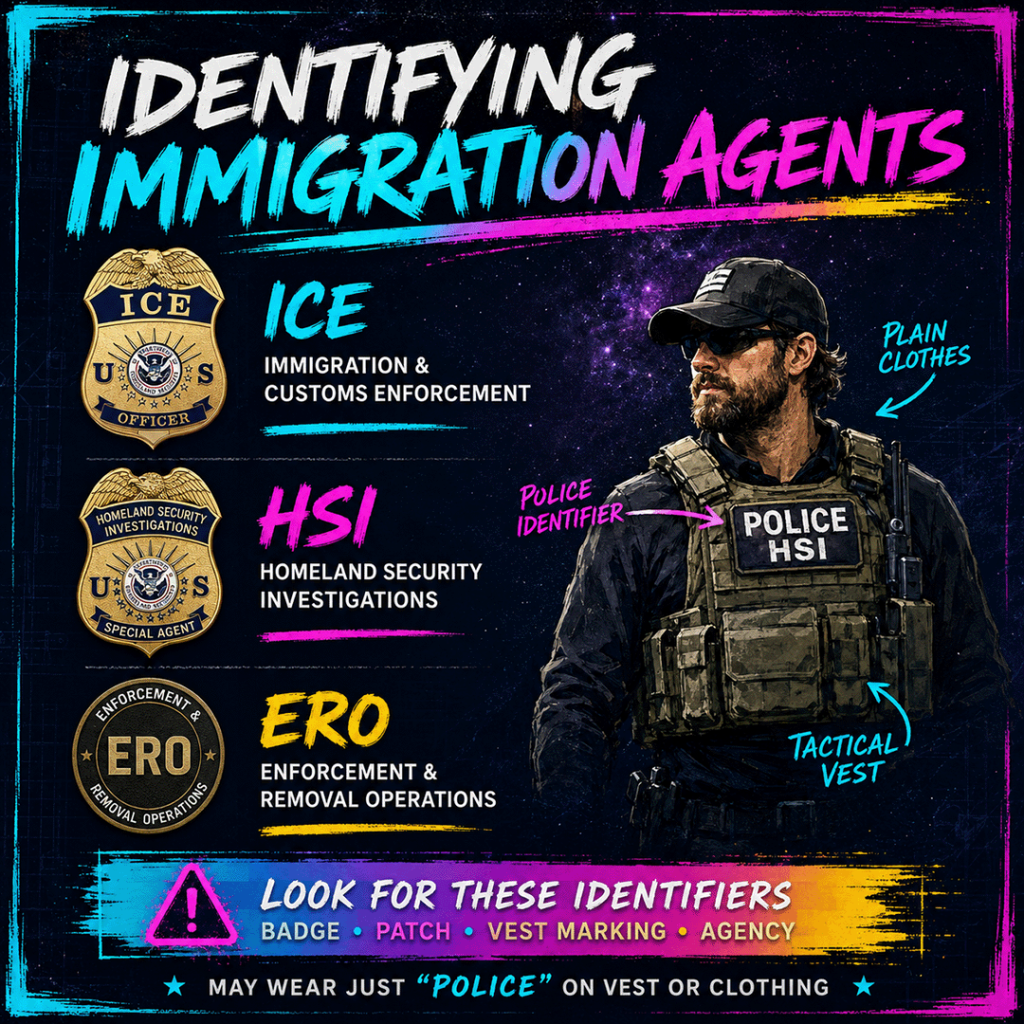
The Cache Valley training named three federal immigration-related entities residents may encounter: ICE, HSI, and ERO. ICE stands for Immigration and Customs Enforcement. HSI is Homeland Security Investigations. ERO is Enforcement and Removal Operations. ICE’s own website describes ERO as the office that manages immigration enforcement processes, including identification, arrest, detention, and removal, while HSI is a federal law enforcement agency within the Department of Homeland Security.
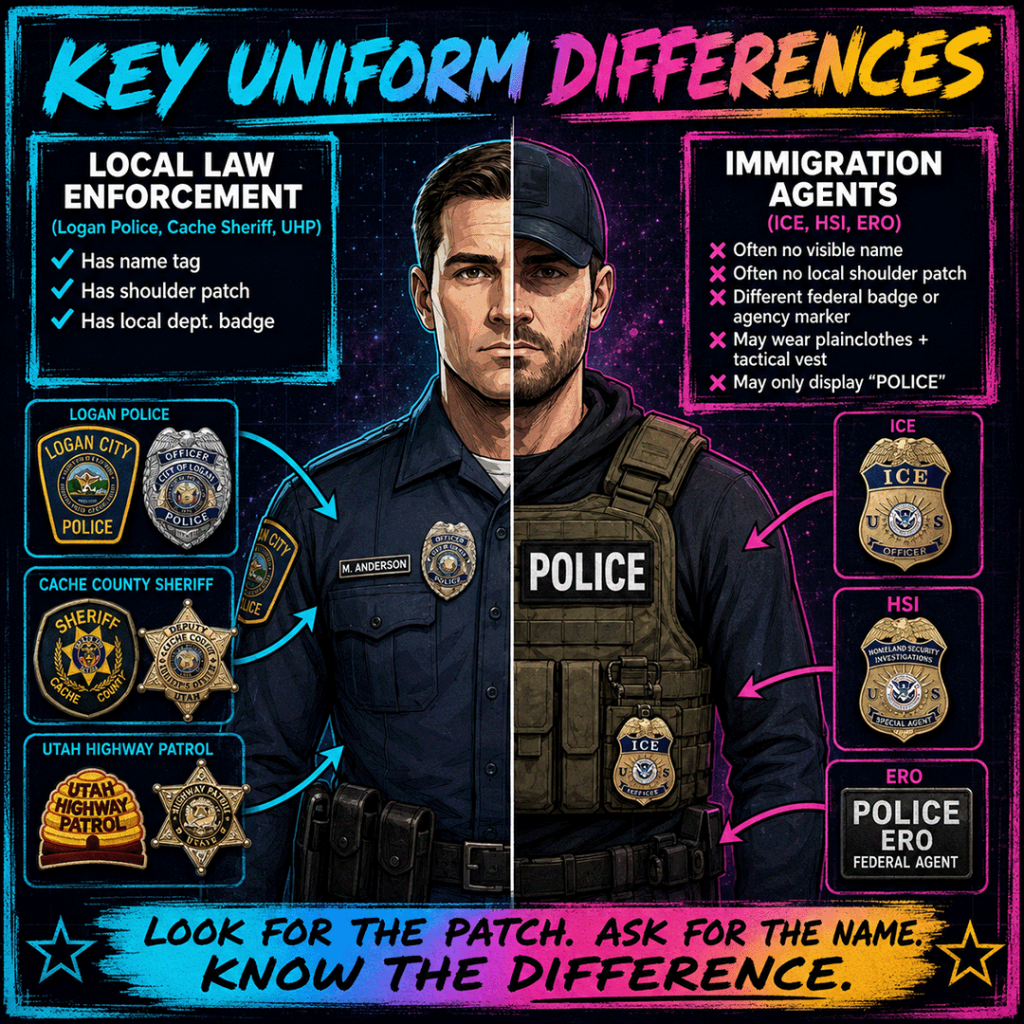
Locally, the training emphasized that immigration agents may not always look like the public expects. They may wear tactical vests. They may use generic “POLICE” markings. They may show only a badge. They may not have a visible name tag. They may not have a local shoulder patch. They may not identify themselves when asked.
However, a quick way to help with identification is to put them into contrast with local officers. Cache Valley law enforcement is more likely to show a name, local badge, and local shoulder insignia; immigration agents may show nothing and refuse to identify themselves.
The training also described verified vehicles associated with local immigration activity as newer American-made vehicles, often unmarked, often black or dark-colored, and sometimes with very dark tint. Named examples included Ford Explorer, Dodge Durango, Suburban, Dodge Ram, and Chrysler Pacifica models. The trainer also noted that some vehicles had normal-looking plates rather than exempt plates.
Ultimately, our job is to observe and report:
- What agency markings do we see?
- Is there a visible badge?
- Is there a name tag?
- Are there shoulder patches?
- What does the vehicle look like?
- What is the license plate?
- What are the agents doing?
- Who else is present?
From there, we can start holding ICE and other bad actors accountable for their actions and protect our community.
What Should We Do Before We Ever See ICE?
Before we see ICE, we should prepare our phones, save the hotline number, make storage space, charge our batteries, turn off biometric unlocking, set up secure backup, and remove sensitive information we do not need to carry. Preparation turns a frightened bystander into a useful witness.
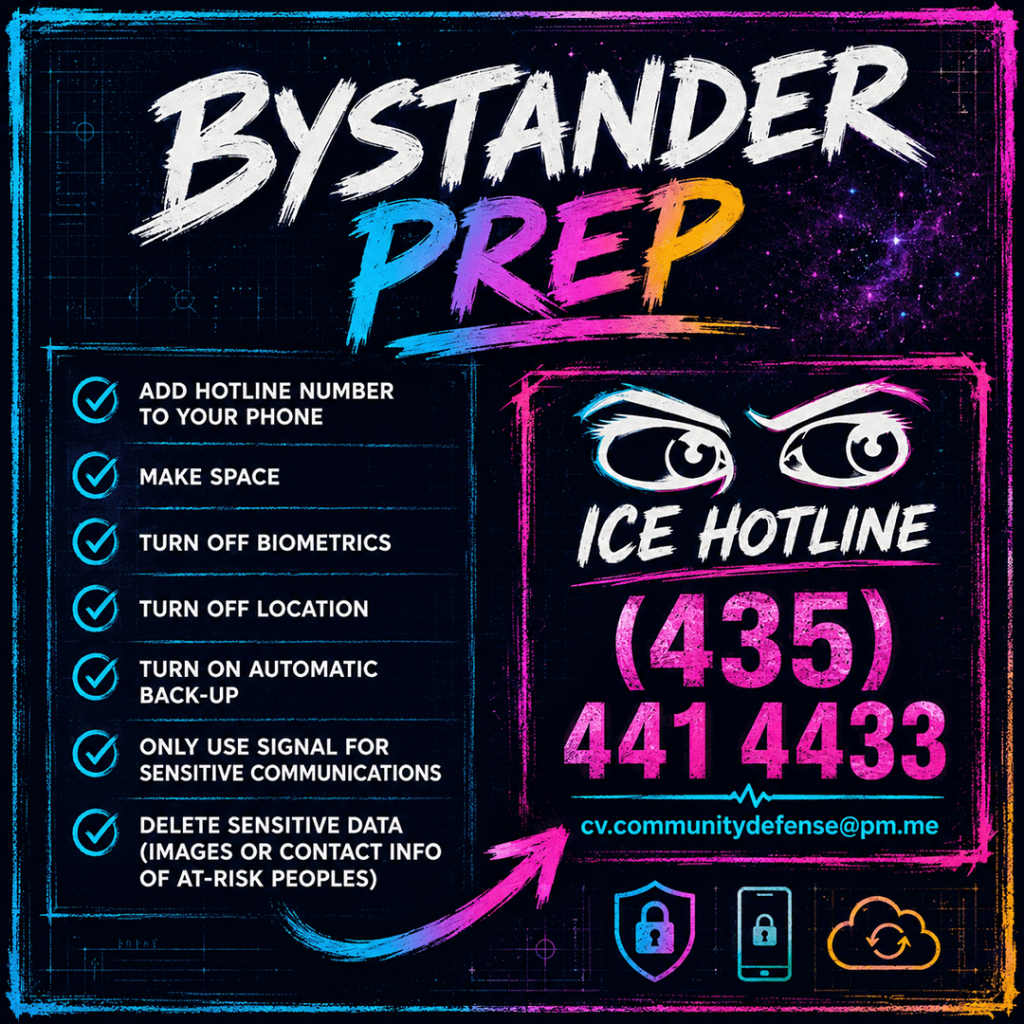
Local residents should add the Cache Valley ICE hotline to their phone: (435) 441-4433. You can also submit tips and information via email at cv.communitydefense@pm.me.
Additionally, prepare your phone for a possible ICE encounter by doing the following:
- Add the hotline number.
- Make space for long video.
- Turn off biometrics.
- Turn off location when not needed.
- Turn on automatic backup.
- Use Signal for sensitive communication.
- Delete sensitive images, names, or contact info for at-risk people.
ACLU of Utah gives similar advice, specifically suggesting that people disable face and fingerprint recognition because passcodes can make it harder for agents to force access to a device. The national ACLU also says that if we are not under arrest, law enforcement needs a warrant to confiscate or view our device without consent; even after an arrest, officers still need a warrant to search its contents. The ACLU also states that the government may not delete our photos or videos.
That does not mean agents will always respect those rights. The ACLU explicitly warns that protected rights have been disregarded and violated before.
So it’s important to prepare for two realities at once: 1) what the law says, and 2) what government agents and law enforcement officers may still try to do:
- Save the Cache Valley ICE Hotline — (435) 441-4433.
- Save cv.communitydefense@pm.me.
- Install Signal.
- Turn off Face ID / fingerprint unlock before high-risk situations.
- Use a long or intricate passcode.
- Enable cloud backup for photos and video.
- Clear phone storage.
- Remove unnecessary sensitive data.
- Tell one trusted person what you are doing if you plan to patrol or document.
This gives us the ability to not only follow the law, but protect ourselves when others might not.
Do We Have The Right To Film ICE Or Other Law Enforcement In Public?
Yes. The First Amendment protects our right to record law enforcement and federal agents performing their duties in public, including ICE. In Utah, ACLU of Utah also points to Utah Code 76-8-305 as protecting the right to record law enforcement in public spaces, as long as we do not interfere.
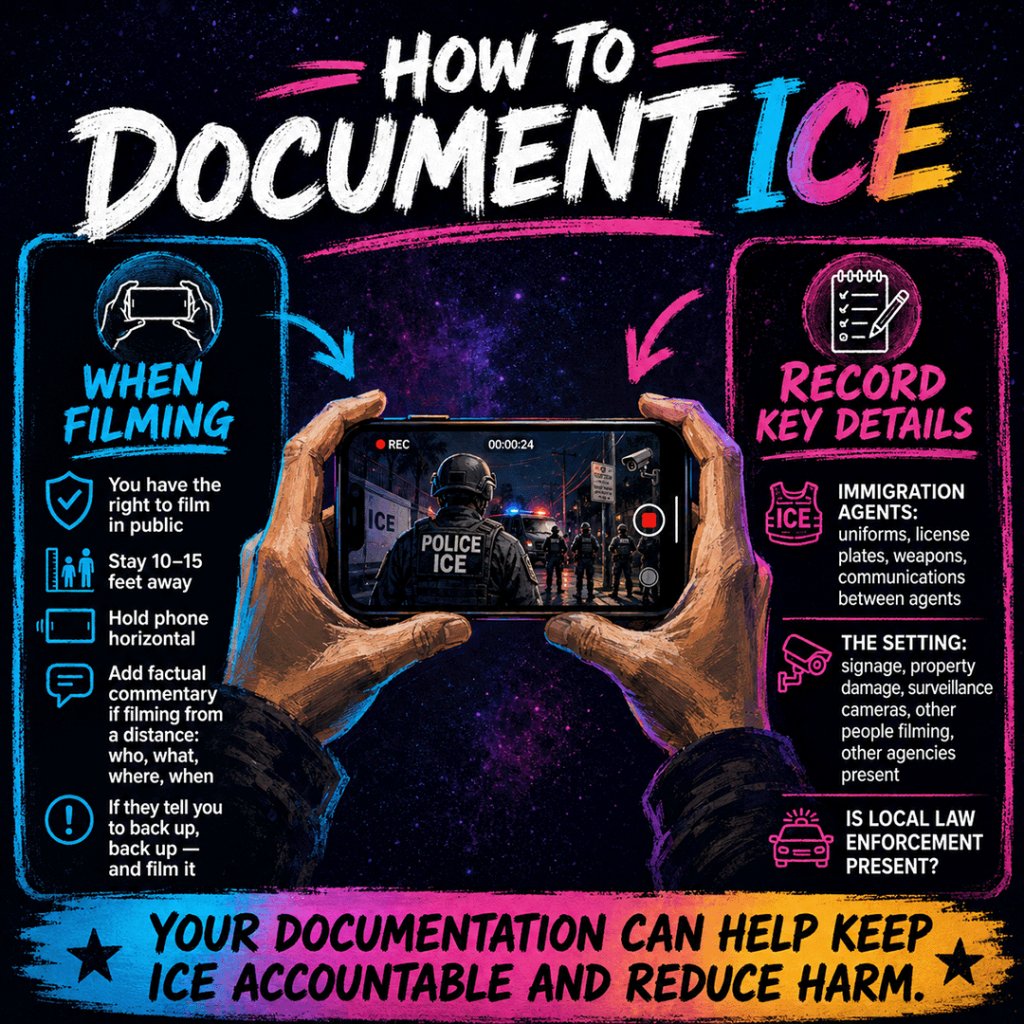
ACLU of Utah says we have the right to record interactions with ICE and other law enforcement officials in public spaces while they are performing duties in plain view, as long as we do not otherwise interfere. If officers ask us to step back, we should step back — but we can continue recording.
The local Cache Valley trainers added a few additional pointers: “You have the right to film in public,” “stay 10–15 feet away,” “hold phone horizontal,” “add factual commentary,” and “back up if they tell you to.”
The Electronic Frontier Foundation gives a similar rule: we have the right to record law enforcement officers doing official duties in public, but we should stay calm, courteous, and avoid interfering. EFF also warns that officers may move toward recorders and then accuse them of interfering, which is one reason distance matters.
The practical filming protocol:
- Stand back 10–15 feet.
- Keep both hands visible.
- Hold the phone horizontally when possible.
- Start with a wide shot that shows the scene.
- Narrate facts, not guesses: “Three armed individuals, black SUV, north side of parking lot, 2:14 p.m.”
- Capture agency markings, badges, vehicles, plates, and agent behavior.
- Avoid filming the detained person’s face — and if they ask you not to film, respect their wishes.
- If told to move back, calmly move back and keep recording.
- Do not touch, block, push, surround, or physically obstruct anyone.
The goal of recording is to document what agents are doing — but “the privacy and the dignity of those people being detained” must also be taken into account, the trainers noted.
What Details Should We Document During An ICE Sighting?
When we see suspected immigration enforcement activity, we should document details that help the community verify what happened: size, activity, location, uniform, time, equipment, vehicles, license plates, badge numbers, agencies, direction of travel, and whether anyone was detained. The cleaner the report, the faster others can respond.
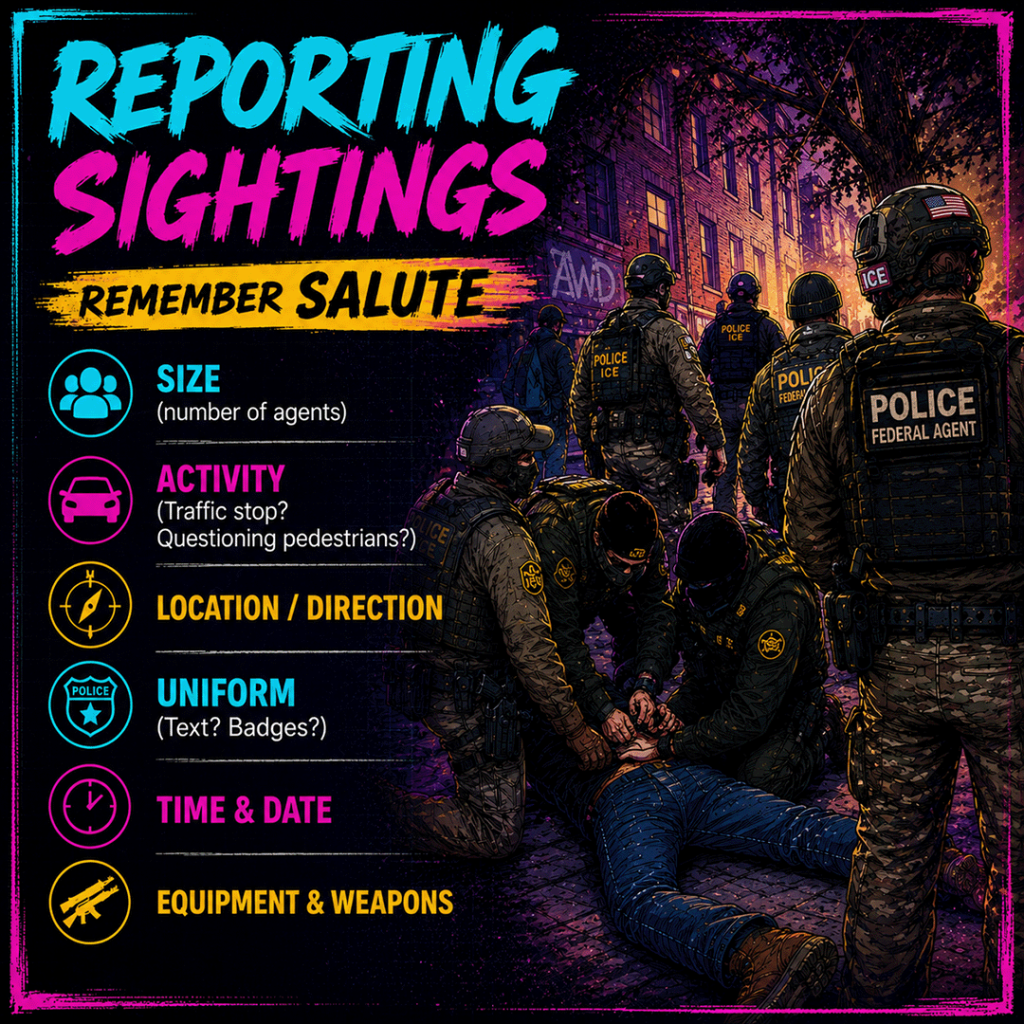
The local training used the acronym SALUTE to drive this home:
- S — Size: How many agents, vehicles, and detained people?
- A — Activity: Traffic stop, arrest, search, questioning, transport, use of force?
- L — Location / Direction: Exact address, intersection, landmarks, direction of travel.
- U — Uniform: Agency text, badges, patches, masks, visible names.
- T — Time: Start time, key moments, departure time, date.
- E — Equipment: Vehicle make and plate, weapons, masks, body cameras, communications.
ACLU of Utah recommends documenting similar details: which agencies are present, where agents are, how many ICE or Border Patrol agents are there, what they are doing, how long they have been there, and what is known about the person being detained.
The training also makes an important point for imperfect witnesses: report what you have, even if it is incomplete. When someone asked whether they should still report if they could not get every SALUTE detail, the answer was yes: “Any tip. Any information you get.” The trainer added, “We’d rather have it than not,” because another person’s partial report may complete the pattern.
A useful report might sound like this:
“I’m at the Maverik near 200 North and 1000 West. It’s 8:42 a.m. I see two dark SUVs and four people in tactical vests marked POLICE. I do not see local shoulder patches. One person appears to be detained. Vehicles are facing west. I am recording from across the parking lot.”
That is actionable and gives responders something to verify.
What Should We Say To Someone Being Detained?
If someone is being detained, we can remind them of their rights without directing them or interfering. Useful phrases include: “You have the right to remain silent,” “You do not have to sign anything without a lawyer,” and “You have the right to call your lawyer.” Keep it calm, brief, and focused.
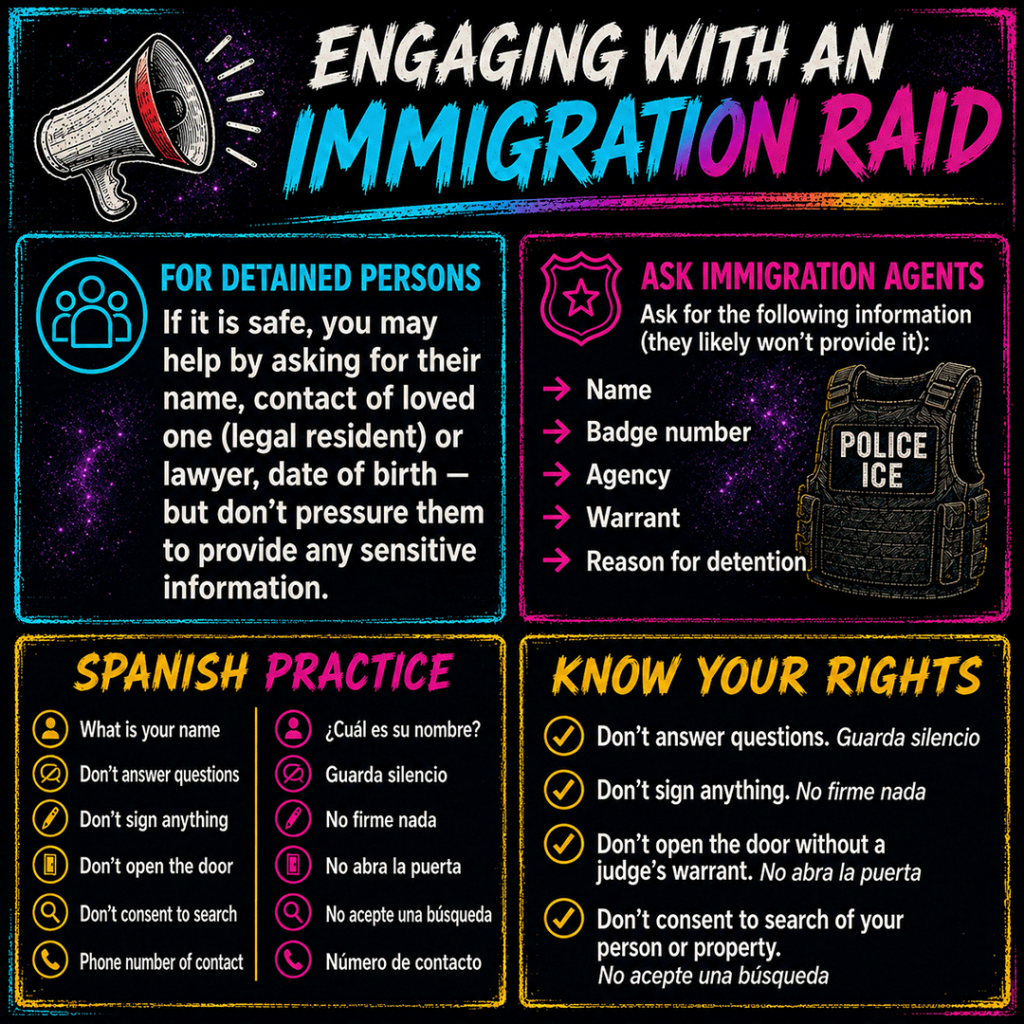
ACLU of Utah says bystanders have the right to discuss people’s legal rights with them, even if ICE or law enforcement officers are detaining them, as long as they do not interfere with the arrest. ACLU of Utah also advises people to remind detained people of rights rather than direct them; for example, say, “You have the right to remain silent,” instead of “Do not talk to ICE.”
The local training used red-card language in English and Spanish. The core phrases were:
- “You have the right to remain silent.” / Tiene derecho a guardar silencio.
- “You don’t have to answer questions.” / No tiene que contestar preguntas.
- “You don’t have to sign anything without a lawyer.” / No firme nada sin hablar con un abogado.
- “You don’t have to open the door without a judicial warrant.” / No abra la puerta sin una orden judicial.
- “You don’t have to consent to a search.” / No acepte una búsqueda.
NILC’s know-your-rights guidance says everyone living in the U.S. has basic constitutional rights, including undocumented immigrants. It specifically says people have the right to remain silent, may refuse to speak to immigration officers, should not answer questions about where they were born or how they entered the U.S., and should talk to a lawyer before signing anything.
The local training also encouraged asking the detained person for information that can help family or legal support locate them:
- Full name.
- Date of birth.
- Contact for a loved one or lawyer.
- Ideally a contact who is not also vulnerable to detention.
That said, we should not pressure a detained person to shout sensitive information if doing so could endanger someone else. But if they can safely share a name, date of birth, and trusted contact, that information may help family and advocates locate them faster.
What Should We Never Do As A Bystander?
As bystanders, we should not interfere, obstruct, touch officers, block vehicles, lie to law enforcement, post unverified footage on social media, or keep filming a targeted person who asks us to stop. Our role is to document, reduce harm, and protect dignity — not escalate the scene.
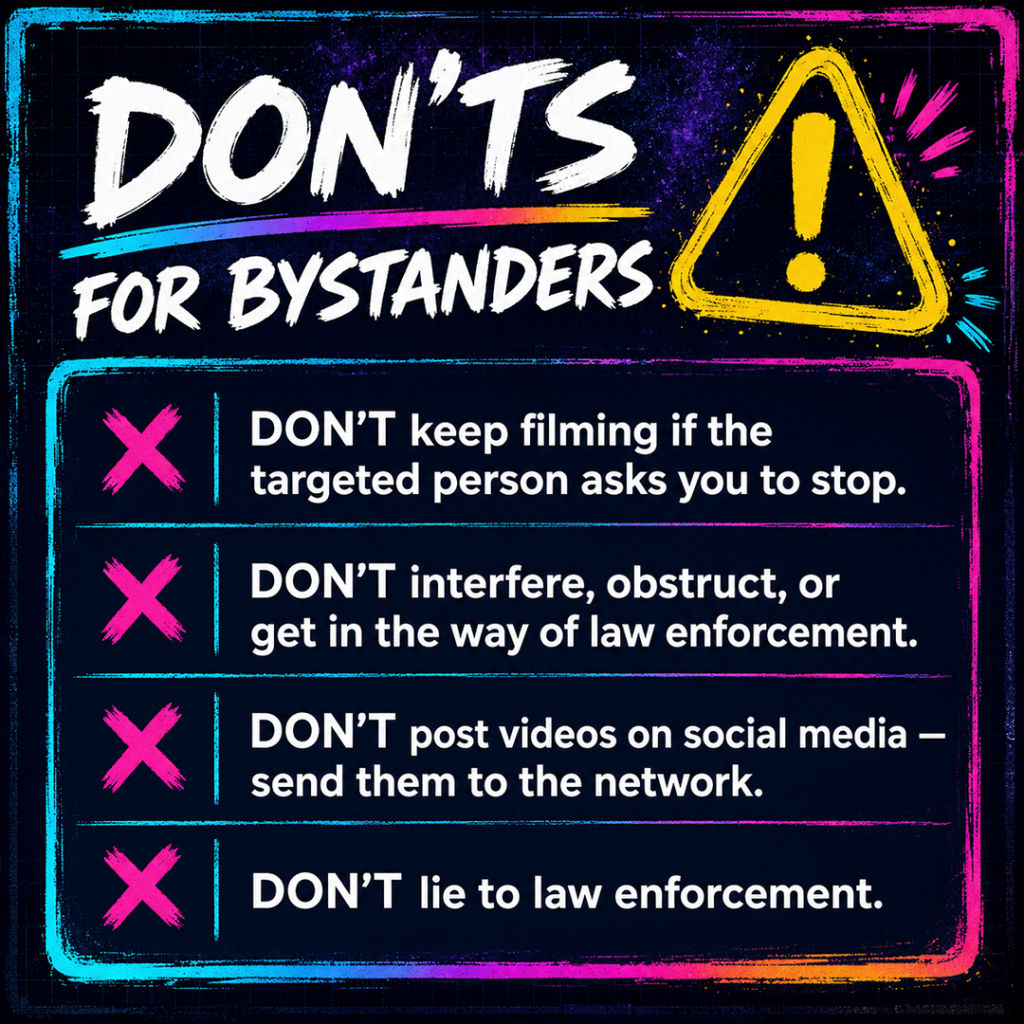
The training’s “don’t” list was clear:
- Do not keep filming if targeted people ask us to stop.
- Do not interfere, obstruct, or get in the way of law enforcement.
- Do not post videos on social media; send them to the local network.
- Do not lie to law enforcement.
ACLU of Utah adds the same de-escalation frame: stay calm; do not run, argue, or resist officers; do not touch, push, or hit an officer; speak respectfully as a de-escalation tactic; and understand the possible consequences of intentionally breaking the law. ACLU of Utah puts the street-level reality plainly: ICE and CBP misconduct cannot be challenged in real time on the street.
In other words, a sidewalk is not a courtroom. If agents violate rights, our job in that moment is usually to preserve evidence, reduce immediate harm, and get the information to people who can use it later.
This can feel emotionally unsatisfying — it can be extremely difficult to watch someone be taken away. However, safety is not passivity. Often, the safest thing we can do may be to stand back and record. A clean video, a license plate, a time stamp, a name, and a witness list can become legal leverage.
How Do We Know The Difference Between A Judicial Warrant And An ICE Warrant?
A judicial warrant is issued by a court and signed by a judge or magistrate. An administrative immigration warrant is issued by an agency such as DHS, ICE, CBP, or USCIS and may be signed by an immigration officer or immigration judge. That difference matters because administrative warrants generally do not authorize searches of nonpublic areas.
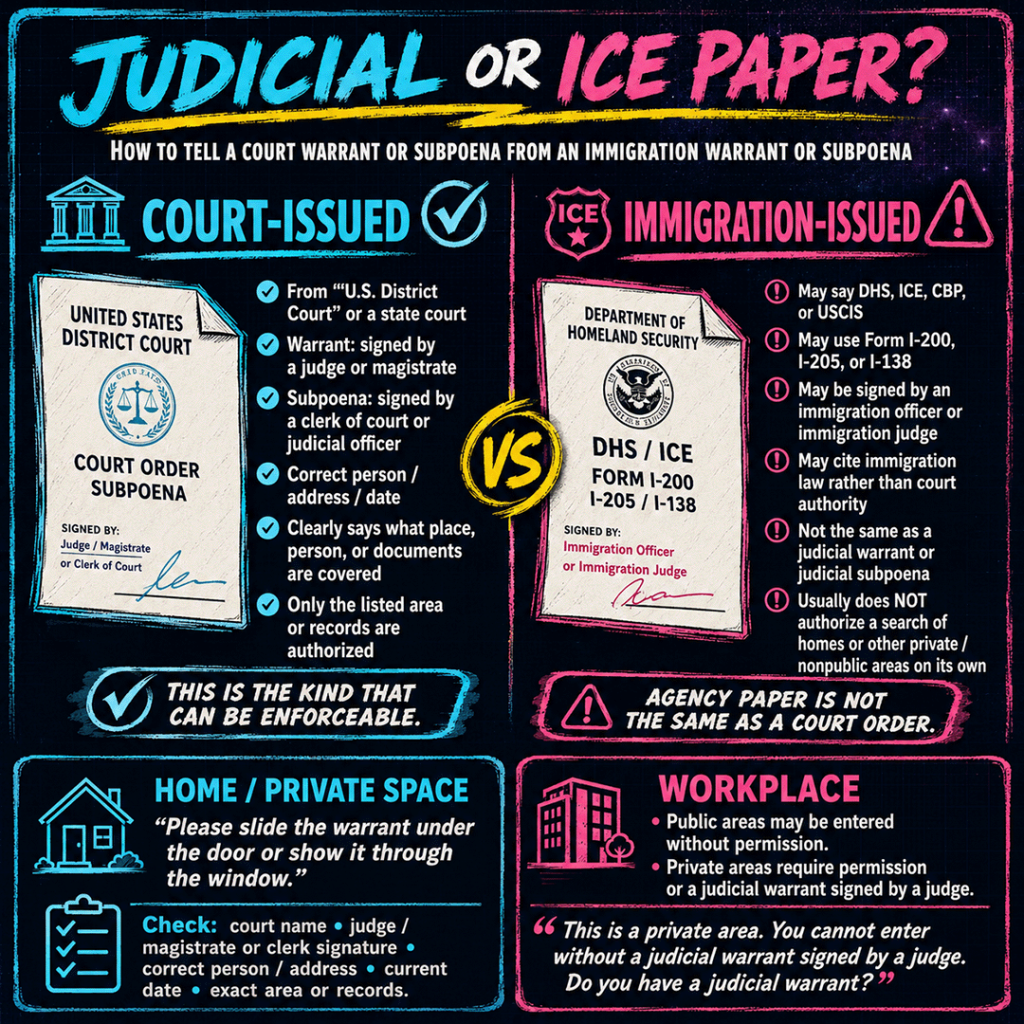
NILC explains that a judicial warrant is a formal written order issued by a judicial court and signed by a judge or magistrate. NILC also states that a warrant signed by an immigration judge is not a judicial warrant.
By contrast, NILC says an administrative warrant is issued by a federal agency such as DHS and can be signed by an immigration judge or immigration officer. Unlike a judicial warrant, an administrative warrant does not authorize a search.
For visual cues, NILC says a valid judicial warrant should be issued by a judicial court, signed by a state or federal judge or magistrate, and identify the address or premises to be searched. Immigration warrants may show DHS forms such as I-200 or I-205, may be signed by an immigration officer or immigration judge, and may cite immigration law rather than court authority.
For homes and private spaces, the practical script is:
“Please slide the warrant under the door or show it through the window.”
Then check:
- Does it say U.S. District Court or a state court?
- Is it signed by a judge or magistrate?
- Is the address correct?
- Is the named person correct?
- Is the date current?
- What exact area does it authorize agents to enter or search?
For workplaces, NILC says public areas — like a restaurant dining area, parking lot, lobby, or waiting room — are different from private areas. ICE agents may enter public areas without permission, but NILC says private areas require permission or a judicial warrant signed by a judge. NILC recommends saying: “This is a private area. You cannot enter without a judicial warrant signed by a judge. Do you have a judicial warrant?”
What Should Businesses, Churches, Venues, And Community Spaces Do To Counter ICE?
Community spaces should decide in advance which areas are public and private, who is authorized to speak with agents, where emergency contacts are posted, how staff will record, and how workers will be reminded of their rights. A plan made during calm is stronger than improvisation during fear.
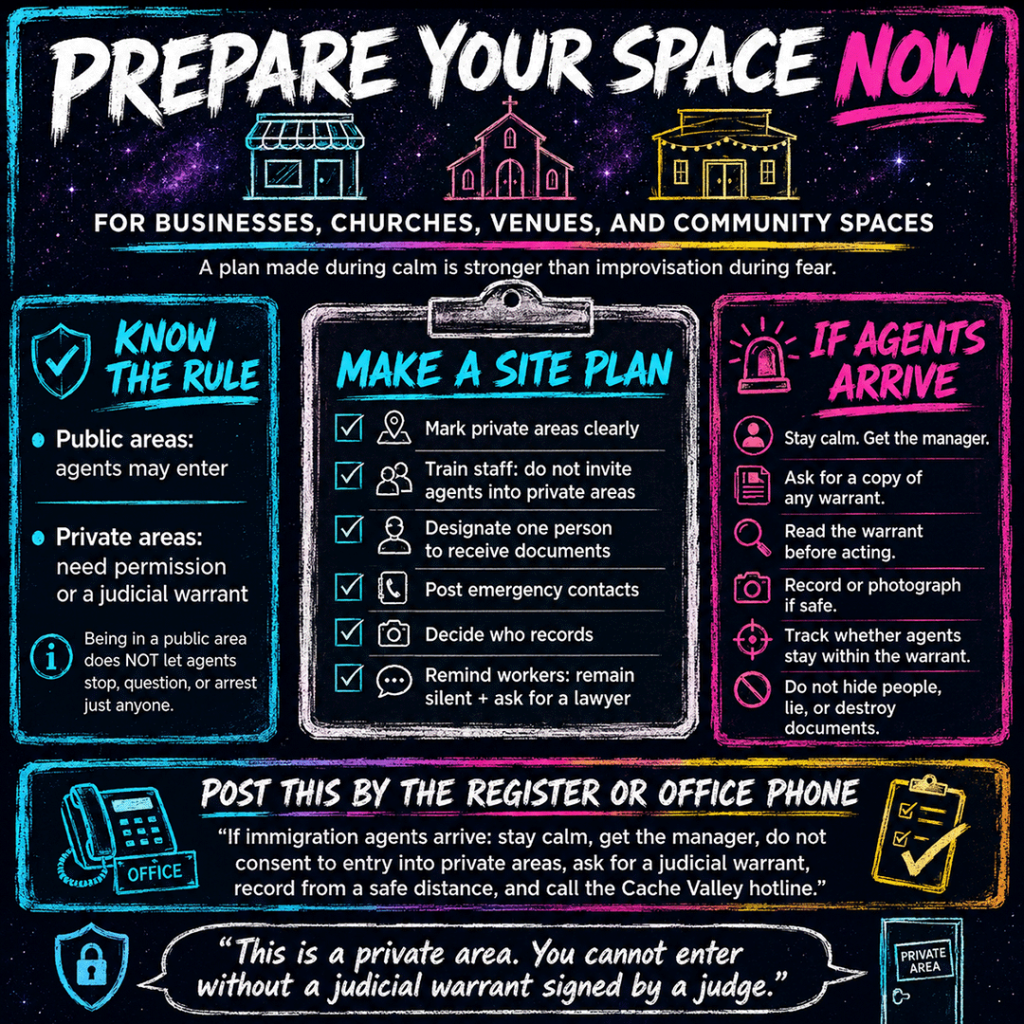
NILC’s employer guidance is useful for any workplace or community venue. It says ICE agents can enter public business areas without permission, but being in a public area does not give ICE authority to stop, question, or arrest just anyone. Private areas require permission or a judicial warrant.
A practical site plan should include:
- Mark private areas clearly.
- Train staff not to invite agents into private areas.
- Designate one person to receive documents.
- Ask for a copy of any warrant.
- Read the warrant before acting.
- Record or photograph the enforcement action if safe.
- Remind workers they have the right to remain silent and ask for a lawyer.
- Do not hide people, lie, or destroy documents.
NILC also says employers can still decline consent to a search even when agents have a judicial warrant, and should track whether agents follow the warrant’s limits.
For Cache Valley, this applies to more than employers. It applies to churches, mutual aid spaces, music venues, restaurants, construction sites, farms, campus-adjacent spaces, and anywhere people gather.
A good policy can simply be a one-page sheet by the register or office phone:
“If immigration agents arrive: stay calm, get the manager, do not consent to entry into private areas, ask for a judicial warrant, record from a safe distance, and call the Cache Valley hotline.”
Should We Use Whistles, Horns, Or Loud Alerts?
We can alert others to ICE activity — whether with voice, whistles, or digital communications — as long as we are not interfering with law enforcement. However, whistles, specifically, are often seen as an escalation tool. Use them only when they reduce risk, not when they add panic, drown out communication, or endanger the targeted person.
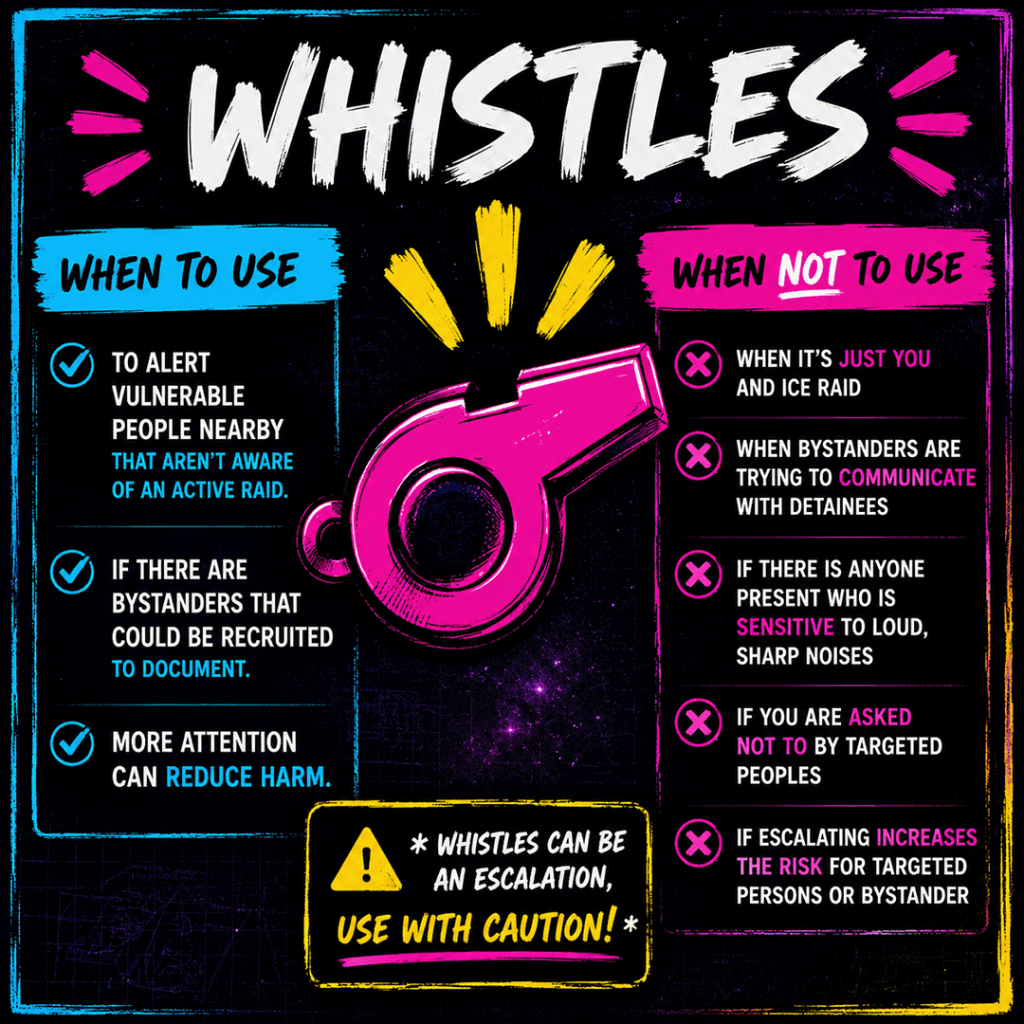
ACLU of Utah says people may notify others of ICE’s presence through vocalization, whistles, horns, other noise-making tactics, or digital communications if they are not otherwise interfering with law enforcement duties.
The local training took a careful harm-reduction approach. Whistles can help when vulnerable people nearby need warning, when other bystanders could be recruited to document, or when more attention may reduce harm. But the training also warned: “Whistles can be an escalation, use with caution.”
Do not use a whistle when:
- The targeted person asks you not to.
- It is just you and agents in an isolated area.
- Bystanders are trying to speak with the detained person.
- A child, baby, trauma survivor, or noise-sensitive person is nearby.
- The noise could escalate danger for the person being detained.
A whistle is not a protest symbol here, it’s a tool. Like all tools, it should be used responsibly and thoughtfully.
What Should We Do During A Traffic Stop Or Vehicle Encounter?
During a traffic stop, we should film if safe, stay calm, ask why we were stopped, provide required driver documents when legally required, avoid answering unnecessary questions, refuse consent to searches, and comply with lawful orders while documenting. Passengers generally have different obligations than drivers.
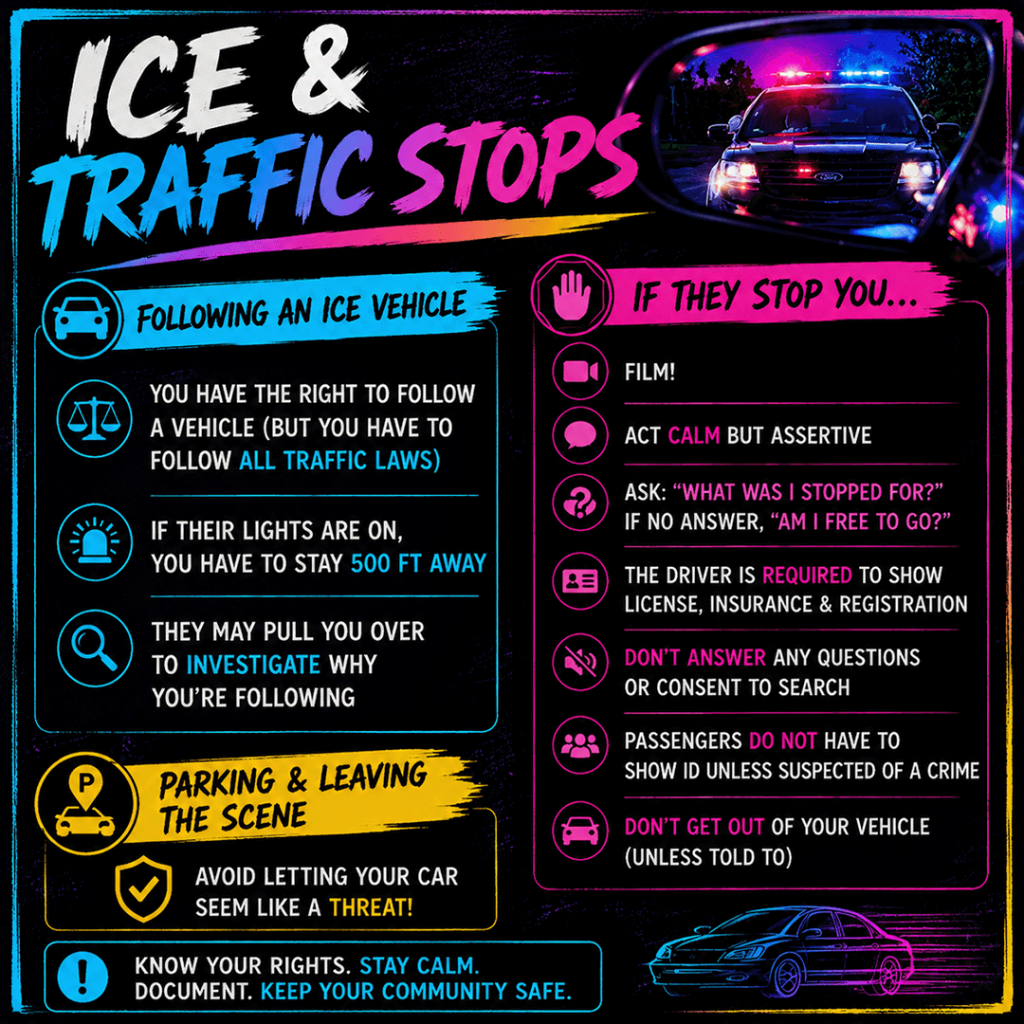
If we are stopped, we should film, act calm but assertive, ask “What was I stopped for?” and if there is no answer, ask “Am I free to go?” A note that drivers are required to show license, insurance, and registration, while passengers do not have to show ID unless suspected of a crime.
The National Immigrant Justice Center similarly advises people to stay calm, not run or resist, keep hands visible, not lie about status, and not provide false documents. It also says undocumented people have the right to remain silent and do not have to discuss immigration or citizenship status with police, immigration agents, or other officials.
For residents following or observing suspected ICE vehicles, the training emphasized that people must follow all traffic laws. The training also emphasized that if emergency lights are on, people must stay 500 feet back.
The vehicle safety rule is simple: do not let your car become the thing agents can call a threat. If arriving near a scene:
- Drive slowly.
- Park legally.
- Leave space.
- Do not block vehicles.
- Do not crowd agents.
- Do not make sudden vehicle movements.
- Film from a safe place.
To put it succinctly: Don’t let your car be seen as a potential weapon.
What Should We Do With Photos And Videos Afterward?
After documenting, we should preserve the original file, back it up, avoid editing the original, avoid posting unverified footage publicly, protect the identity and dignity of detained people, and send footage to trusted legal or rapid-response channels. The goal is usefulness, not virality.
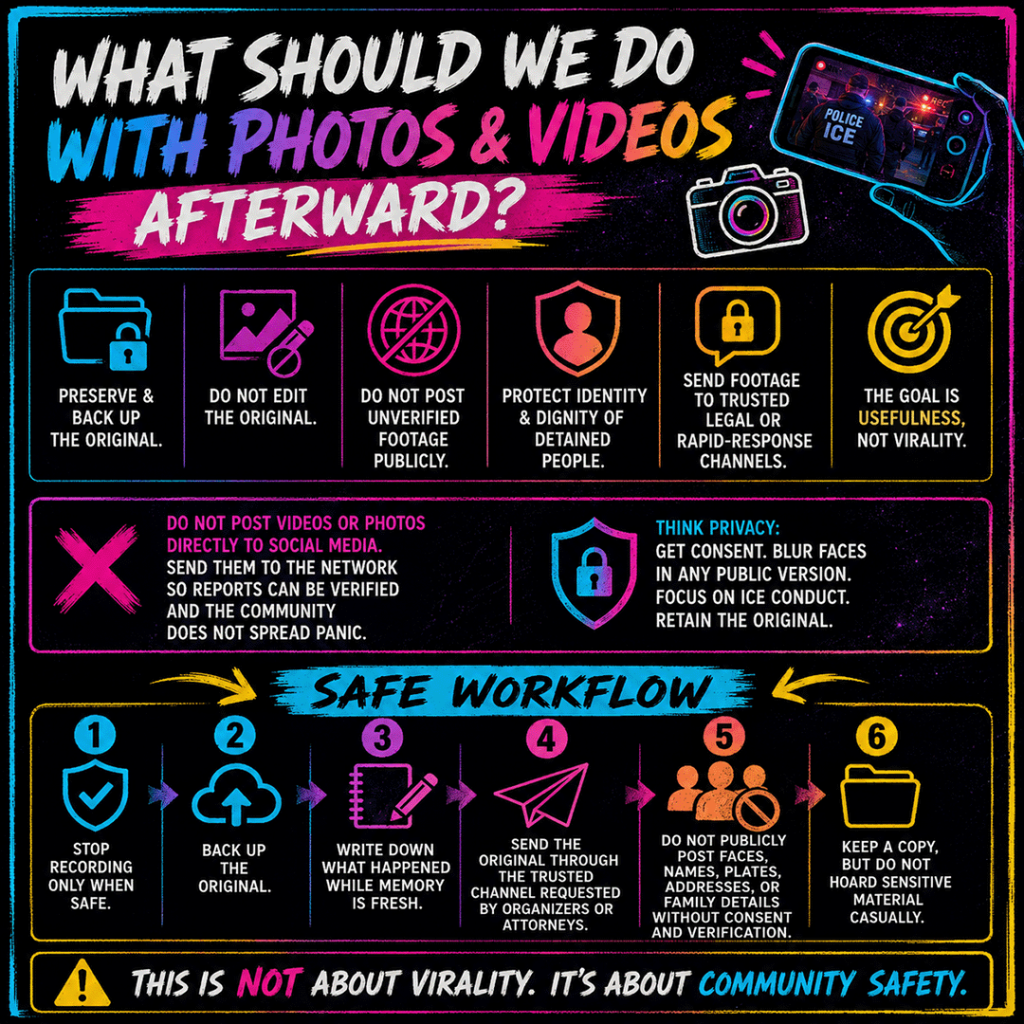
The training was explicit: do not post videos or photos directly to social media; send them to the network so reports can be verified and the community does not spread panic.
EFF adds an important privacy layer: ICE arrests may expose someone’s immigration status or family vulnerability. EFF advises thinking about consent, blurring faces in any public version, and focusing on ICE conduct while retaining the original video.
We should also not modify the original if sharing footage with a lawyer or journalist, because the original may matter in court. It recommends backing up footage immediately and handling sensitive information with care. Residents should use Signal for sensitive communications and delete sensitive data they do not need to carry.
A safe workflow when it comes to pictures and video:
- Stop recording only when safe.
- Back up the original.
- Write down what happened while memory is fresh.
- Send the original through the trusted channel requested by organizers or attorneys.
- Do not publicly post faces, names, plates, addresses, or family details without consent and verification.
- Keep a copy, but do not hoard sensitive material casually.
This absolutely should not be about posting content to social media and all about holding ICE accountable.
How Do We Report ICE Activity In Cache Valley?
Cache Valley residents can report suspected ICE activity to the local hotline at (435) 441-4433 and share information through cv.communitydefense@pm.me. Reports should include SALUTE details when possible, but partial information is still worth reporting.
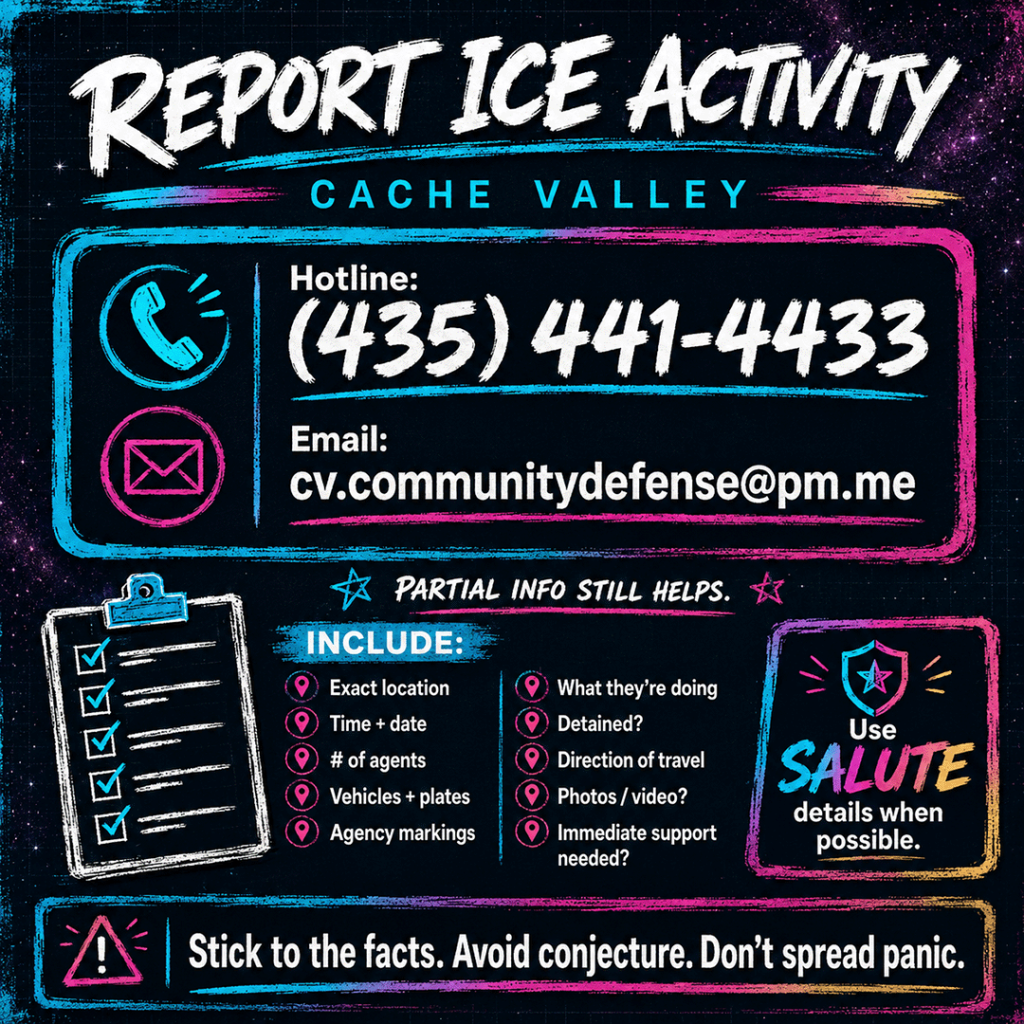
When reporting, include:
- Exact location.
- Time and date.
- Number of agents.
- Number and type of vehicles.
- License plates if visible.
- Agency markings.
- What agents are doing.
- Whether someone was detained.
- Direction of travel.
- Whether you have photos or video.
- Whether immediate support is needed.
Sticking to the facts and avoiding conjecture (or creating a public panic) is one of the most practical ways to help local response networks.
How Can We Support Families After Someone Is Detained?
After someone is detained, the community can help by connecting families with legal support, food, rent support, transportation, childcare, translation, emotional care, and trusted information. The raid is not over when agents leave. For the family, that is often when the crisis begins.
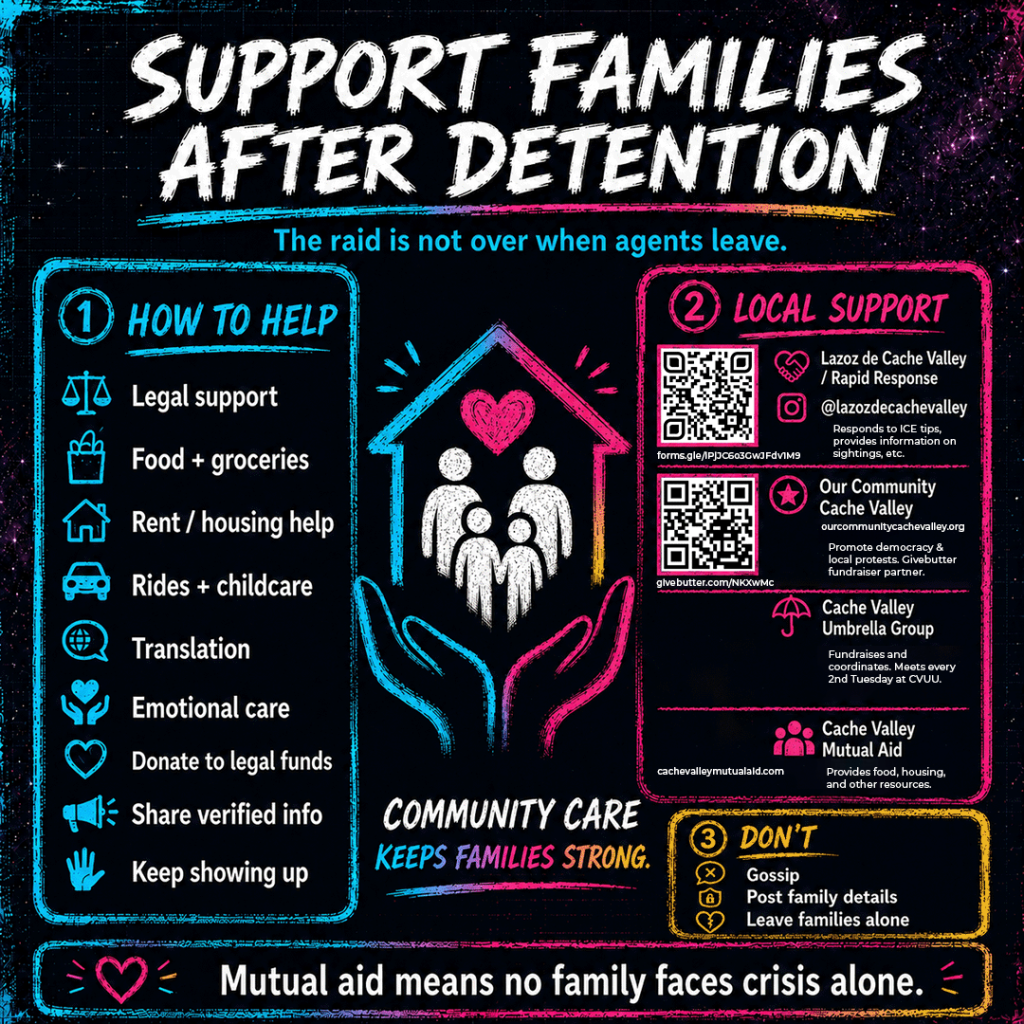
At the training, organizers described families afraid to go back out after a provider was taken. One speaker said some families need groceries delivered or help getting groceries because the trauma and fear make normal errands feel dangerous.
There are several local ways to lend support:
- Lazos de Cache Valley / Cache Valley Community Defense Rapid Response Network
- Instagram: @lazozdecachevalley
- Fundraiser: https://givebutter.com/NKXwMc
- Get Involved: forms.gle/iPjJC6o3GwJFdv1M9
- Cache Valley Mutual Aid for food and housing support.
- Our Community Cache Valley for democracy and protest organizing.
- Cache Valley Umbrella Group, for fundraising and coordination.
- Meets every second Tuesday at CVUU.
A detention can mean rent is due and the primary income is gone. It can mean children need rides. It can mean a spouse is terrified to answer the door. It can mean a family is asked to make legal decisions in a language they do not fully understand while the state applies pressure.
The National Immigrant Justice Center recommends families create safety plans in advance, including emergency contacts, school pickup authorization, written authorization for medical or legal decisions involving children, and knowing how to use ICE’s online detainee locator.
For neighbors, the best ways to help are:
- Bring groceries.
- Donate to legal funds.
- Offer rides.
- Help with childcare.
- Translate (only if qualified).
- Share verified information.
- Do not gossip.
- Do not post family details.
- Keep showing up.
Mutual aid allows neighbors to help each other — and prevent any families from facing a crisis alone.
Frequently Asked Questions About ICE & Bystander Response In Cache Valley
Can We Film ICE In Public In Utah?
Yes. ACLU of Utah says the First Amendment and Utah Code 76-8-305 protect the right to record law enforcement, including ICE, in public spaces while they perform duties in plain view, as long as we do not interfere. If officers tell us to step back, we should step back and keep recording.
Should We Post ICE Videos On Social Media?
Usually, no. The local training says not to post videos or photos directly to social media and to send them to the network for verification instead. This protects targeted people’s privacy, reduces panic, and preserves footage for legal or accountability use.
What Is The Difference Between An ICE Warrant And A Judicial Warrant?
A judicial warrant is issued by a court and signed by a judge or magistrate. An ICE or administrative warrant is issued by an agency such as DHS and may be signed by an immigration officer or immigration judge. NILC says administrative warrants generally do not authorize searches of nonpublic areas.
What Should We Say If ICE Comes To Our Door?
Do not open the door just to talk. Ask agents to slide the warrant under the door or show it through a window. Check whether it is signed by a judge and names the correct address. NILC and NIJC both emphasize that people have the right to remain silent and speak with a lawyer before signing anything.
What Information Should We Try To Get If Someone Is Detained?
If safe, try to get the person’s full name, date of birth, and contact information for a loved one or lawyer. The Cache Valley training says this can help family members and support networks locate the person and connect them with legal help. Be careful not to expose another vulnerable person.
What If We Only Saw Part Of What Happened?
Report it anyway. The Cache Valley training emphasized that partial tips still matter because multiple partial reports can reveal a pattern. Use SALUTE if possible: size, activity, location, uniform, time, and equipment.
So, What Should We Do If We See ICE In Cache Valley?
If we see ICE or suspected immigration enforcement in Cache Valley, we should stay calm, stay back, record from a safe distance, document SALUTE details, remind people of their rights without interfering, and report verified information to the Cache Valley hotline at (435) 441-4433. We should not post unverified footage, block agents, lie, or turn someone else’s trauma into content. The work can be difficult, but is simple at its core: document state power, protect neighbor dignity, and make sure families are not left alone after someone is taken.
If we are not sure what to do, then we should do the safest useful thing: film, report, and stay out of the way. If we want to do more, then save the hotline number, prepare our phone, learn the basic rights phrases, and plug into the local rapid response or mutual aid network before the next crisis arrives.
- Lazos de Cache Valley / Cache Valley Community Defense Rapid Response Network
- Instagram: @lazozdecachevalley
- Fundraiser: https://givebutter.com/NKXwMc
- Get Involved: forms.gle/iPjJC6o3GwJFdv1M9
- Cache Valley Mutual Aid for food and housing support.
- Our Community Cache Valley for democracy and protest organizing.
- Cache Valley Umbrella Group, for fundraising and coordination.
- Meets every second Tuesday at CVUU.