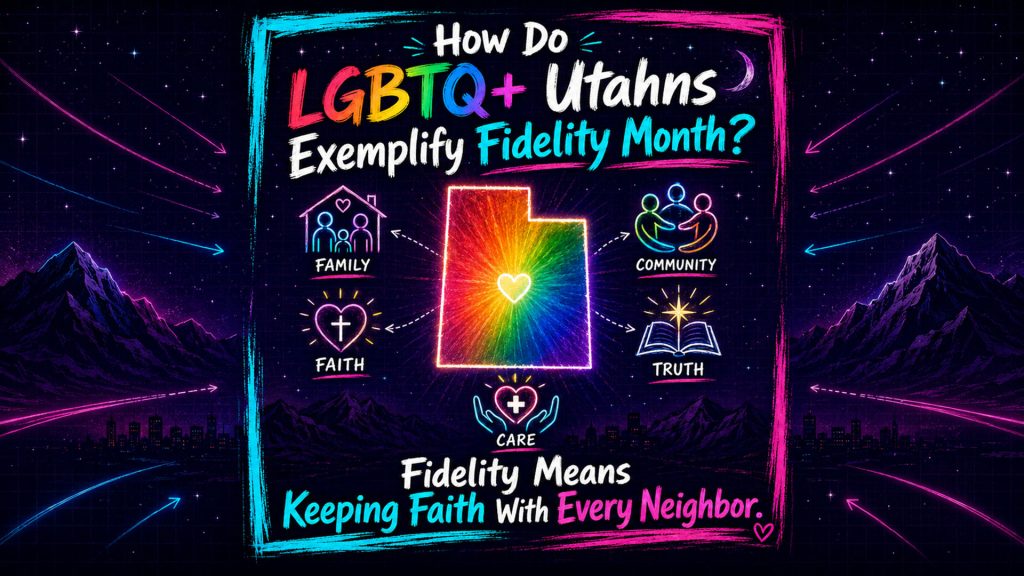
Utah’s LGBTQ+ communities exemplify Fidelity Month by practicing faithfulness to family, community, truth, and care. If fidelity means keeping promises , making commitments, and being faithful, Pride Month is not the opposite of fidelity — it is one way Utahns practice it. LGBTQ+ people do not exist outside of fidelity — they are among its clearest teachers.
TLDR – Utah’s LGBTQ+ Communities & Pride Month Exemplify “Fidelity”
- Fidelity means keeping faith with every neighbor.
- LGBTQ+ Utahns already embody faith, family, and care.
- Pride Month is not anti-fidelity — it is fidelity.
- Family values must include every kind of family.
- Faith without compassion becomes control.
- Timing Fidelity Month during Pride risks erasure.
- LGBTQ+ youth need reliable love, not public shame.
- Utah’s LGBTQ+ groups are doing civic repair work.
- Real fidelity names who belongs (hint: everyone) clearly.
- The next faithful step is practical support for all Utahns.
Who Really Represents “Fidelity” in Utah?
If Utah is going to spend June talking about fidelity, we should start with the people who have kept faith after being told they did not belong.
According to KSL and the Deseret News, Gov. Spencer Cox declared June 2026 “Fidelity Month” in Utah as several red states embraced conservative alternatives to Pride Month. Sen. Mike Lee’s office described the national push as a celebration of “faith, family values, and patriotism.” The official Fidelity Month movement says it is about rededicating ourselves to God, spouses and families, communities, and country.
But if fidelity means faithfulness, Utah’s LGBTQ+ people have a lot to teach us. They have kept faith with families that did not always know how to love them well. They have kept faith with churches that sometimes treated them like problems to manage. They have kept faith with communities that needed their labor, art, service, kindness, taxes, music, care, and courage — even while those communities debated their value and rights.
And many of them have done it without becoming cruel.
This is not an argument against fidelity — nor is it an argument against faith, family, country, and community. It is an argument that those words already include, and are exemplified by, Utah’s LGBTQ+ people.
How Do Utah’s LGBTQ+ Communities Exemplify Fidelity Month?
Utah’s LGBTQ+ communities exemplify Fidelity Month by keeping faith with family, country, community, truth, care, and God. They build support systems, protect vulnerable youth, serve neighbors, sustain families, preserve spiritual belonging, and ask Utah to live up to its own stated values.
The question is not whether LGBTQ+ Utahns fit inside fidelity. They already do. The better question is whether our public definition of fidelity is actually in line with that ethos.
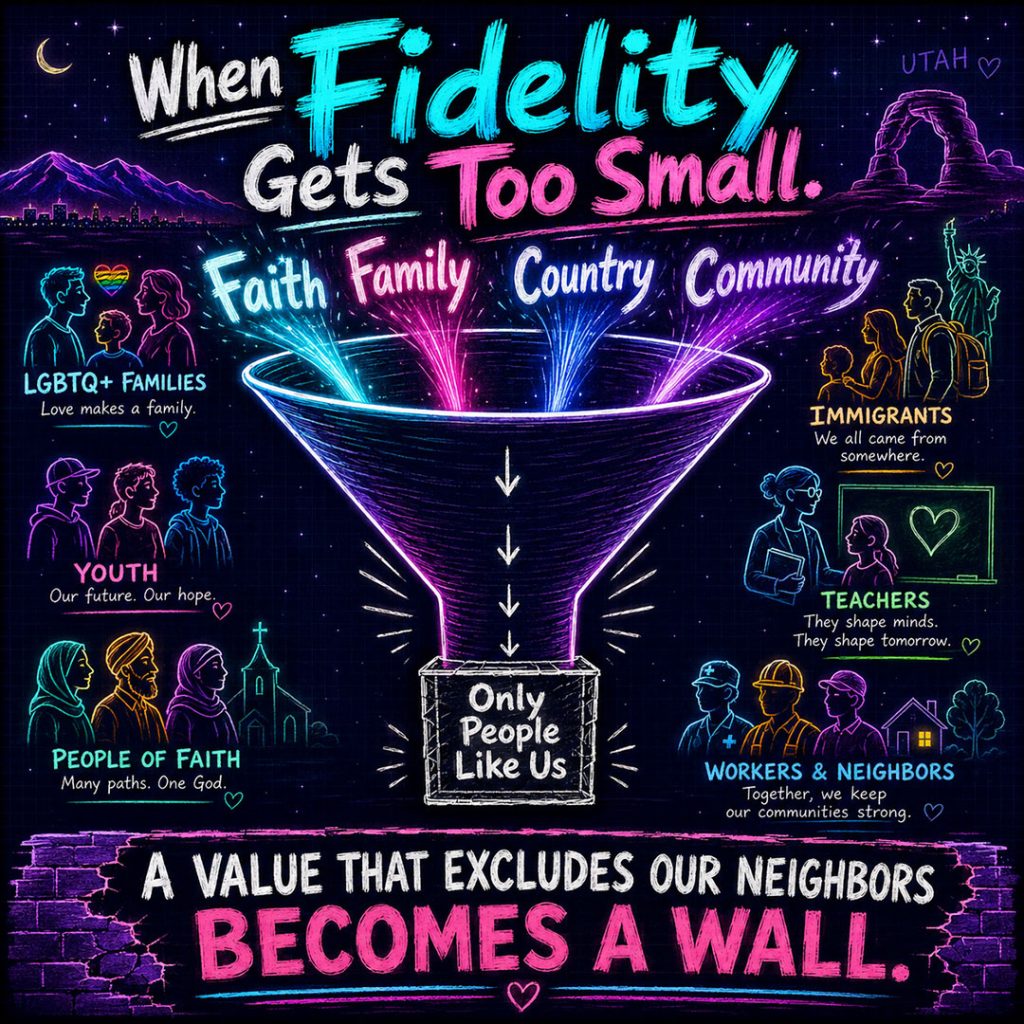
This matters because moral language can either open a door or build a wall. “Family” can mean every family trying to stay safe, loved, fed, housed, and whole. Or it can become a manipulative way to only include certain families. “Faith” can mean humility, service, repentance, and love. Or it can become a costume for control. “Country” can mean every neighbor who lives, works, worships, teaches, nurses, farms, cooks, creates, and pays taxes here. Or it can become a dog whistle that keeps people out.
Fidelity is not proven by narrowing our social and civic circles. Fidelity is proven by keeping faith with all our neighbors and community members — even people we think should not be included. Especially people we don’t think should be included.
And our own LGBTQ+ residents are showing us how to do this better than anyone. I have personally seen them welcome straight people, Christians, Mormons, conservatives and the like into their spaces — including Pride — offering hugs, love, and support.
That is why LGBTQ+ Utahns belong in any kind of Fidelity Month representation.
What Is Fidelity Month In Utah?
Fidelity Month is a June observance promoted as a recommitment to faith, family, country, and community. In Utah, Gov. Spencer Cox’s 2026 declaration landed during Pride Month, which made many LGBTQ+ Utahns hear it less as unity and more as erasure.
KSL and the Deseret News reported that Cox joined Arkansas in recognizing June as Fidelity Month while red states looked for conservative alternatives to Pride Month. The official Fidelity Month site frames the movement around fidelity to God, spouses and families, communities, and country. QSaltLake published the Utah proclamation language, which emphasized faith, family, and country.
Supporters may sincerely see this as a positive moral project. There are no doubt people using the phrase earnestly — instead of manipulatively or maliciously. Plenty of people hear “fidelity” and think of loyalty, marriage, sacrifice, church, parenthood, and civic responsibility.
But impact still matters.
Project Rainbow Utah criticized the declaration as a “slap in the face” to LGBTQ+ Utahns. That reaction is not hard to understand. June is already Pride Month. For LGBTQ+ people, Pride is not just glitter, flags, parties, and parades. Pride is memory. Pride is survival. Pride is grief. Pride is a teenager seeing, maybe for the first time, that they might have a future.
So when public leaders use June to elevate “faith, family, and country” without clearly naming LGBTQ+ people as part of those values, the omission feels pointed. After all, real fidelity includes all Utahns.
And the truly faithful response to that hurt should not be defensiveness, but listening.
Why Does The Timing Matter During Pride Month?
The timing matters because Pride Month already carries deep meaning for LGBTQ+ people, especially in places where belonging has been contested. Replacing, reframing, or overshadowing Pride with Fidelity Month risks telling LGBTQ+ Utahns that their visibility is conditional and their families are secondary.
Anyone with a sense of empathy, sympathy, compassion, love, or kindness should immediately see the problem.
Utah has had years of tension around LGBTQ+ visibility. Cox previously faced criticism for Pride-related statements that avoided naming LGBTQ+ people directly. Utah also passed a 2025 law restricting Pride flags in schools and government buildings, which led Salt Lake City to adopt new official city banners incorporating Pride symbolism.
In 2023, Utah banned most gender-affirming care for minors. The Associated Press later reported that a state-commissioned study contradicted key claims used to justify that ban, finding positive mental health and psychosocial outcomes tied to care.
That is the environment LGBTQ+ Utahns are living in.
So if a leader says “fidelity” in June, while LGBTQ+ people are losing public symbols, medical options, and straightforward recognition, it begs the question:
Faithful to whom?
If we care about fidelity, we should care about the treatment of those in our communities and spheres of influence. We should want a community that is rich and diverse. A low-fidelity speaker distorts music. And low-fidelity politics distorts the people. It takes a full human community and compresses it into one acceptable note.
Utah is bigger than that.
How Do LGBTQ+ Utahns Show Fidelity To Family?
LGBTQ+ Utahns show fidelity to family by building loving marriages, raising children, caring for relatives, sustaining families, and helping parents become safer. Their family life is not an exception to family values. It is one of the places family values become real.
Point blank: LGBTQ+ people have families. They are family members.
They are spouses. Parents. Children. Siblings. Aunts. Uncles. Cousins. Grandparents. Caregivers. Foster parents. Adoptive parents. Stepparents. Godparents. Emergency contacts. Meal train organizers. Hospital visitors. The person who drives across town at midnight because someone’s kid is scared.
The Williams Institute has estimated that more than 2.5 million LGBTQ adults in the U.S. are parenting children. Its research has also found that same-sex couples raising children are more likely than different-sex couples raising children to be raising adopted or foster children.
It does not get more pro-family than that!
And in Utah, this point carries extra weight because we come from a culture that often treats family as sacred. Many of us learned early that family is not disposable. We learned to show up. We learned to bring food. We learned to help people move. We learned to sit in hospital rooms. We learned to care for children who were not biologically ours.
Now we have to apply those values consistently.
If a gay couple adopts a child who needs a safe home, that is fidelity to family. If a trans adult stays connected to parents who are still learning, that is fidelity to family. If a queer sibling keeps showing up to family dinner even when every conversation requires courage, that is also fidelity to family. If parents join Mama Dragons and learn how to affirm their LGBTQ+ children, that, too, is fidelity to family.
The Family Acceptance Project has found that family acceptance protects LGBTQ+ young people against depression, substance abuse, and suicidal behavior. Its work is especially important because it helps families support LGBTQ+ children within their own cultures and faith communities.
So the question is not whether or not we support families. It’s whether we’re willing to protect all family members and all families — even if they look a little different than ours.
How Do LGBTQ+ Utahns Show Fidelity To Faith?
LGBTQ+ Utahns show fidelity to faith by seeking truth, preserving spiritual belonging, building affirming religious spaces, and refusing to be silenced. Many stay connected to God, conscience, prayer, service, and community even though religious institutions often make that costly.
Those of us shaped by Mormon culture should understand this better than almost anyone.
We know what it means to be misunderstood. We know what it means to have outsiders reduce our beliefs to caricature. We know what it means to be told our family structures, rituals, garments, temples, missions, scriptures, or language make us strange.
That memory should make us more protective of minority belonging, not less.
LGBTQ+ people of faith are often doing something profoundly difficult. They are holding together identities that other people keep trying to rip apart. They are asking whether God is bigger than the box some people say He is. They are building earnest lives out of prayer, ache, honesty, and hope.
Affirmation, an organization for LGBTQ+ Mormons, families, and friends, describes its work as creating communities of safety, love, and hope that promote understanding, acceptance, and self-determination. Mama Dragons began with mothers, many from Latter-day Saint backgrounds, learning how to support and celebrate LGBTQ+ children. Today, Mama Dragons says it serves a community of more than 25,000 parents.
That is fidelity.
Not the shallow kind that confuses obedience with love, but a deeper kind that doesn’t abandon children to serve a status quo or traditional way of life that never actually reflected the reality of the universe.
We do not all have to agree on doctrine to agree on care. A church can hold its beliefs. A parent can wrestle with their faith. A family can take time to heal. But none of that requires contempt. None of that requires humiliation. None of that requires turning a child into a theological battleground.
Things that help people love, thrive, grow, and stay alive are worth championing. Things that produce shame, isolation, fear, and despair should make us pause.
How Do LGBTQ+ Utahns Show Fidelity To Community And Country?
LGBTQ+ Utahns show fidelity to community and country by organizing support, building safer spaces, serving neighbors, strengthening civic life, and asking public institutions to become more trustworthy. They are not asking to be outside Utah. They are asking Utah to recognize who already belongs here.
Look at the actual work happening.
The Utah Pride Center describes its work as uniting, empowering, and celebrating Utah’s diverse LGBTQIA+ community. Its history traces decades of local advocacy, including community-building, outreach, anti-violence work, AIDS awareness, and Pride organizing.
Encircle provides free therapy, programs, and community for LGBTQ+ youth, young adults, parents, and allies across five Utah locations. Project Rainbow Utah raises funds, supports visibility, and provides community support through its Community Fund. Equality Utah educates the public, develops young advocates, and supports emerging LGBTQ+ leaders.
That is civic fidelity.
It is the slow, continuous work of keeping people connected. It is the work of answering the phone. Creating the group. Hosting the event. Finding the therapist. Training the volunteer. Raising the money. Putting up the flag. Building the spreadsheet. Sitting with the parent. Checking on the teenager.
It is also the work of telling the truth when public power hurts people.
This is what real fidelity in Utah looks like. Public leaders are not faithful when they use broad moral words while affected communities feel erased. They are faithful when they listen, repair, clarify, and change what needs changing.
That same principle applies far beyond Pride. It applies when we ask what to do if we see ICE. It applies when we consider who gets to come into this country and build a life here. It applies whenever a community rallies together for its members — whoever they may be.
A faithful country is not one where everyone looks the same. A faithful country is one where people can live honestly and still be protected by the promises of the Constitution. A faithful country allows people of all kinds, from all walks of life, to live life authentically, enjoy liberty, and earnestly pursuit happiness.
What Would Real Fidelity To LGBTQ+ Youth Require?
Real fidelity to LGBTQ+ youth requires safer homes, safer schools, affirming adults, accurate information, mental health support, and policies shaped by evidence instead of fear. We do not protect young people by discouraging honesty and authenticity. We protect them by giving them a place to belong alongside us.
A young person should not have to choose between being themselves and being loved. They should not have to calculate whether one sentence at the dinner table will cost them their home, church, friends, school safety, or future.
The Trevor Project’s 2024 national survey found a significant association between anti-LGBTQ+ victimization and higher suicide risk. In 2026, reporting on Trevor’s newer findings highlighted the same basic pattern: accepting communities are protective, while hostile environments create harm.
The Family Acceptance Project has been saying this for years. Acceptance is not a decorative word. It changes health outcomes. So if we want fidelity to family, we need family practices that lower danger.
Here is the practical version:
| If We Value | We Should Practice | We Can Start By |
|---|---|---|
| Family | Reliable love | Tell LGBTQ+ youth they will not lose us |
| Faith | Humble care | Stop using God as a threat |
| Community | Visible safety | Support affirming spaces and events |
| Country | Equal protection | Oppose laws that target harmless difference |
| Truth | Evidence-led policy | Listen to LGBTQ+ people and health experts |
| Freedom | Authentic selfhood | Protect conscience for everyone |
This does not require every family to resolve every disagreement or difference in beliefs overnight. But it does require adults to act like adults.
We can wrestle privately without making children carry our fears and concerns. We can ask questions without interrogating. We can hold beliefs without cruelty. We can learn before legislating. We can slow down before posting. We can decide that no doctrine, party, or public slogan is worth making a child — or any human — feel disposable.
That is fidelity.
How Can We Practice Fidelity To LGBTQ+ Neighbors This Month?
We can practice fidelity to LGBTQ+ neighbors by being a safe space, holding institutions accountable, and shining a light on harmful public policy. The goal is not to win a culture war, but to make Utah safer, kinder, freer, and more responsible for people already here.
If Fidelity Month means anything useful, it should give us a way to act immediately. Here are concrete ways Governor Cox and our state leaders can do just that.
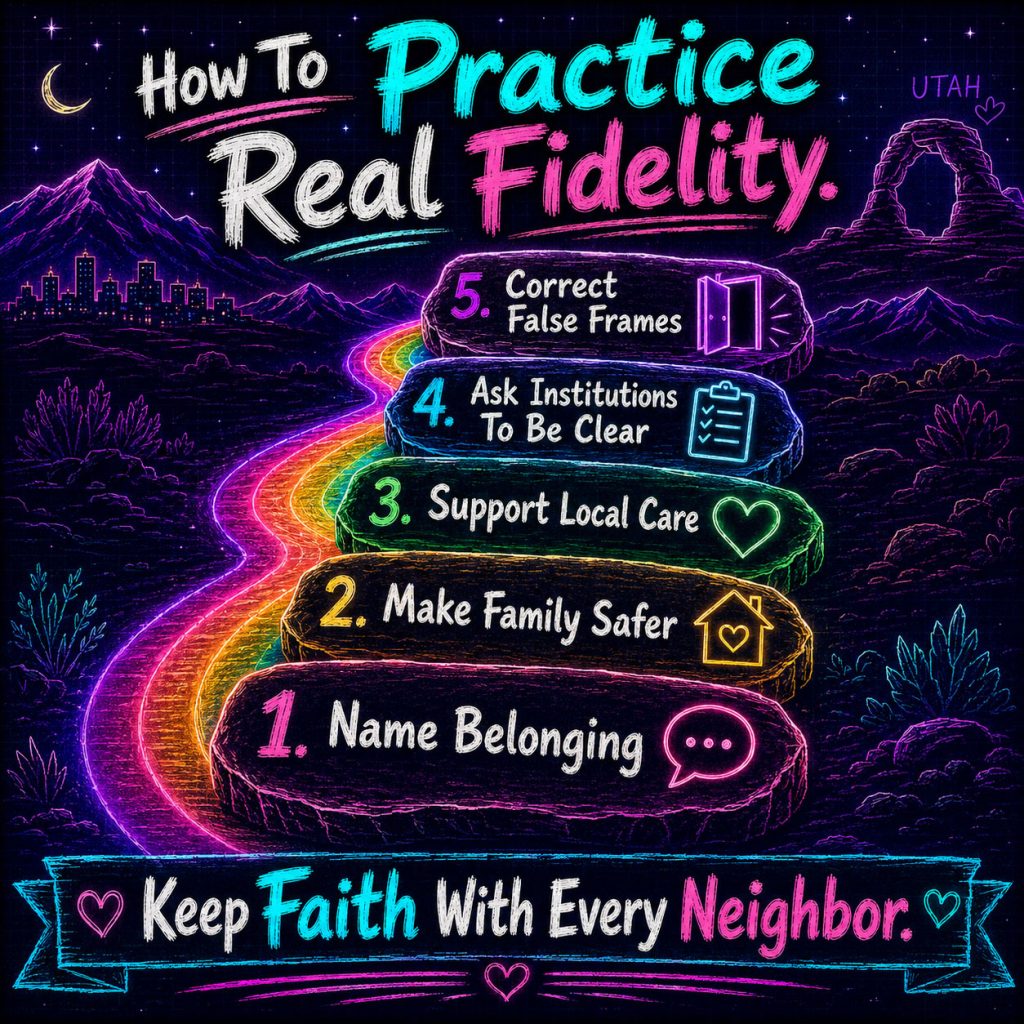
Step 1: Name LGBTQ+ People As Part Of Faith, Family, And Country
If someone says Fidelity Month is about faith, family, and country, we can answer warmly and clearly: “Yes — and LGBTQ+ people are part of all three.” This breaks the false dichotomy that these things cannot co-exist (when they are actually deeply connected). This isn’t a mockery of anyone’s values, it’s simply the reality of what those values actually are.
Step 2: Make Our Family A Safe Space
Ask yourself, and your loved ones, if LGBTQ+ people are realistically safe inside your family. Then make that safety visible. Invite them to family gatherings. Defend them at dinner. Call out cruel jokes. Tell them they are loved without having to plead for recognition and care.
We don’t need perfect language — simply safe, reliable, comforting, affirming love.
Step 3: Support One Utah LGBTQ+ Organization
Pick one local organization and give something practical. Support the Utah Pride Center. Donate to Encircle. Buy a flag from Project Rainbow Utah. Follow Equality Utah. Share Mama Dragons with a parent who is trying. Send Affirmation to someone navigating Mormonism and LGBTQ+ identity. Money helps. So does visibility. So does showing someone where to find help and support before they’re in crisis.
Step 4: Hold Institutions Accountable
If we belong to a church, workplace, school, venue, nonprofit, or city group, we can ask a simple question: “How do LGBTQ+ people know they are safe here?” Which is a very different question than asking if you’re being nice or if you mean well. Real support and safety means having a visible nondiscrimination policy, reporting pathway, inclusive family language, staff training, resources, visible support online and offline, a youth safety plan, and a leader willing to stand up for others even when it’s not popular to do so.
Step 5: Correct One False Frame
When someone treats LGBTQ+ visibility as anti-family, we can answer that with facts and empathy. LGBTQ+ people have families. LGBTQ+ people strengthen communities. LGBTQ+ youth do better when accepted. LGBTQ+ adults serve, teach, parent, work, worship, volunteer, and love. Pride is not the opposite of fidelity. Pride is fidelity in action. So say so.
Do Fidelity Month Supporters Actually Realize What They’re Doing?
There is certainly an argument to be made that Fidelity Month supporters may not believe they are excluding LGBTQ+ people at all. They may say they are simply affirming faith, marriage, family, patriotism, and civic virtue during a time of cultural fragmentation. However, when confronted with the lived experiences of people they are excluding — whether intentionally or unintentionally — they must humble themselves and listen. If they do not, they are not practicing fidelity.
Certainly, there are people who sincerely worry that society is losing a shared moral language. There are parents who feel disoriented by rapid cultural change. There are religious people who feel mocked by progressive spaces. There are conservatives who hear “Pride Month” and assume it means their own values are being pushed out.
The problem is that public values are not measured only by intent. They are measured by who gets protected, who gets heard, and who pays the cost when good intentions have harmful outcomes.
If Fidelity Month is truly about family, then LGBTQ+ families must be included. If it is truly about faith, then LGBTQ+ people of faith must be honored. If it is truly about country, then LGBTQ+ citizens must be protected. If it is truly about community, then LGBTQ+ organizations must be treated as community builders, not culture-war threats.
That is fidelity.
Frequently Asked Questions About LGBTQ+ Utahns And Fidelity Month
What Is Fidelity Month In Utah?
Fidelity Month in Utah is Gov. Spencer Cox’s June 2026 declaration calling Utahns to recommit to faith, family, and country. Supporters frame it as a unity effort. Critics see its timing during Pride Month as a signal that LGBTQ+ visibility is being displaced.
Are Pride Month And Fidelity Month Opposites?
No. Pride Month and Fidelity Month only become opposites if fidelity is defined narrowly. If fidelity means keeping faith with family, community, truth, and human dignity, then Pride can be understood as a public act of fidelity to LGBTQ+ life and belonging.
How Do LGBTQ+ People Show Fidelity To Family?
LGBTQ+ people show fidelity to family by loving partners, raising children, caring for relatives, sustaining chosen families, and helping families become more honest. Their lives do not weaken family values. They reveal whether our family values are consistent.
How Can Christians Practice Fidelity During Pride Month?
Christians can practice fidelity during Pride Month by loving LGBTQ+ neighbors without contempt, protecting children from shame, listening before judging, supporting family acceptance, and refusing to use faith as a reason to make people less safe, less free, or less welcome.
What Can We Do This Week To Support LGBTQ+ Utahns?
This week, we can support LGBTQ+ Utahns by making ourselves a safe space, donating to one local LGBTQ+ organization, correcting false claims, sharing affirming resources, and holding institutions accountable for how they impact LGBTQ+ people.
How Should Public Leaders Talk About Fidelity Month?
Public leaders should talk about Fidelity Month by clearly including LGBTQ+ people as part of Utah’s families, faith communities, neighborhoods, schools, workplaces, and civic life. If a declaration meant to unite people makes some residents feel erased, leaders should listen and repair.
So, How Do Utah’s LGBTQ+ Communities Exemplify Fidelity Month?
Utah’s LGBTQ+ communities exemplify Fidelity Month by keeping faith with family, truth, community, country, and care — often after those same values were used to exclude them. They build support systems, protect youth, preserve spiritual belonging, strengthen civic life, and remind us that fidelity is bigger than tradition alone.
If Fidelity Month becomes a substitute for Pride Month, it will fail its own name. But if it becomes an invitation to keep faith with every neighbor, then LGBTQ+ Utahns are not a challenge to fidelity. They are a living example of it. And whenever people try to claim otherwise, we should push back.
So, share this article with someone who uses the word “fidelity” narrowly — and ask them to grow their concept of fidelity into something that truly honors family, truth, community, country, care, and God.