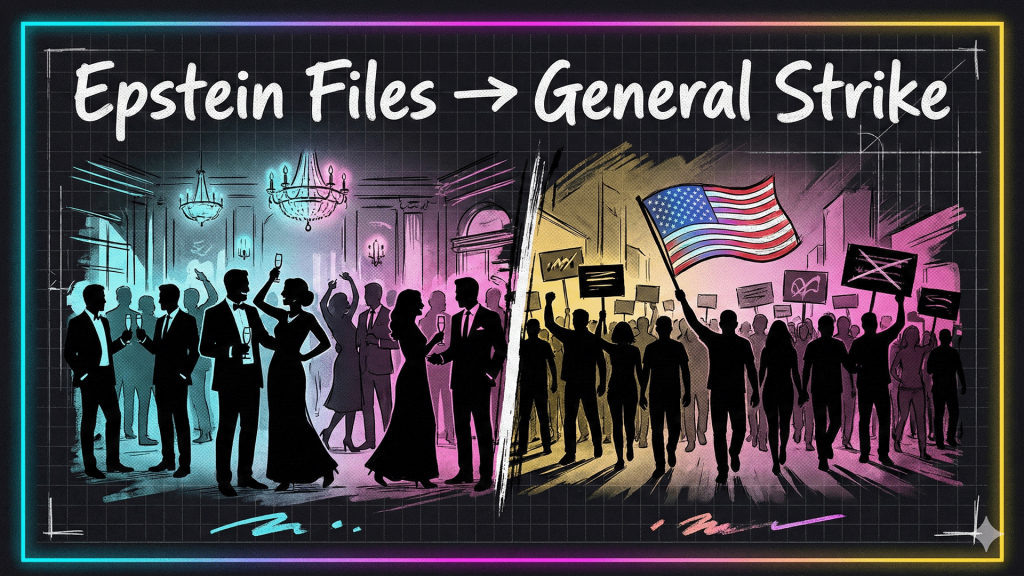
TLDR – Why We NEED a General Strike to Address the Epstein Files
- If leaders are coercible, they’re not leaders — they’re liabilities.
- The Epstein story is bigger than Epstein — it’s about access, leverage, and impunity.
- This isn’t left vs right. It’s the protected vs the disposable.
- A general strike only works with specific, measurable demands.
- Voting isn’t a viable plan when incentives stay corrupted.
- Nonviolence isn’t passivity — it’s disciplined leverage.
- A strike needs logistics: mutual aid, comms, legal support, and redundancy.
- Demands must include accountability, governance reform, and economic structure change.
- Sortition and polycentric governance increase representation and better protect freedoms.
- Your next step: Join or build a local strike-capable network in your community.
When Leadership Stops Listening
You’re on your phone again. It’s late. Your brain is tired, but it won’t let go. You scroll past another headline about the Epstein Files, another thread, another breaking news update, another argument about what it all means. And you just feel sick to your stomach.
Then you look at what the people who are supposed to be steering the ship are doing — CEOs, governors, senators, agency heads, party leaders, media gatekeepers. And it doesn’t seem like any of them are treating this with the weight it deserves.
In fact, even going beyond the Epstein Files, it doesn’t seem like they have a single clue about what life is like for you, your familiy, your friends, and your coworkers.
Seeking Accountability, Finding Nothing
Those feelings aren’t unique. Most Americans are feeling that way right now — regardless of political affiliation. We’re not asking for perfection or saints. We’re just asking for the basics: truth, accountability, and a system that protects kids and vulnerable people instead of powerful men.
But what we keep seeing over and over is that the ruling class can’t hear us. Or worse, they can hear us and they just don’t care. They treat our fears like a passing mood, our anger like a personal failing, and our morals like negotiable details.
They’re treating us like an abusive, predatory partner. But guess what? When a system protects predators, it doesn’t deserve our trust. And when people are observably abusive or coercive, they forgo the benefit of the doubt.
I understand that can be a hard realization to digest. If everyone at the top is complicit — or protecting those who are — then what are we even standing on? What’s real? What’s safe? What future are we walking into?
But stability doesn’t come from the people who insist they run things. It comes from each other — from our solidarity, structure, and community. It comes from ordinary people deciding coming together to build a better future for everyone.
The Epstein Files Reveal a Compromised Ruling Class
When people say “the Epstein Files,” most people mean a list of names. But the deeper revelation isn’t a roster. It’s systemic behavior around power. It’s how institutions move when the people at risk are powerless, and the people implicated are rich.

What “Compromised” Actually Means
A ruling class is compromised when accountability becomes optional for insiders.
That can happen through direct participation in harm. It can also happen through protection, silence, and leverage. It just needs proximity, favors, and secrets. It needs enough people who fear consequences more than they fear injustice.
That’s how a network, or even a society, rots: By rewarding complicity through silence. As the saying goes: “The only thing necessary for the triumph of evil is for good men to do nothing.”
That statement continues to prove true. If the system can’t protect the vulnerable, it will protect the powerful.
The Release Itself is Part of the Story
On January 30, 2026, the U.S. Department of Justice released over three million pages, plus thousands of videos and a large volume of images in supposed compliance with the Epstein Files Transparency Act.
However, Reuters reported that investigators found over a million additional documents that could be relevant. That discovery pushed timelines again. The DOJ framed the delay around volume and necessary victim-protective redactions. And they emphatically denied they were shielding U.S. President Donald J. Trump from scrutiny.
Some of those reasons can be real. Survivors deserve privacy. Ongoing cases can require care. Redactions can protect people who never asked to be public.
But the pattern still matters. When transparency arrives late, incomplete, and blacked out, it’s hard to take it at face value. Even if parts of it are valid, it certainly feels like someone is trying to control the narrative.
What This Reveals About Elite Impunity
The Epstein case isn’t only about who did what. It’s about what happens when elites get close to harm. The question becomes: does the system isolate the harm, or does it absorb it at the cost of others well-being?
In practice, systems that protect insiders use familiar moves. They create procedural fog. They promise accountability “soon.” They release enough to claim openness, and not enough to resolve the core questions. They push the public into either cynicism or hysteria, then call both “extremes.”
But none of this actually lends itself to trust or legitimacy. People believe, with good reason, that different rules apply at the top. It’s hard not to feel appalled when watching people and institutions protect their own reputations faster than they protect kids.
A compromised leadership class doesn’t need everyone to be guilty. It only needs enough people to be trapped by what they did, saw, or benefited from.
And when people are trapped, they protect each other — whether out of loyalty or self-preservation, it doesn’t matter.
The Only Way Out is Measurable Accountability
If we want accountability, we need independent oversight. We need clear timelines. We need transparent rules for what gets redacted and why. We need reporting that the public can audit, not just be told to trust.
Otherwise, this becomes another ritual. Another file dump, a resulting media spotlight, partisan controversy, and then… nothing. Everyday Americans learn that nothing changes and no one will be held accountable. And those at the top learn that they can get away with literally anything — and to just wait it out.
That’s the real threat here: What getting normalized and at what cost.
The Ruling Class is Woefully Out of Touch With Reality
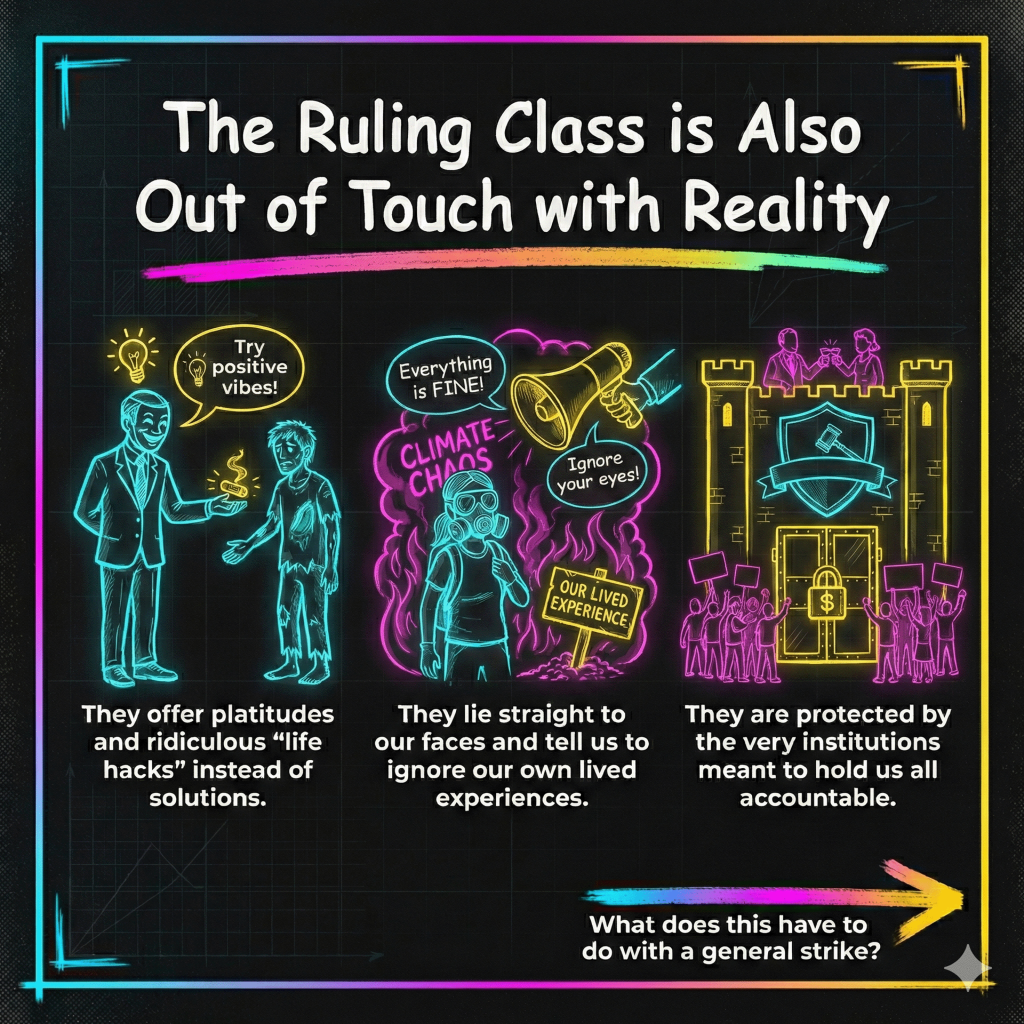
When people call leaders out of touch, it can sound like a petty critique. Like we’re mad they said something awkward. But it reveals a certain insulation from consequence — the kind that lets you harm people, then go to bed at night without a care in the world.
Insulation changes how you speak, what you notice, what you dismiss, and whether you change or stay stagnant. Once leaders stop feeling their foundations shake, they start confusing comfort with correctness.
Put simply, our leaders in both public and private sectors have become woefully detached from the reality of everyday Americans — and many of them truly don’t seem to realize it.
Corporate Detachment is Elitist Irresponsibility
In February 2024, CBS News covered WK Kellogg CEO Gary Pilnick suggesting cereal for dinner. He framed it as an affordable option during inflation. Most people didn’t care if it was affordable. They heard a wealthy executive offering lackluster survival hacks in place of actual solutions.
That backlash wasn’t fragile — nor should it have been. When families struggle, they want relief and accountability. They don’t want pathetic coping tips from people insulated from the pain.
This is a corporate pattern we shouldn’t ignore. Executive culture rewards confidence, even when it’s wrong. It rewards distance, even at the cost of understanding the reality of your workers lives.
And when workers object, leaders often treat it like attitude instead of an actual signal that there is something woefully wrong with their worldview and the systems they benefit from.
Our Work Culture Reveals Who Thinks They’re Right
In February 2025, Reuters reported on a Jamie Dimon town hall at JPMorgan. He scorned employee pushback to a five-day return-to-office mandate. A petition circulated, and frustration spread. But JPMorgan didn’t budge.
Regardless of your thoughts on remote work vs office work, there’s an important point here regarding power dynamics. When a CEO can say “deal with it,” and the people under him simply do, it reinforces consequence-free governance inside a company. That same posture bleeds outward into politics and public life.
When people ultimately comply out of threats for their livelihood, it can be mistaken for consent. And every time workers cave, the goalpost of what executives and elites can get away with moves farther in their favor.
Politicians Confidently Defy Reality in Messaging
In early February 2026, Reuters reported that President Donald Trump repeatedly claimed he “beat” inflation and that prices were falling — even as many voters still reported serious pain at the register. That disconnect isn’t harmless spin. It’s a signal that leadership thinks messaging can substitute for material reality.
When your bills stay high and leaders declare victory anyway, it’s not a simple disagreement. It’s gaslighting. And once leaders start managing perception instead of fixing conditions, trust collapses — because people learn the hard way that their pain will never be treated as real until it threatens the powerful.
And it’s not just the President.
During Epstein Files oversight questioning about sex trafficking and abuse, Attorney General Pam Bondi pivoted to bragging that the Dow was over 50,000 — insisting that that’s what Congress should be talking about. It’s incredibly damning that, when confronted with human suffering and institutional failure, our leaders reject reality and try to get us to focus on something else instead.
And Bondi’s statement is actually a double-whammy of disconnect, because most of America doesn’t care if the Dow is 50,000 or 500,000. That’s because most of America doesn’t truly benefit from the stock market. Not like the ruling class does. The idea that the stock market matters to anyone more than the suffering of children is further evidence of the ruling class’s disconnect from reality.
When leaders attempt to pivot from alarming systemic problems with sex trafficking to stock market successes, they are showing us what they value and who they think they’re working for. And it sure isn’t us.
Elite Detachment Hides Behind Processes
Both corporate leaders and politicians avoid meaningful accountability the same way: they hide behind processes and procedures. They don’t usually say “no” outright. They say, “We’re working on it,” or “It’s complicated,” or “We need to do it the right way.” Then they use the calendar as a shield, because time is one of the most effective tools power has.
A Case Study in Congressional Stock Trading
Congressional stock trading is a clean case study because the conflict is obvious. Members of Congress shape laws and policies that can move markets. Some of those same members buy and sell individual stocks. Even if a lawmaker never commits insider trading, the public can still see the issue — and trust erodes in plain sight. So you would think fixing it would be straightforward.
In September 2025, the Associated Press reported a rare left-right coalition in the House pushing legislation to ban members of Congress and their families from owning and trading individual stocks. This wasn’t a niche ideological crusade — it had cross-party appeal. Then, in December 2025, Reuters reported that Rep. Anna Paulina Luna (R) began a drive to force votes on this bipartisan bill — trying to bypass the normal committee pipeline.
That’s not a move lawmakers make when leadership is happily moving a bill along. It’s the move they make when the usual process is being used to slow-walk the issue, bury it, or keep it from ever reaching a yes-or-no moment on the House floor.
Finally, in January 2026, Reuters reported that House Republicans advanced a different bill through the House Administration Committee. That GOP-led bill tightened restrictions, but Democrats argued it left major loopholes and didn’t go far enough. Democrats pushed for a stronger, more sweeping ban approach in that committee context and got blocked.
So to sum up:
- A bipartisan ban effort gains support (rare, notable).
- Leadership doesn’t quickly schedule it for a vote (the system defaults to delay).
- A member tries to force a floor vote (because the normal process is acting like a brake).
- Then leadership advances a narrower alternative (something that sounds responsive, but preserves more discretion).
This is what elite detachment looks like in practice. Instead of actual accountability, we get half-hearted attempts at change which die the moment they reach a point where it could actually impact those in power and change the status quo.
Privacy Debates Show the Same Issue
You can watch the same insulation in privacy policy. In 2024, the Congressional Research Service summarized the American Privacy Rights Act as a comprehensive federal privacy framework. It also flagged the biggest fight: preemption, meaning federal rules could override state privacy laws.
That fight splits across party lines in messy ways. Some Republicans like preemption because it limits state regulation. Some Democrats oppose it because it can weaken stronger state protections. Meanwhile, companies prefer predictable rules that don’t disrupt business models.
So regular people get a familiar outcome. Leaders debate frameworks. Data keeps getting harvested. Enforcement stays soft. And the public keeps feeling like nobody is steering for them.
How This Connects Back to the Epstein Files
As seen above, a leadership class that lives insulated from consequence will protect itself first — choosing reputation and comfort over justice and truth.
And once you see it here, you start seeing it everywhere else — especially in moments where the public is demanding consequences, and institutions respond with timelines, committees, redactions, and managed disclosure.
This is the exact same pattern we’re seeing with the Epstein Files. When the stakes threaten elites, the system reaches for procedure first, not repair.
That is why the Epstein Files go beyond a scandal and are becoming a crisis of institutional legitimacy. They don’t only suggest individual wrongdoing. They highlight a system that normalizes impunity for insiders — at the expense of everyone else.
Why the Time for a General Strike is Now
Trust has already collapsed, and the people in charge keep acting like nothing is wrong. When leaders treat legitimacy like it doesn’t matter, it forces the rest of us into a difficult position. We either have to accept the lie or push back.
Right now, we are living through overlapping crises that touch everything: housing, healthcare, wages, privacy, climate, and institutional credibility. When crises stack, societies enter an upheaval window. In those windows, the rules feel softer. People stop obeying out of habit. They start asking what is actually true.
History shows these windows can go two ways. They can harden into dystopia. Or they can open into a new baseline of enhanced rights and material stability. I would rather we take the option that keeps people alive.
We just need to organize properly.
The Need for Nonviolent Leverage to Avoid Collapse
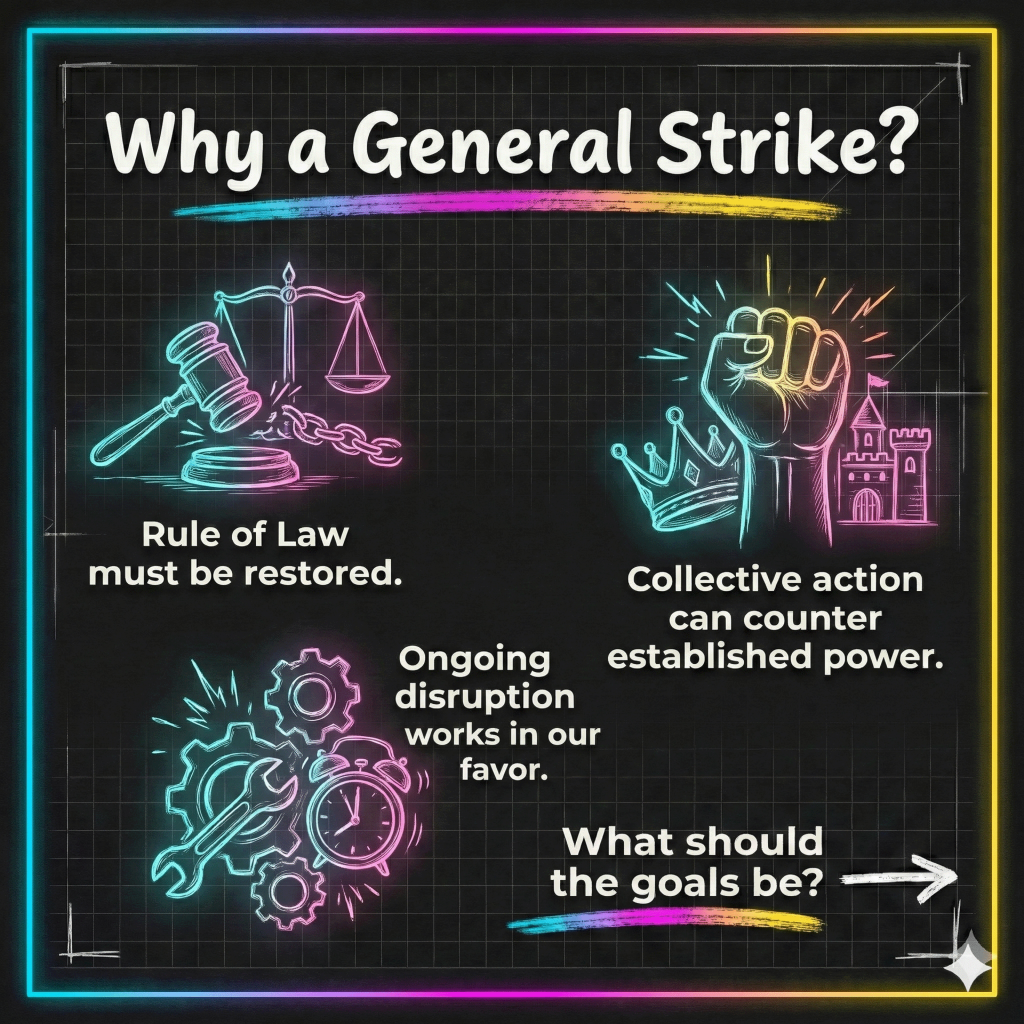
Political scientist Erica Chenoweth’s research, highlighted by Harvard Kennedy School, shows nonviolent campaigns have historically succeeded more often than violent ones. The reason is not purity. The reason is participation. Nonviolence lets more people join, and it can trigger loyalty shifts inside institutions.
It’s important to remember that power doesn’t only live in presidents and CEOs. It lives in compliance. It lives in payroll systems, shipping lanes, and daily labor. It lives in what Gene Sharp called “pillars of support,” meaning the institutions that keep a regime functioning.
A general strike targets those pillars — ideally without asking people to shoot anybody.
I won’t say that nonviolent action always wins. History shows otherwise, and the Journal of Democracy has warned that success rates have declined since 2010, as regimes adapted. But that just makes planning even more important.
One thing I’m absolutely not interested in is seeing the collapse of America or modern society. Collapse hurts regular people first. It breaks medicine supply chains. It breaks rent stability. It breaks the fragile stuff families depend on.
So I want peaceful pressure that forces negotiation. But that requires a well-oiled machine. It means we need discipline, narrative clarity, and deeper community support.
What a General Strike Requires to Succeed
If you take nothing else from this section, take this: A strike succeeds before it begins. It succeeds in the months where people build reliability, redundancy, and care.
A general strike asks working people to absorb risk. That means the movement must reduce risk wherever it can. Otherwise, only the most desperate participate, and the coalition shrinks.
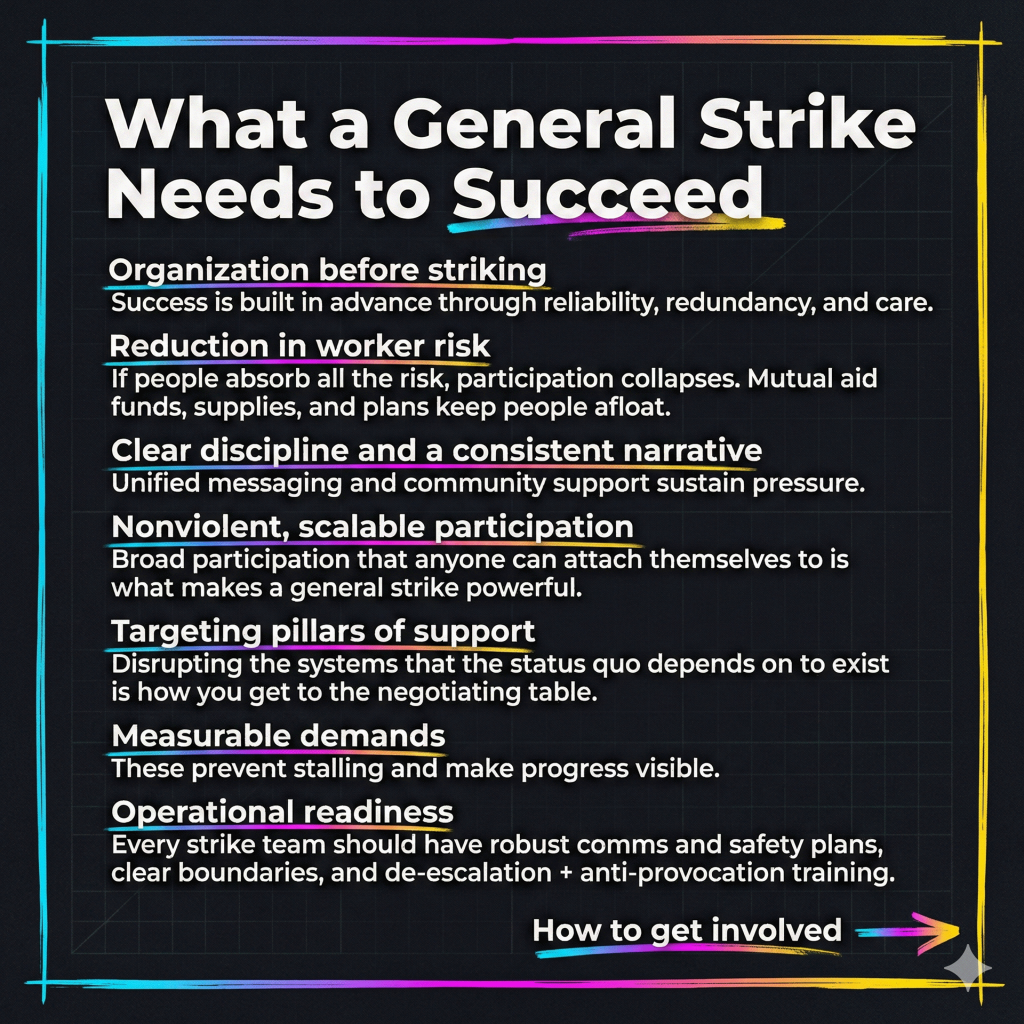
Here’s the infrastructure we need:
- Mutual aid that actually feeds people. You need food distribution, ride shares, childcare swaps, and small emergency funds.
- Rent and bills planning. You need a plan for landlords, utilities, debt collectors, and late fees.
- Workplace mapping. You need to know who can walk out, who can slow down, and who cannot.
- Legal awareness. In the U.S., the National Labor Relations Board explains that strike rights vary by context, and reinstatement rules differ by strike type. People need clarity before they take risks.
- Communications redundancy. You need more than social media. You need phone trees, encrypted chats, and offline meetups.
- De-escalation and safety roles. You need trained people who keep actions calm and predictable.
- Spokespeople and message discipline. You need a simple public narrative that doesn’t fracture under pressure.
The fastest way to kill a strike is to treat it like a performance. The second-fastest way is to treat it like a purge. Movements collapse when they start policing identities and ideologies instead of demanding measurable change.
General Strike Demands Must be Measurable
Bad leaders survive on ambiguity. They promise reviews, commissions, and reforms. Then they bury you in timelines, caveats, and processes. That’s why a national general strike must have demands that can be tracked like a marketing dashboard.
I mean measurable in a very literal way:
- A clear action, not a feeling.
- A deadline, not an aspiration.
- An independent verifier, not an internal memo.
- Public reporting on a cadence, not a one-time press conference.
If demands aren’t measurable, you get symbolic concessions, a few speeches, or a task force. You get exhausted and nothing changes. Measurable demands turn moral outrage into clear progress. They force a yes-or-no outcome. They make stalling visible.
It changes progress from nebulous to actionable.
What the Working Class Should Demand in a General Strike
Demands from a general strike should be clear, time-bound, and auditable. That way progress can be measured independently of any spin.
Here are the five core things that I think are the foundations for a better country, society, and future. And we’re at such a pivotal point in time, that I truly think they can be achieved if we mount a robust, inclusive, cross-party general strike.
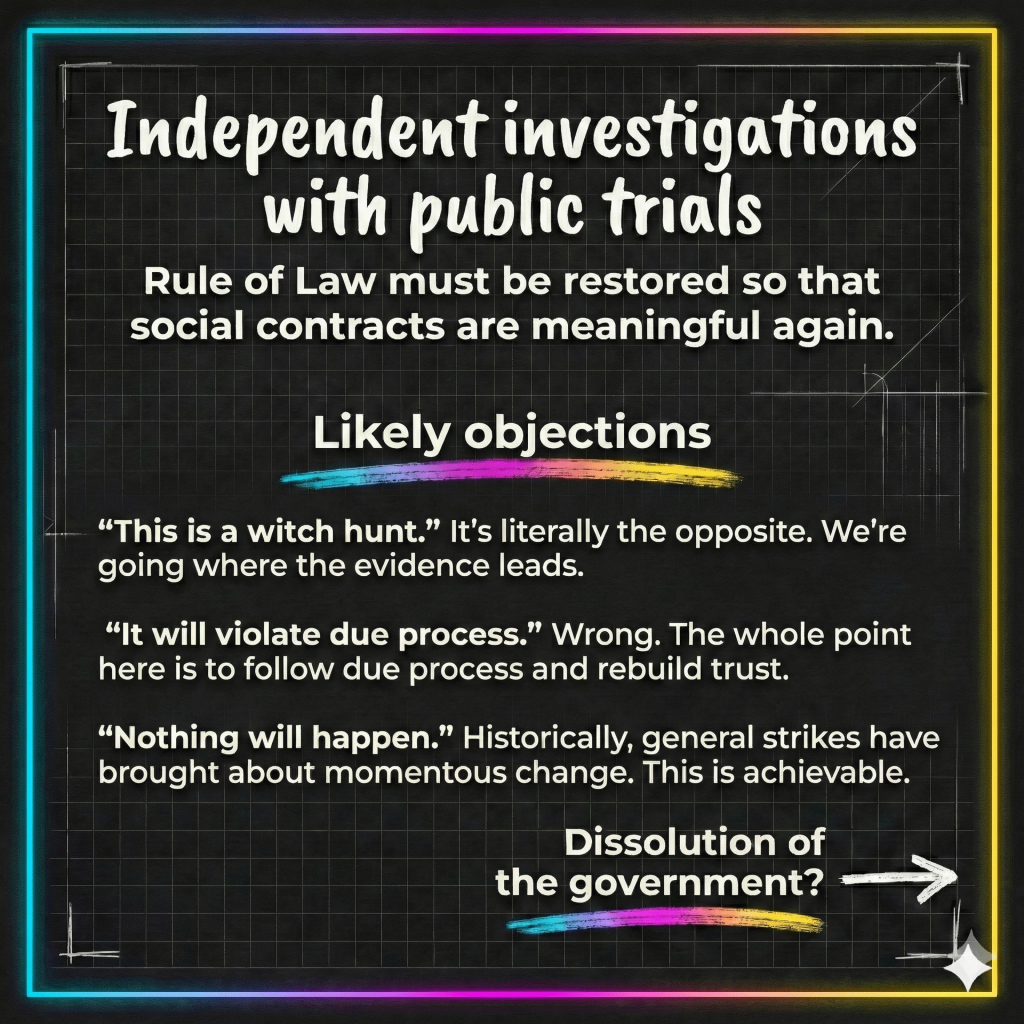
Nuremberg-style trials for Epstein perpetrators — and other credible crimes against humanity
We should demand independent investigations and prosecutions into sex trafficking and related crimes connected to Epstein’s network — with arrests where evidence supports it, and trials that are public, serious, and survivor-protective. We should also investigate allegations of crimes against humanity at the hands of ICE and other government agencies.
A society cannot survive when the powerful can do unspeakable harm without consequence. It tells regular people the rules are decorative and begins to break down rule of law everywhere — elections, courts, schools, workplaces.
Additionally, the idea that these individuals are valuable contributors without whom we would be lost is deeply flawed. Consider how much talent and innovation is lost inside poverty and oppression. For every Elon Musk there are an untold number of brilliant and creative minds who never got the chance to make the impact Musk did thanks to his inherited privilege and power.
I promise you that if we hold elite “innovators” and “thinkers” accountable for their actions while empowering everyday individuals to pursue their ideas and dreams, we will unlock untold levels of innovation and advancement while increasing societal cohesion and trust.
Measurables to Ensure Progress
- An independent special counsel or commission with subpoena power and published scope
- A public release log: what exists, what’s withheld, and the legal basis for each category
- A victim-first protocol: privacy protections, support funding, and trauma-informed testimony options
- A monthly progress report with counts (charges filed, cases opened, referrals made)
Addressing Myths and Objections
- “This is a witch hunt.” It’s literally the opposite. A witch hunt starts with a target and works backward to create “evidence.” We’re starting with mountains of evidence, a clear process, and transparent oversight.
- “It will violate due process.” It absolutely will not. The whole point here is to follow due process and rebuild trust in our system of checks and balances. We should be following due process, first and foremost.
- “Nothing will happen.” Untrue. Historically, general strikes have brought about momentous change. If we leverage our labor collectively to force those in power to act, this is achievable.
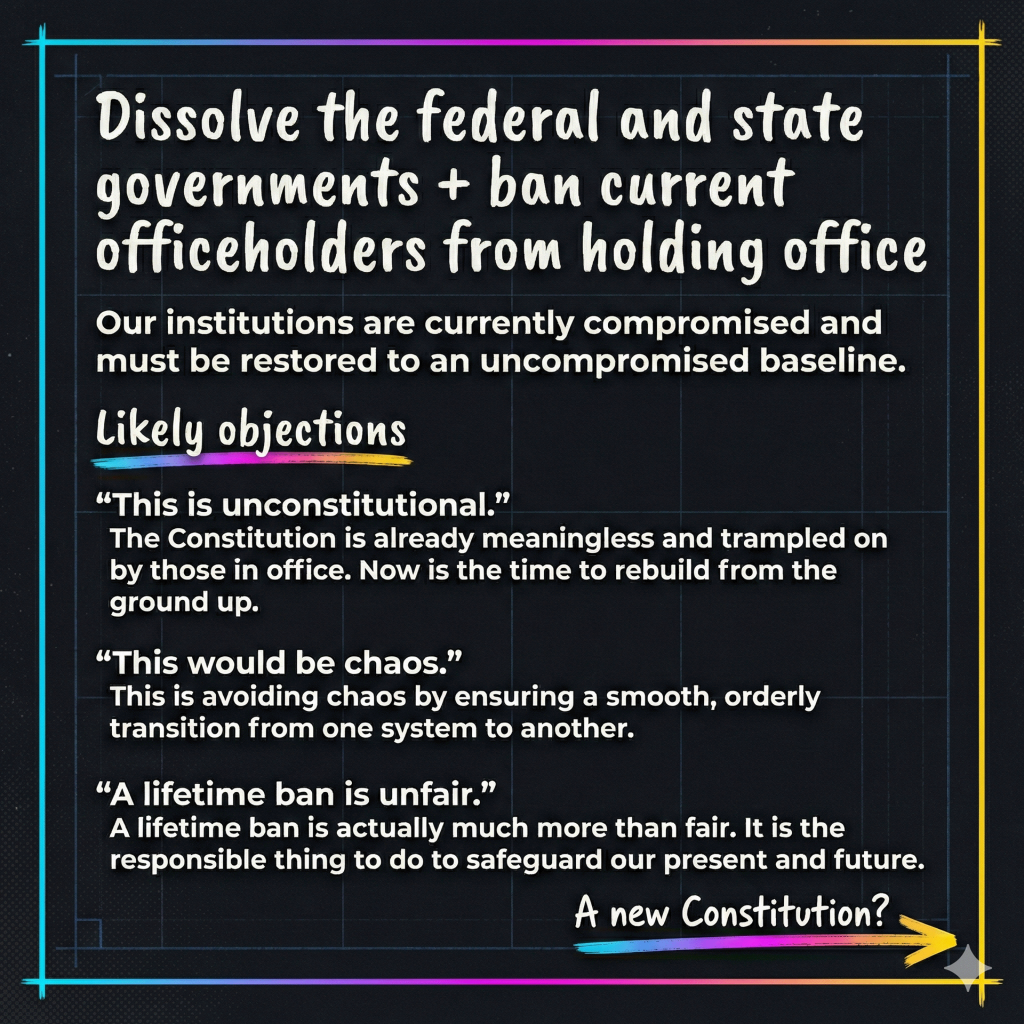
Dissolution of federal and state governments, along with bans on current and former office-holders
We need a democratic reset of the governance structures that are currently captured by donor money, careerism, and immunity culture. That should come with strong restrictions that prevent today’s political class from simply rebranding itself and taking power again.
Dissolution might sound radical, but it doesn’t have to be.
Peaceful transfers of power like this have happened before. We can transition into new governing bodies and systems without destroying the infrastructure and social contracts that everyday Americans — and especially marginalized people — rely on.
But this dissolution should happen. When institutions stop responding to public harm, they stop being legitimate or worthwhile in any tangible sense. People keep getting asked to be patient, but patience becomes a tool of control. A reset is not about punishment, either. It’s about ending a system that rewards dishonesty and shields insiders from consequence.
Measurables to Ensure Progress
- A defined transition pathway (constitutional convention, amendments, or other lawful mechanism)
- A temporary caretaker structure with a hard end date
- A public anti-corruption package: lobbying limits, revolving-door bans, and transparency rules
- A clear eligibility rule for future office (cooling-off periods, conflict checks, enforcement)
Addressing Myths and Objections
- “This is unconstitutional.” The Constitution is already meaningless. Those in power are regularly violating human rights, civil rights, and ignoring the checks and balances of our government. Now is the time to craft a new Constitution, new government, and new systems of power. It starts by ensuring the old caste is removed from power without the possibility of return.
- “This would be chaos.” Chaos is what we get when trust collapses and there’s nothing on hand to replace it. This is avoiding chaos by ensuring a smooth, orderly transition from one system to another.
- “A lifetime ban is unfair.” So is a lifetime of poverty or suffering due to factors beyond a person’s control. These individuals have had entire careers to show they can be responsible and benevolent with power. The ruling class as a whole has had generations to show this. A lifetime ban is actually much more than fair, it is the responsible thing to do to safeguard our present and future.
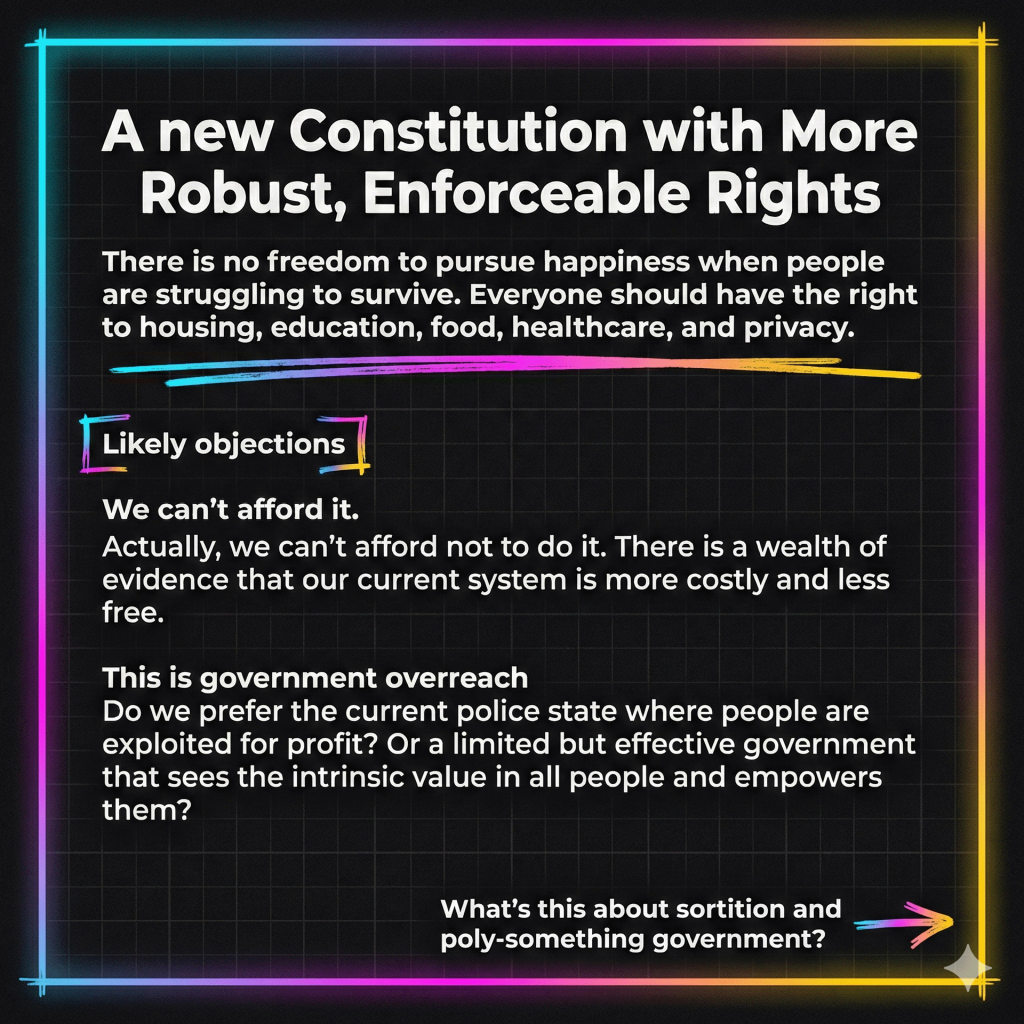
A new Constitution with enforceable rights to health, housing, food, and privacy
Our original American Constitution had some great things going for it. But even the Founding Fathers disagreed on whether it should be a fixed document, or wiped clean and rewritten every few years. The amendment system was the compromise they landed on.
A system of checks and balances, protected speech, and guaranteed due process for all are excellent. But it’s clear the current Constitution comes up short in several ways. A new Constitution should include additional enforceable baseline rights: healthcare, education, housing, food, and privacy (data and physical).
Freedom that doesn’t keep you alive is rhetorical. People aren’t free when they face bankruptcy from a hospital visit, eviction from a missed paycheck, or constant surveillance by employers and government agencies. A system that demands obedience but can’t guarantee basic dignity breeds instability, resentment, and ultimately revolution.
By peacefully transitioning to a new Constitution, we are ensuring less chaos and bloodless change while maintaining critical infrastructure that Americans rely on.
Measurables to Ensure Progress
- A defined benefits floor (health coverage standards, housing stability metrics, nutrition access, education access)
- A funding formula that cannot be hollowed out or gutted
- An enforcement mechanism regular people can use
- Privacy rules with real penalties and independent auditing
Addressing Myths and Objections
- “We can’t afford it.” Actually, we can’t afford not to do it. There is a wealth of evidence that our current system is more costly and less free. We already pay through ER costs, homelessness, lost productivity, and private extraction.
- “This is government overreach.” That’s for us to decide. We’re already being governed. Which path do we prefer? A police state where people are exploited for the profit of others while under constant surveillance? Or a limited but effective government that acknowledges the intrinsic value of all people and empowers them to pursue their dreams and contribute meaningfully to society?
A shift to polycentric, sortition-based governance
If there’s one thing the Trump Administration has made crystal clear, it’s that we cannot put all our eggs in one basket when it comes to civil liberties. But, as seen from the Civil Rights Movement of the 1960s, we can’t trust a patchwork of states to ensure the collective rights of our nation, either.
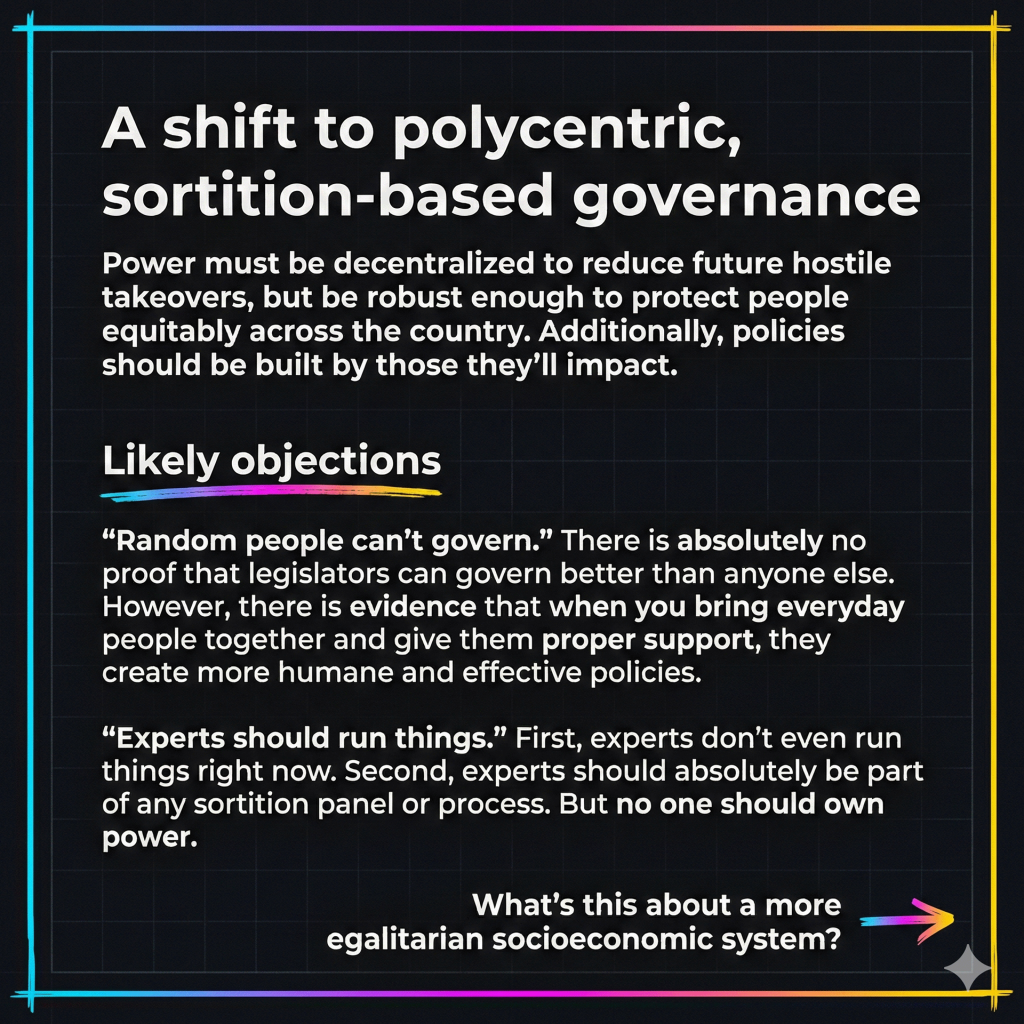
Instead, we should begin the transition toward a true polycentric system, where power is spread across multiple centers instead of concentrated in one capital, branch, or class. Additionally, such a system should be guided by sortition, where everyday Americans directly work on the policies that shape their lives.
Our current Constitutional structure is a good start (three branches of government + state vs. federal powers), but we can go farther by pushing decisions down to the lowest effective level while building many accountable problem-solving hubs that can cooperate, compete, learn, and correct each other.
In practice, that means that there is real fiscal and legal power at every level (city, county, tribal, regional, etc.), shared authority for cross-border issues (housing, water, transportation, climate, public health), and participation that’s less like a public comment session during a town hall meeting and more like population-representative panels of everyday Americans working directly on the policy decisions that impact them.
Why Sortition and Polycentric Governance Work Well Together
This might sound like a convoluted web or sprawling bureaucracy. However, the goal here isn’t fragmentation — it’s resilience. Multiple centers reduce single-point failure; enable experimentation; create more checks on abuse; and can better enforce baseline rights, institutional transparency, and guardrails that prevent hostile takeovers.
Additionally, career politics reward performative actions, not actual problem-solving. Donor systems reward loyalty, not truth. Sortition helps break that apart by rotating power through ordinary people, while still bringing in expert testimony and transparent deliberation. Polycentric design reduces the blast radius of corruption because no single node controls everything.
Done well together, these actually cut through red tape by empowering individuals and local entities to make the choices they know are best for them based on their lived experiences and observations.
Measurables to Ensure Progress
- Standing citizen assemblies at local, state, and federal levels
- Transparent selection rules and demographic representativeness targets
- Public deliberation records and conflict-of-interest enforcement
- Defined scopes: what assemblies decide, what they recommend, and what triggers referendums
Addressing Myths and Objections
- “Random people can’t govern.” There is absolutely no proof that a lawyer, realtor, business owner, or capitalist can govern people better than those people can govern themselves. Even a successful CEO has a very narrow skillset that doesn’t necessarily translate to governance. Government is not a business, nor should it be treated like one. Conversely, there is ample evidence that when you bring everyday people from all walks of life together, give them support and information, and allow them to collaborate and debate constructively, they create more humane, workable, and effective policies.
- “Experts should run things.” First, experts don’t even run things right now. In fact, they’re routinely ignored. Second, experts are great advisors. And they should absolutely be part of any sortition panel or process. But no one should own power. Sortition makes that more achievable at scale.
Shift to a more egalitarian socioeconomic system
It’s a fact that those at the top take more and use more. Their companies are built on public infrastructure paid for by public tax dollars. They exploit the working class for cheap labor to the point where more and more workers rely on government programs they themselves are funding through taxes. They design products and services specifically meant to extract wealth from everyday Americans and consolidate it amongst themselves.
Yet mega-companies and the ultra-wealthy tend to pay the lowest amount of taxes. It is absolutely the inverse of what it should be.
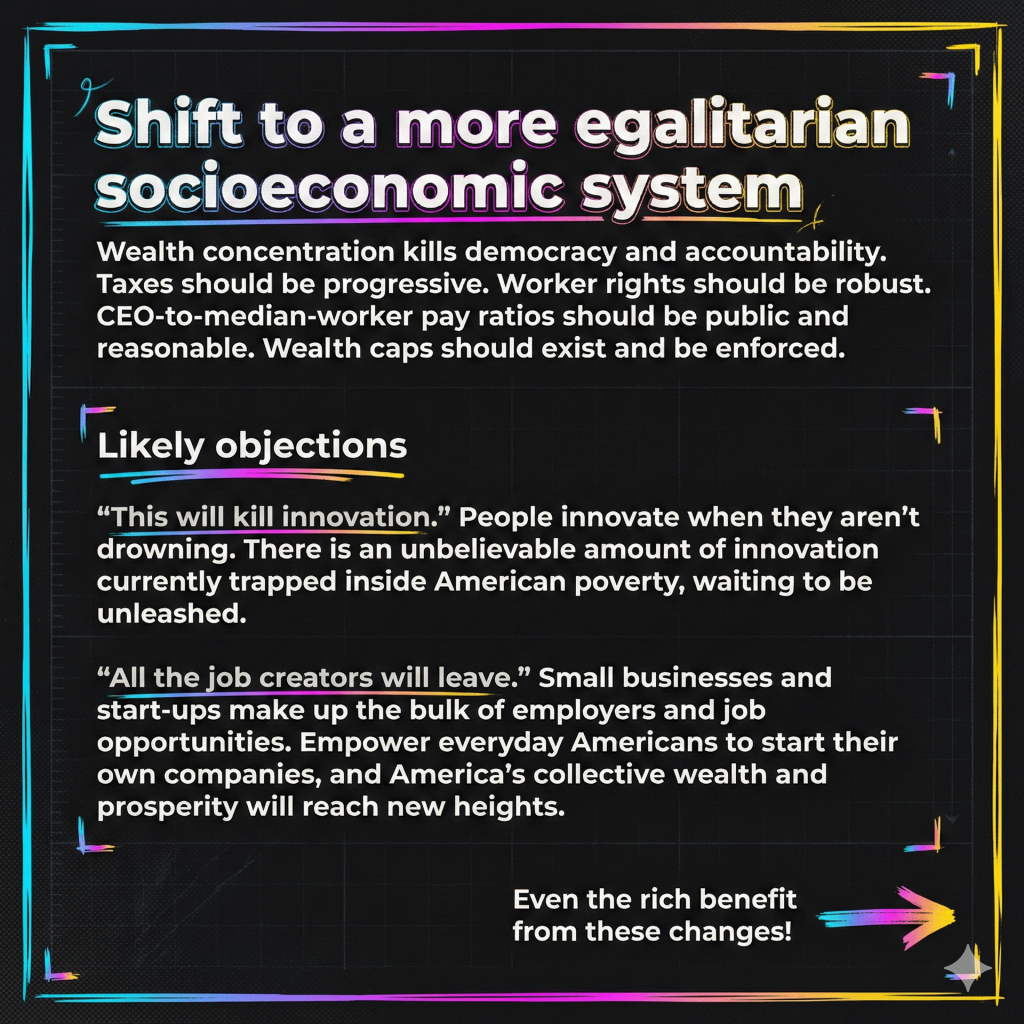
We should demand a progressive tax structure that actually sees people paying their fair share — alongside stronger workers rights, and real pathways to worker-owned businesses. There should also be caps on extreme wealth accumulation, because at a certain point wealth has less to do with earned success and more to do with exploitation of people, resources, and legal frameworks.
When wealth concentrates, democracy dies. The rich don’t just buy yachts. They buy policy outcomes and insulation from accountability. That insulation is the breeding ground for the exact dysfunction we’re watching unfold in the Epstein Files: secrecy, coercion, and impunity culture.
Measurables to Ensure Progress
- Worker ownership targets and incentives tied to measurable adoption
- Stronger anti-monopoly enforcement and transparent merger review
- Tax policy tied to inequality metrics, with automatic triggers
- CEO-to-median-worker pay ratio disclosures with consequences
Addressing Myths and Objections
- “This will kill innovation.” People innovate more when they aren’t drowning. Security fosters risk-taking. As it stands, there is strong evidence that America’s innovation engine is in its immigrants. Imagine how much innovation is currently trapped inside America’s rising poverty rate, just waiting to be freed and fully realized.
- “All the job creators will leave.” There is actually very little evidence this is true. Small businesses and start-ups make up the bulk of employers and job opportunities. Empower everyday Americans to start their own companies, and America’s collective wealth and prosperity will reach new heights — shared and enjoyed by everyone.
A True, Ongoing General Strike can Create Peaceful Change
A general strike is a collective decision to pause the labor that keeps society running, until the people in charge agree to measurable demands. It is pressure that doesn’t require a single broken window.
This matters morally and strategically. Violence shrinks coalitions. And it gives opposition an excuse to escalate while fracturing public sympathy fast. Nonviolence does the opposite. It invites teachers, nurses, warehouse workers, parents, and retirees. It lets people participate without needing to arm themselves.
Political scientist Erica Chenoweth has argued — based on large-scale historical analysis — that nonviolent campaigns have often outperformed violent ones, largely because broad participation becomes possible. That doesn’t mean nonviolence is easy. But it is scalable.
That said, scholars and outlets like the Journal of Democracy have noted that nonviolent campaigns have faced declining success rates in the last decade or so, as states adapt. So if we want peaceful change, we need proper preparation and solidarity.
Here’s what that looks like practice:
- Clear rules for actions, and clear boundaries
- Marshals and de-escalators at every public gathering
- Redundant comms, so rumors don’t run the show
- Safety plans for vulnerable people
- A culture that rejects provocation, even when anger is justified
If we can’t hold that discipline, we don’t have the kind of resilient movement that can create change. We have a moment. And moments often quickly fade without long-term impacts.
Even the Rich Benefit From These Changes
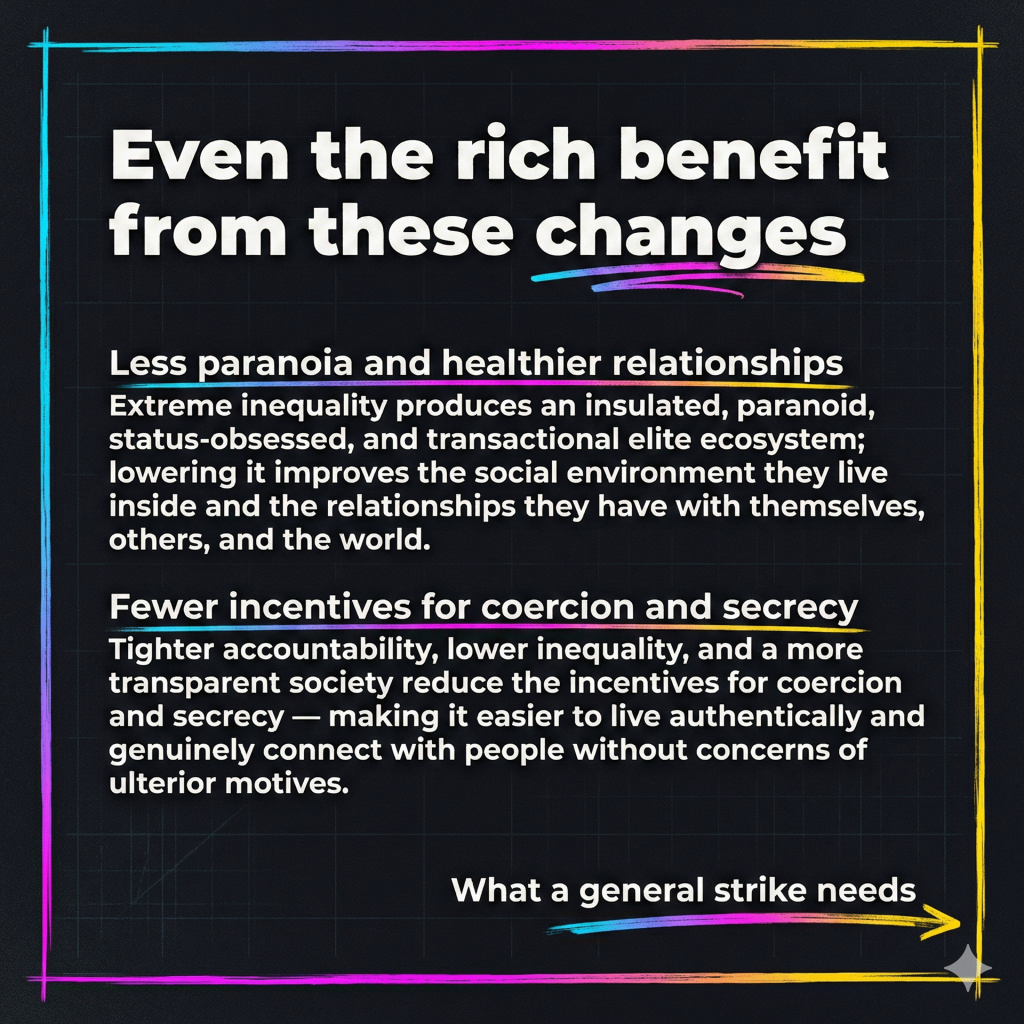
A culture built on extreme wealth concentration creates a specific kind of elite life. It’s insulated, paranoid, status-obsessed, and transactional. That ecosystem does not produce healthy relationships. It produces exploitation, favors, secrecy, and silence. Which is how you get the kind of behavior and activities like those laid bare in the Epstein Files.
So even the rich stand to benefit from a society with tighter accountability and lower inequality. A healthier society — built on transparency, authenticity, and acceptance — reduces the incentives for coercion and shrinks the market for secrecy.
Personally, I want a world where fewer people get hurt, period. And I’d prefer a path to that world that doesn’t require mass bloodshed, trauma, pain, or suffering.
A disciplined general strike gives us that path. It gives us leverage without destruction. It gives us a way to force negotiation while keeping our humanity intact.
Where To Go From Here
If you’ve read this far, I’m going to assume you’re looking for something that is fundamentally different from our current systems of power. I’d wager that, like me, you think we’re at a fork in the road, and we can go terribly wrong or wonderfully right.
I’m tired of doomscrolling alone, getting angrier, feeling more afraid, and resigning myself to the belief that nothing can change. That’s how the status quo remains entrenched without even having to move a muscle. They don’t have to convince us to love them, just that we should give up.
I’d like to ask that we not give up — on ourselves or each other.
How to Make an Immediate Difference
- If you feel overwhelmed by the scale of things, then pick one small role and commit for 30 days.
- If you feel isolated, then have one real conversation this week with someone local about mutual aid (not politics).
- If you feel powerless at work, then start mapping out solidarity: who you trust, who you don’t, and what risks exist.
- If you’re already connected, then shift from talking to building: one shared fund, one shared supply list, one shared plan.
If You Do Nothing Else, Do This
If there’s one thing to hammer home at the end of this, it’s to start learning how general strikes actually work — and start building the local foundations for one in your community.
- Write down five names of people within 15 minutes of you.
- Text two of them and ask for a short meet-up this week.
- In that meet-up, agree on one mutual-aid action you can do this month.
- A grocery run pool
- A childcare swap
- A tiny emergency fund
- A rides list
- A supply map of who has what
That’s it. That’s how we start.
After that, it’s just about building outward. Find labor educators. Learn legal basics. Link up with existing strike networks. Move from isolated outrage to coordinated impacts.
It might feel small at first, but, as they say, ripples become waves. And waves can become a tsunami.
FAQ About the Epstein Files and General Strikes
Is a general strike legal in the United States?
Some strike activity is protected. Some is not. The line depends on who you are, where you work, and what the strike targets.
The National Labor Relations Board explains that many private-sector workers have a right to strike under the NLRA. It also explains two core categories: “economic” strikes and “unfair labor practice” strikes. Those categories matter for reinstatement rights, and for how employers can respond.
Public-sector strikes are a different world. The National Education Association notes that, in the federal government and most states, public-sector strikes are prohibited and often enforced with serious penalties.
I’m not going to pretend this is simple. If you work in government, you need local legal clarity before you risk your livelihood. My pragmatic take is to learn the basics, then plan around your real risk.
Can I get fired?
The NLRB’s own materials explain that “economic strikers” can be permanently replaced, even if they remain employees under the law. It also explains that “unfair labor practice” strikers have stronger reinstatement rights. The NLRB also warns that strike misconduct can cost you reinstatement rights.
That’s why I keep pushing infrastructure first. If a strike asks people to absorb risk, the movement must reduce risk. Otherwise, only the desperate can participate, and the movement collapses.
Why not just vote?
Voting is a tool. And it’s realistically one with diminishing returns in the current sociopolitical climate — when donors and lobbying shape incentives. More and more, politicians can ignore public will and still get rewarded.
A general strike is like putting a wrench into the systems of power. By bring economic production to a halt, it can force negotiation when officials and institutions stop listening and responding to the will of the people.
Isn’t a general strike basically violence?
No. It can involve violence. But it doesn’t require it. In fact, violence is usually how you lose.
Harvard’s Erica Chenoweth and Maria Stephan found that nonviolent civil resistance campaigns historically succeeded more often than violent ones. Their research emphasized participation and “loyalty shifts” as key mechanisms. However, the Journal of Democracy has also reported that success rates for nonviolent revolutions have declined since 2010, as regimes adapt.
So a nonviolent general strike is not magic. But it is our last best hope for large-scale systemic change short of armed revolution. I realize this may be a privileged take, but I will reject physical violence and dehumanization of others as tactics as long as I can. I do not want to become what I’m trying to replace.
What about infiltration, provocateurs, and agents of chaos?
Movements attract disruption. Some disruption is organic. Some is intentional.
The best defense is structure, not paranoia. Create clear rules for actions. Appoint de-escalators. Build communication redundancy. Document decisions. Keep finances transparent and claims evidence-based.
Most importantly, you don’t let purity policing run the show. Movements don’t die from disagreement. They die from ego-infused mistrust spirals.
How do we choose demands without fracturing?
Demands need three traits. They must be:
- Legible to the public
- Measurable with a clear deadline
- Enforceable through ongoing pressure
There’s no such thing as a perfect platform. But winning in a general strike creates space for deeper change. While my ambitions above are big, they start with small, concrete, measurable actions that will push the needle in the right direction.
What if people can’t afford to strike?
A strike without mutual aid is a privilege event. A strike with mutual aid becomes a shared risk model. That’s what makes it working-class power instead of working-class sacrifice.
If your community cannot support basic needs, you need to build that first. Find sources for reliable food, childcare, rides, emergency funds, and housing assistance.
These should be in place before a walkout.
What can one person do this week?
One person can do more than they think:
- Identify five people you trust
- Have one local conversation about mutual aid
- Pick one small support action you can sustain for 30 days
- Ask one labor educator or organizer what you should learn next
This provides a great foundation you can continue to build on.