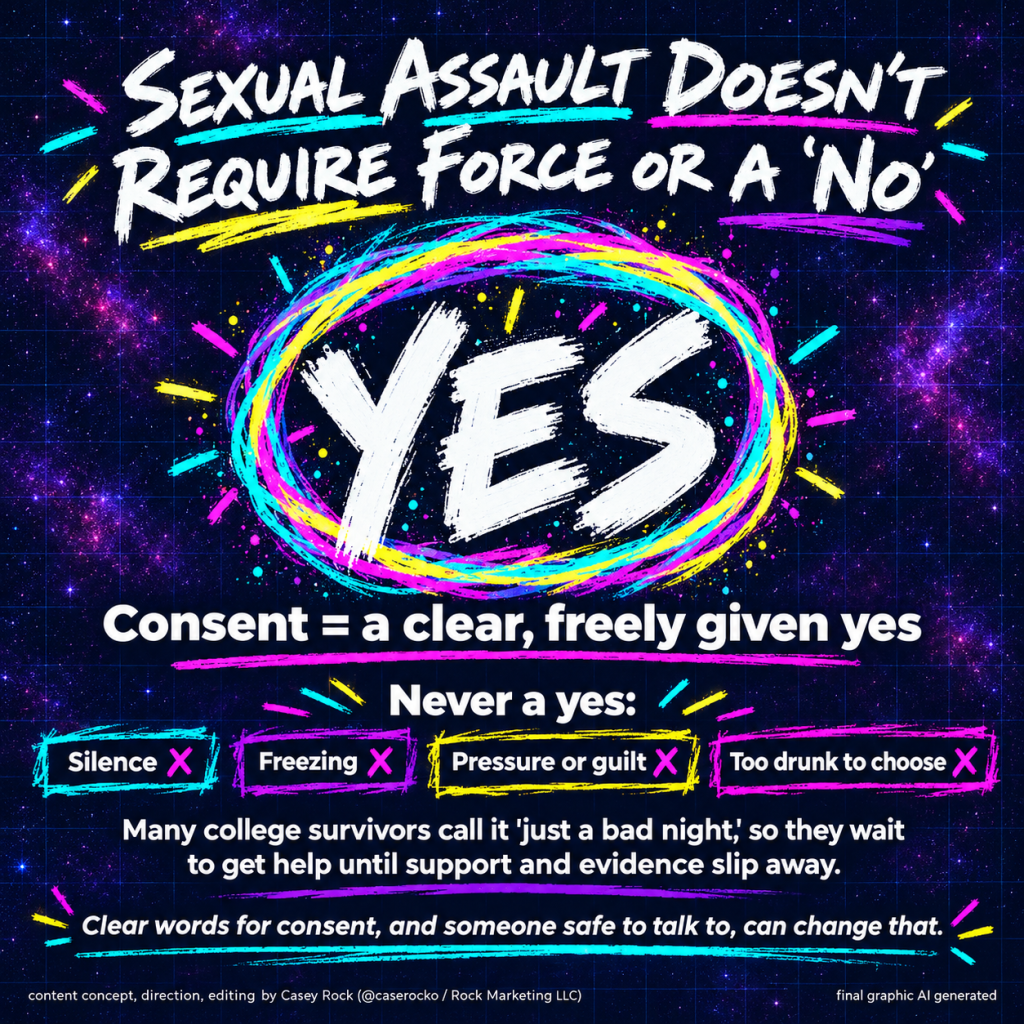
It can be sexual assault even if no one used force and you never said no. Consent is a clear, free yes. Silence, freezing, a yes pulled out by guilt or threats, or being too drunk to choose doesn’t count. Many survivors first call it a bad night, so walk through the facts with a confidential advocate.
TLDR – Understanding A “Bad Night” vs. Sexual Assault
- Ask what happened before deciding what to call it.
- Silence, freezing, or a pressured yes isn’t consent.
- Too drunk to choose means no consent is possible.
- Most campus assaults involve someone we know.
- Professors and RAs usually must report what we share.
- Advocates and counselors can keep it confidential.
- A forensic exam doesn’t require a police report.
- Ask a friend, “What would you like me to do?”
- Men shift the norm when they call out other men.
- Colleges should train every semester, not once a year.
- We all need to teach consent in our spaces; early and often.
The Cornell Case Shows How Long It Can Take To Process Sexual Assault
A former Cornell University student says seven members of the Chi Phi fraternity drugged her with ketamine and raped her at their chapter house in October 2024. She sued them, the university, and the fraternity under the name Jane Doe on Sept. 16, The New York Times reported.
Cornell’s own Title IX process expelled two men and suspended two more. It found two not responsible, and one had graduated before any discipline, CBS News reported, citing Cornell President Michael Kotlikoff. Tompkins County District Attorney Matthew Van Houten, who declined to file criminal charges in 2024, has said Doe’s first statement to campus police described the night as voluntary and consensual.
New York Gov. Kathy Hochul, who has since handed the case to a special prosecutor, noted that Cornell police left out Doe’s statement that she was 100% sure she had been raped.
Why the Timeline Matters
Every college student should sit with one detail buried in the Title IX records The Times obtained. When Doe got home the next morning, a roommate told investigators, she didn’t use the words rape or assault. She talked about it as a crazy thing she had done. The day after that, she texted one of the men that none of it had been illegal.
About a week out, she found anonymous posts on a Greek life forum describing a gang rape at Chi Phi. She told investigators that was the first time she heard her story told as an assault. It took talking, listening, and digesting everything for Doe to really get the language, and awareness, to accurately describe what she experienced.
By Nov. 3, she was texting one of the men that most of that night had not been consensual. On Nov. 7, 18 days after the party, she asked an Ithaca emergency room for a rape kit, The Times reported. RAINN, the national anti-sexual violence organization, says DNA evidence usually has to be collected within 72 hours. By then, that window had long closed.
Cornell is a reminder for all of us to check ourselves, along with the schools, teams, and groups around us.
Which Words Do We Need To Know To Better Discuss Sexual Assault?
We need plain words for consent, coercion, incapacitation, and the freeze response. Just as important is knowing who on campus keeps things private and who has to report. Without that vocabulary, many of us could end up describing sexual assault as something that was just “weird” or “awkward.”
Then we talk ourselves out of help we deserve.
These definitions draw on Utah State University’s policies, the federal Office on Women’s Health, and peer-reviewed research. Your school’s exact wording may differ, so check its policy page too.
Ten Terms Every Student Should Know
- Consent
- A clear, freely given yes to a specific act, with a specific person, at a specific time. We can take it back at any point. Silence or a past hookup doesn’t count.
- Sexual coercion
- Unwanted sexual activity that happens after someone pressures, tricks, threatens, or guilts us without physical force. It can leave us feeling like we owe them sex.
- Incapacitation
- Being too impaired by alcohol, drugs, sleep, or passing out to make a real choice. An incapacitated person cannot consent, even if they seem to go along.
- Tonic immobility (the freeze response)
- A brief, automatic inability to move or speak during intense fear. It’s a reflex, and it’s common during sexual assault.
- Unacknowledged assault
- An experience that meets the definition of sexual assault or rape, but that the person doesn’t call by that name.
- Sexual geography
- A term from Columbia University researchers for how spaces shape power. Whose room it is, and who controls the alcohol or the ride home, affect how free someone feels to leave.
- Reporting employee
- A school employee who must pass along what we share about sexual misconduct to the Title IX office, even if we ask them not to. Students often say mandatory reporter. At USU, the list includes faculty, coaches, campus police, supervisors, and everyone who works in Residence Life, including RAs.
- Confidential resource
- A campus advocate, counselor, or medical provider who doesn’t report our conversation to the Title IX office. Off-campus crisis lines are confidential too.
- Supportive measures
- Free help like class changes, housing moves, or no-contact orders. Under current federal rules, schools must offer them whether or not we file a formal complaint.
- Institutional betrayal
- Extra harm a school or other institution causes when it fails to prevent abuse or responds poorly. Psychologists Carly Smith and Jennifer Freyd link it to worse mental health for survivors.
Why Do So Many of Us Say “Nothing Happened” to Sexual Assault?
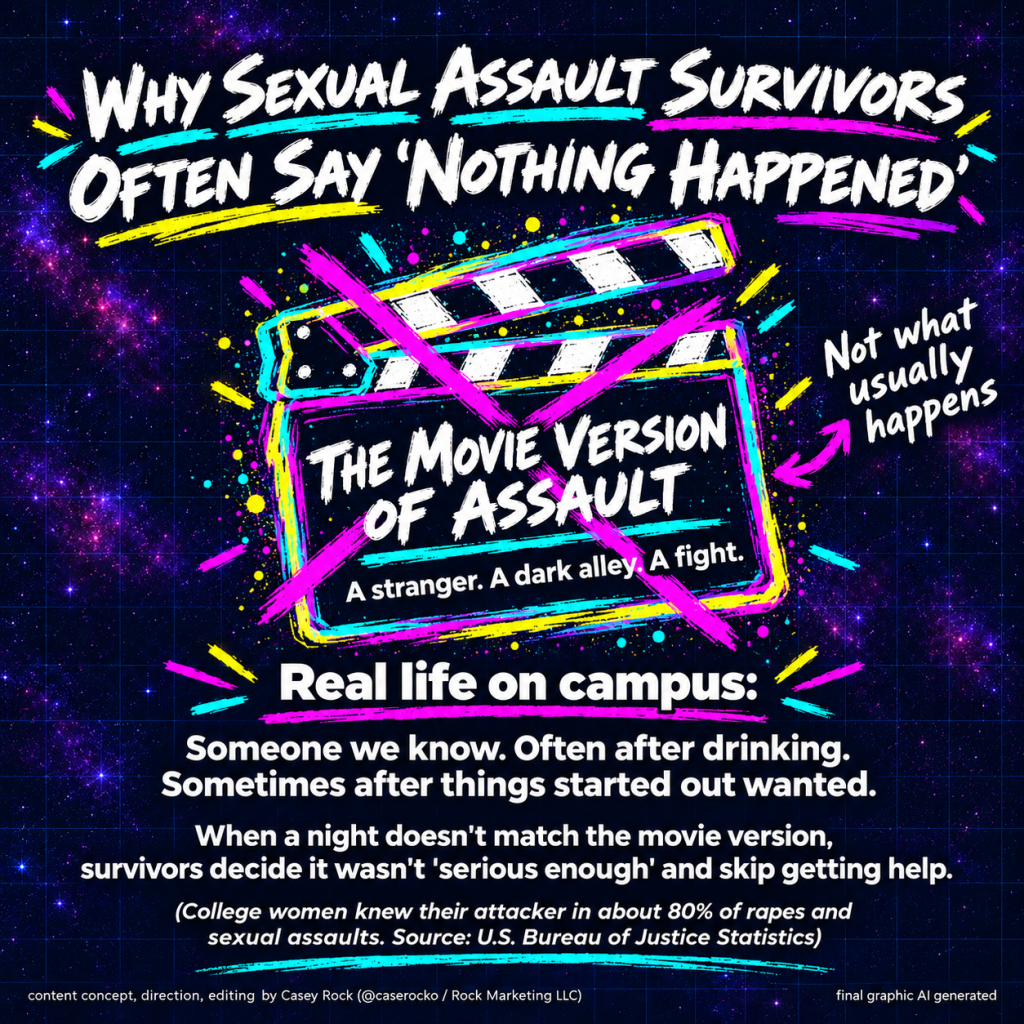
Most of us carry a movie version of assault: a stranger, a dark alley, a fight. Real campus assaults usually involve someone we know, often after drinking, and sometimes after things started out wanted. When our night doesn’t match the script, we shrink it down. Research shows this happens in most cases.
The Stranger-in-an-Alley Script Is Wrong
College women knew their attacker in about 80% of rapes and sexual assaults, the Bureau of Justice Statistics found in a 2014 report. The same report found that 80% of these crimes against students never reached police. Psychologist Antonia Abbey’s research, published by the National Institute on Alcohol Abuse and Alcoholism, paints a similar picture. A typical college sexual assault happens on a date, in someone’s home, after consensual kissing. At least half involve alcohol.
That pattern collides with the story many of us absorbed growing up. If we chose to go upstairs, kissed them, or had a few drinks, the movie script tells us it can’t count. So we file it under “weird.”
Researchers Laura Wilson and Katherine Miller pooled 28 studies of 5,917 women in a 2016 meta-analysis in the journal Trauma, Violence, & Abuse. They found that 60.4% of women whose experiences met the definition of rape did not call it rape. Many used labels like bad sex or miscommunication instead, and college students showed a higher rate than other women.
Why Does “Not Serious Enough” Keep Sexual Assault Survivors Silent?
Many of us compare our night to the worst version of assault and decide ours doesn’t count. If we had been drinking, if it started out wanted, or if we weren’t hurt, we tell ourselves someone else needs help more. So we wait, while the support and evidence we need slips away.
About 25.9% of undergraduate women reported nonconsensual sexual contact by force or inability to consent since enrolling, according to a survey done by the Association of American Universities. So did 6.8% of undergraduate men and 22.8% of transgender, nonbinary, and genderqueer undergraduates. Yet the top reason survivors gave for skipping campus resources was that it didn’t seem serious enough.
At Carnegie Mellon, one of the 33 schools in the 2019 survey, women who said a rape wasn’t serious enough (or picked “other”) were asked why. About 71% said alcohol or drugs were involved. About 69% said they weren’t injured, and 51% said it began consensually.
None of those details changes whether it was assault, but each one makes a night look less like the movie version. Survivors who skipped going to police gave related reasons in a 2014 Bureau of Justice Statistics report. About 26% called it a personal matter and 20% feared reprisal. Another 12% said it wasn’t important enough, and 10% didn’t want to get the offender in trouble.
Freezing Is a Reflex
Many of us assume we would fight back. Our bodies often have other plans. In 2017, Swedish physician Anna Möller and her colleagues studied 298 women who came to a Stockholm emergency clinic after a sexual assault. Seventy percent reported significant tonic immobility during the assault, and 48% reported extreme tonic immobility. Those who froze faced 2.75 times the risk of later PTSD and 3.42 times the risk of severe depression, the team reported in Acta Obstetricia et Gynecologica Scandinavica.
Freezing often looks like staring at the ceiling, waiting for it to end, going silent, or becoming unresponsive. Afterward, it often feels like proof that we let it happen. The science says otherwise. If someone stops moving or speaking, that’s our signal to stop.
What Alcohol Does to Consent
Drinking doesn’t automatically erase consent. (Utah State University’s policy says a person isn’t necessarily incapacitated just because they’ve been drinking.) The question is whether they were too impaired to make a real choice. USU’s policy also closes a common loophole: being drunk ourselves is no excuse for missing that someone else was incapacitated.
State criminal law can lag behind. Under New York law, a drunk or high person counts as mentally incapacitated only if someone gave them the substance without their consent.
Here’s a practical rule for the rest of us. If we’re wondering whether someone is too drunk to consent, that doubt is our answer. Wait until tomorrow.
How Can We Check In With Ourselves After a Night That Felt Off?
Skip the label for now and walk through the facts. Ask what we wanted, what we said, whether we could think clearly, and whether we felt free to stop. Researchers find that questions about specific behavior catch assaults the word “rape” misses. Clear facts give us, and anyone helping us, something solid to work with.
Wilson and Miller’s meta-analysis points straight at this approach. Surveys that describe specific acts, instead of asking “were you raped?”, find far more assaults. We can use that method ourselves.
Try answering these questions honestly, alone or with someone you trust:
- Before anything started, what did I actually want to happen?
- Did I say or show a clear yes, or did I go along because stopping felt harder?
- How much had I had to drink or use? Are there gaps in my memory?
- Did anything change partway through that I didn’t agree to, like a new act, a new person, or a condom coming off?
- Could I have left if I wanted to? Whose room was it, and who had the door, the ride, or the phone?
- How did my body react? Did I freeze, go quiet, or check out?
- What did I feel the next morning, and what am I telling myself to make it okay?
- If my best friend described this exact night to me, what would I tell them?
What Should We Do With Our Answers?
There’s no score here. Mixed answers are normal, and feelings can shift over weeks, just as Doe’s did. We also don’t need certainty before we ask for help. A confidential advocate can sit with the messy version and walk us through options without filing anything.
What If We’re Worried We Crossed a Line?
Most people who cause sexual harm don’t think of themselves as dangerous. However, harm doesn’t require bad intent, and the other person is the one who lives with the impact. Facing that possibility takes courage, and it’s how we grow.
I’m not writing this from a pedestal. I’ve had a night of drinking and what seemed like very consensual activity turn into a hard, sobering conversation the next morning. And looking back at my teens and twenties, a lot of behavior people brushed off would (and should) be treated differently today.
Those mornings are uncomfortable. Explaining them away is worse.
If a night is nagging at us, these questions belong on the table too:
- Did they say yes clearly, or did I fill in the blanks?
- After a “no,” a “maybe,” or a pause, did I ask again?
- Were they noticeably drunker or higher than me?
- Did I keep going after they went quiet or still?
- Somewhere along the way, did I invite or allow anyone else to join in?
If any of those land, we should stop and get support. Campus counseling centers are usually confidential. Resist the urge to text the other person asking them to say it was fine. That shifts the weight of our discomfort onto them.
Where Is the Line Between Consent, Pressure, and Assault?
Consent is a free, clear, specific yes that can be taken back at any time. Pressure crosses into coercion when guilt, threats, or wearing someone down produce the yes. Assault is any sexual act without consent, including with someone who is incapacitated. Real life gets murky, so it helps to know what the warning signs sound like.
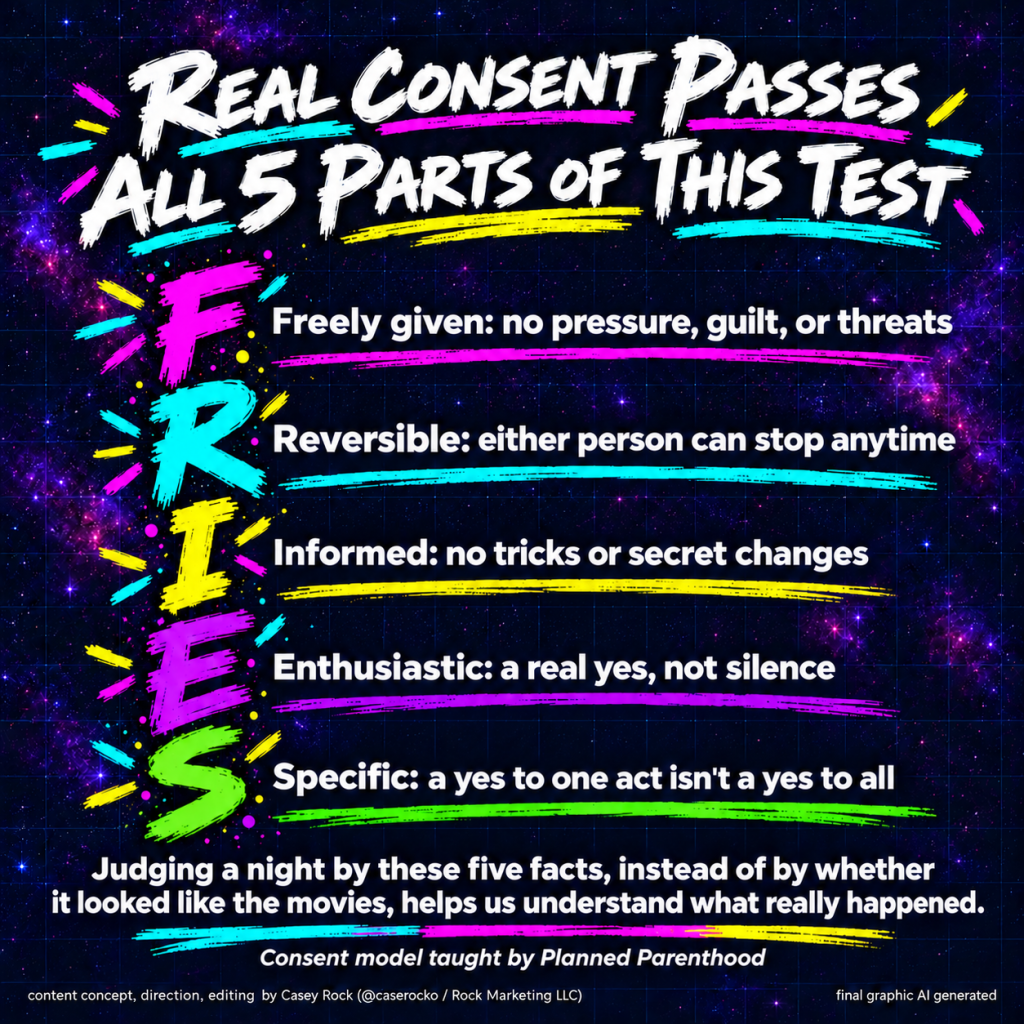
Planned Parenthood teaches consent with the acronym FRIES. Consent should be Freely given, Reversible, Informed, Enthusiastic, and Specific. The table below translates common moments into those terms, drawing on USU’s policy examples, the Office on Women’s Health, and consent educators.
What Does Crossing the Line Sound Like?
| What It Sounds or Looks Like | Why It Fails the Consent Test |
| “I don’t know… maybe?” | Uncertain words are not a yes. USU’s policy lists “I don’t know” and “maybe” as signs of non-consent. |
| Silence, going still, not kissing back | Silence and not actively taking part are not consent. |
| “Come on, you did last weekend.” | Past sex, or a current relationship, never grants permission for tonight. |
| Asking again and again until they give in | Wearing someone down is coercion. USU lists guilting someone into sex as a possible example of assault. |
| “If you really liked me, you would.” | Guilt and threats to end things are classic coercion tactics, according to the Office on Women’s Health. |
| Switching to a new sex act without asking | Consent is specific. A yes to one act isn’t a yes to another. |
| Secretly removing a condom | Consent has to be informed. McMaster University’s consent educators call this “stealthing” and classify it as sexual assault. |
| A friend joins in or walks in | A yes to one person is not a yes to anyone else. |
| Slurring, stumbling, or passed out | An incapacitated person cannot consent at all. |
How Do We Ask In The Moment Without Making It Weird?
Checking in is less awkward than most of us fear, and far less awkward than the alternative. Short, specific questions work best: “Is this okay?” “Do you want to keep going?” “Want to slow down?” Then we actually listen, including to bodies. A pulled-back hand or a sudden silence is an answer.
Consent educators at McMaster University offer a useful frame for whoever is initiating: make it safe for the other person to say no. A yes given out of pressure or fear isn’t freely given. If saying no to us would cost someone their ride home, their housing, or their place in a friend group, their yes carries less weight than it sounds.
A yes only means something if no is a safe answer.
Who Can We Talk To Without Starting a Formal Report?
Campus advocates, counselors, and off-campus crisis lines can keep what we share confidential. Medical staff on campus can too, with a legal exception noted below. Professors, coaches, police, and resident assistants (RAs) are different. As reporting employees, they must pass what we tell them to the Title IX office, even if we ask them not to.
There’s no gentle way to say this. Once a reporting employee hears it, the report is going in. At USU, they must file within 24 hours. That holds even if we ask them to wait, even if we plan to report it ourselves, and even if what they heard was secondhand.
Plenty of students, and even the employees bound by it, may reasonably see this as a breach of trust. Schools defend the rule as a way to spot repeat offenders and make sure every student gets offered help.
Whether right or wrong, this is exactly why it’s worth knowing the rule before the moment we need it.
Who Keeps It Private, and Who Has to Report?
USU sorts employees into three groups: reporting employees, confidential resources, and resource-connection employees, who share resources but don’t file reports. Every school draws these lines a little differently, so check your campus’s list.
| Who We Talk To | Must They Report to Title IX? | What Usually Happens Next |
| Friend or roommate (not working as an RA) | No | They can listen and help us find resources. |
| Professors, coaches, campus police, supervisors, RAs, and other Residence Life staff | Yes, even if we ask them not to | The Title IX office emails us about support and options. We don’t have to respond. |
| Campus advocates (USU’s SSAVI office) | No* | Confidential support, safety planning, and help weighing options. |
| Counselors (USU CAPS) | No* | Confidential care. |
| Campus medical staff (Student Health & Wellness Center) | No* | Confidential care, but Utah law requires providers to tell police when they treat injuries from violent crimes, including sexual assault. |
| Off-campus crisis centers and hotlines | No | 24/7 confidential support and hospital accompaniment. |
| Title IX office directly | No need; they are Title IX | Supportive measures, with or without a formal complaint. |
| Police | No; they aren’t school employees | A criminal investigation, separate from the school’s process. |
*Confidential offices must still report abuse of children or vulnerable adults, and therapists must report a real threat against a specific person. Advocates also share anonymous crime details (no names) with USU police for federal Clery Act counts.
What Happens After a Professor Files a Report?
A reporting employee can’t skip the report because a student asks, and the student can’t cancel it. USU’s own sample script for employees ends with the right question, though: “What would you like to have happen next?”
After a report, the Title IX office typically emails the student about support and options. Schools must offer supportive measures whether or not the student files a formal complaint. In most cases, the student decides whether to go further, though a school can move ahead on its own in some situations, such as a threat to campus safety.
Can We Get Medical Care Without Going to Police?
Yes. RAINN says a sexual assault forensic exam should be free, and we don’t have to report to police to get one. Evidence can be stored in case we decide to report later. At USU’s Logan campus, students and employees can get an exam from a certified nurse examiner at Cache Valley Hospital.
Remember the Utah exception above, though: medical providers must notify police when they treat injuries from violent crimes. Notifying police doesn’t force us to give a statement or press charges. Calling CAPSA first means an advocate can explain how that works and meet us at the hospital.
Numbers Worth Saving in Your Phone
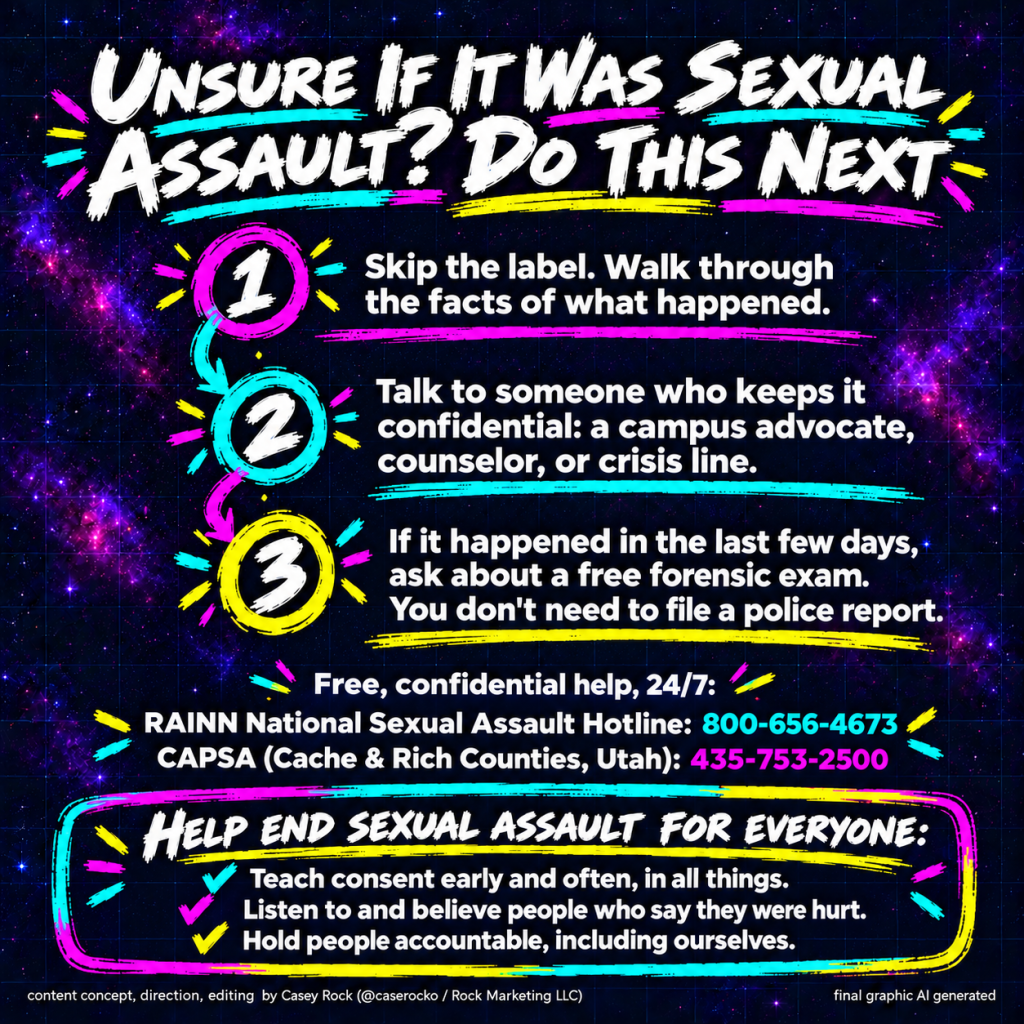
- CAPSA (Cache and Rich counties, 24/7, free and confidential): 435-753-2500
- Utah Sexual Violence Crisis Line (24/7): 1-888-421-1100
- RAINN National Sexual Assault Hotline (24/7): 800-656-4673
- USU SSAVI (confidential campus advocacy): usu.edu/ssavi
- 988 for a mental health crisis, or 911 for immediate danger
What Should We Do When a Friend Tells Us Something Happened?
Believe them first, listen more than talk, and let them decide what happens next. We shouldn’t push a label, quiz them on details, or make reports for them without asking. And if our own campus job makes us a reporting employee, we have to report what they share, so it’s worth sharing that before they say anything (if it’s possible).
Utah’s statewide coalition, UCASA, and USU both promote an approach called Start by Believing. A disclosure is no time for cross-examination. Questions like “Why did you go up there?” or “How much did you drink?” land as blame, even when we mean well.
Smith and Freyd found that poor institutional responses can deepen trauma, and for many survivors, a friend’s reaction is the very first response they get.
Which Habits Help Most When Someone Confides in Us?
A few habits make the biggest difference:
- Listen without fixing. Let them tell it their way, in their order.
- Use their words. If they call it “a bad night,” don’t force “rape” on them. Share the vocabulary gently if they ask for it.
- Ask what they want. “What would you like me to do?” lands far better than “Are you sure?” and hands the next step back to them.
- Offer options, not orders. Share the confidential resources above and let them choose.
- Check your role. If you’re an RA, a student employee, or a teaching assistant, you may be a reporting employee. Say so before they share more, so they can decide what to tell you.
- Flag the clock. If it happened in the last few days, mention that medical care and evidence collection are available without a police report.
- Follow up later. A text a week later can matter more than the first conversation.
How Do We Step In Before Something Bad Happens?
We can step in early, in small ways, and usually with help. Bystander programs teach three moves: be direct, create a distraction, or delegate to someone with more pull. Studies show campuses that train students this way see less violence, and one well-timed reply in a group chat can change a whole night.
The Cornell lawsuit shows how fast a group chat can fill with bystanders. According to the complaint, one fraternity member posted a sexually explicit message to a Snapchat group called “Chi Phi Actives,” telling members that Doe was upstairs, Law Commentary reported. Those allegations haven’t been proven. Still, every student recognizes the moment. Dozens of people see a message like that, and each one decides whether to say anything.
Bystander training changes outcomes. A multiyear study in the American Journal of Preventive Medicine compared one campus using the Green Dot program with two campuses that had no bystander programs at the start. Interpersonal violence victimization rates were 17% lower on the Green Dot campus.
In a group chat, the direct move can be one reply: “Not funny. Somebody check on her.” Closer to home, USU runs a bystander program called Upstanding, created by the Utah Department of Health. It reached 14,950 people, mostly students, between fall 2017 and spring 2024.
How Can All of Us Become Advocates for Consent and Accountability?
Advocacy starts in the spaces we’re already in: group chats, teams, houses, clubs, jobs, congregations, and families. We don’t need a title or a certificate. What it takes is saying out loud what most people around us already believe, making help easy to find, and holding friends to the same standard we’d hold a stranger.
Why Does One Voice Change a Room?
Most people already agree with us, but they assume they don’t. Patricia Fabiano and colleagues studied college students for a 2003 paper in the Journal of American College Health. The men underestimated how much other men valued consent and how willing their peers were to step in.
Those wrong guesses mattered. Men’s sense of what their peers believed shaped their own behavior and their willingness to act as allies. Social psychologist Catherine Sanderson points to research showing that men’s beliefs about their peers predict whether they’ll intervene better than their own attitudes do. The most common reason they give for staying quiet is fear of being ridiculed.
So silence feeds on itself. Each person stays quiet because they think they’re the only one bothered, and that silence convinces everyone else of the same thing. When one person says “that’s not funny” or “somebody check on her,” the rest of the room often finds out they weren’t alone.
In other words, most rooms are full of people waiting for someone else to speak up first.
What Can We Do Right Where We Are?
Advocacy looks different depending on who we are and where we stand. A few starting points:
| Where We Are | Something We Can Do |
| In a group chat | Don’t laugh along with jokes about someone being too drunk to stop. One reply breaks the illusion that everyone’s on board. |
| In a fraternity, sorority, team, or club | Write consent, sober-monitor, and reporting expectations into bylaws and new-member onboarding. Post confidential resource numbers where people actually look. |
| Hosting a party | Keep a sober point person, watch the drinks, and make sure every guest has a way home that doesn’t depend on someone else. |
| As a man talking with other men | Bring it up first. Our friends’ opinions carry weight that no outside trainer’s ever will. |
| As a professor, coach, TA, or RA | Explain your reporting role on the syllabus or at the first meeting, before anyone needs it, and list confidential options right next to it. |
| At work, in a congregation, or in a local music or arts scene | Put the reporting path where people will see it (social bios, signs, pinned posts, handbooks) instead of burying it on a subpage. |
| As a parent, older sibling, or mentor | Teach consent from the start. Don’t make kids hug anyone they don’t want to, and respect their reasonable no’s. Then talk about pressure, consent, and the freeze response alongside other growing-up talks. |
| As a survivor | Nothing. You don’t owe anyone advocacy. If you ever choose to speak up, it should be on your terms. |
Men Must Be A Critical Part Of Any Solution
Consent isn’t a women’s issue to manage on everyone else’s behalf. Honestly, I think this starts and stops with men.
In the CDC’s 2016/2017 National Intimate Partner and Sexual Violence Survey, 54.3% of women reported sexual violence at some point in their lives. The vast majority were harmed by men. Nearly 1 in 3 men (30.7%) reported it too — but they were also mostly the victims of other men. And transgender and nonbinary students face some of the highest rates of all.
To be clear, I know it’s “not all men.” And I’d love for us to live in a world free of the identity politics that divide us today. But the way we get there is by the privileged and power siding with the oppressed and hurt. In this context, that’s mostly men. And if we really want to fight for male survivors, the best way to do that is to fight for female survivors too.
That’s the whole point of solidarity. A rising tide lifts all boats.
Men also shape the peer norms the research above describes. So, guys, we have got to hold each other accountable. The men causing harm are often our friends, or at least our peers. When women don’t have the power they should to hold someone accountable, it’s on us to use ours.
What If Someone Warns Us About a Man in Our Circle?
Sometimes a disclosure isn’t about one night at all. It’s a warning. I’ve been in a handful of situations where women approached me about men in my own circles. The first thing I try to ask isn’t “Are you sure?” or “Do you have evidence?” It’s “What would you like me to do?”
Often, the women I talked to weren’t looking to start a firestorm or send someone to prison. In fact, by the time they talked to me, some had already tried that. More often than not, they were warning people they trusted, especially people in a position to keep an eye on the man, hold him accountable, or push him to change.
If that surprises anyone, it shouldn’t.
Calling out sexual misconduct can bring backlash, retaliation, and real danger, even for women who have support. And the formal system rarely delivers. RAINN estimates that out of every 1,000 sexual assaults, 25 perpetrators end up incarcerated. For every perpetrator who goes to jail or prison, roughly 39 more never do. That’s the math women are weighing every time they decide who to tell.
So when someone trusts us with a warning, we follow their lead. That might mean watching him at parties, making sure he isn’t the one driving people home, or never leaving him alone with someone who’s been drinking. If they want us to, it might even mean sitting him down for a hard conversation.
(Though, it’s worth pointing out, if our job makes us a reporting employee, that obligation still applies, so we should say so before anyone shares details.)
What Does Accountability Look Like When It’s a Friend, or Us?
Accountability gets harder when we love the person. It’s much easier to call something a misunderstanding than to picture someone we know as the one who caused harm. But the institutional betrayal Smith and Freyd describe isn’t limited to universities. A team, a house, or a friend group can close ranks the same way.
If a friend or loved one of ours has been accused of sexual misconduct, two people need our care: 1) the person who came forward about them, and 2) our friend. These steps help us support our friend without putting the person who came forward at risk.
- Keep what we’ve heard to ourselves. Don’t tell our friend what we heard unless the person who came forward asks us to. Even if we leave out names, a small friend group can make it obvious who talked.
- Leave the person who came forward alone. Don’t reach out to them on our friend’s behalf, ask them to drop it, or repeat their story to anyone. Pressure like that can count as retaliation under Title IX.
- If our friend already knows they’ve been accused, or they confess something to us, listen without taking sides. We can hear them out without defending or excusing what happened, and point them toward counseling.
- Get advice before acting on a worry. If we’re concerned about what our friend might do next, talk it through with a confidential advocate first.
- Put safety ahead of comfort. The safety and choices of the person who came forward matter more than our friend’s comfort, or our own.
If someone tells us we crossed a line:
- Listen without defending ourselves. Harm doesn’t require bad intent. The other person lives with the impact either way.
- Don’t ask them to make us feel better. Seeking reassurance hands them the job of managing our guilt, on top of what they’re already carrying.
- Ask what repair they want, if any. Then respect the answer, even if it’s “nothing, just leave me alone.”
- Change the behavior, and get help doing it. A counselor or trusted mentor can help us understand what happened and make sure it doesn’t happen again.
Where Does Redemption Fit?
We can argue about cancel culture and second chances. But redemption comes after accountability. That means owning the harm, repairing what we can, and taking measurable steps so it doesn’t happen again.
From the outside, it’s usually unglamorous: an apology that asks for nothing in return, and a habit that actually changes (and stays changed). Until we’re believing women and doing that work, there isn’t much room to talk about redemption.
I don’t have easy answers for rebuilding trust or social cohesion. Still, I believe it starts with each of us. We can believe people who tell us they’ve been hurt, and ask what support they actually want. And we can refuse to look away when the person causing harm is someone we know.
Women should be listened to, victims should be believed, and men need to hold men accountable.
What Should College Leaders Change After Cornell?
Colleges should teach sexual misconduct prevention like any other core skill: every semester, with realistic practice, and with tests of what students actually understand. USU currently requires one training a year. Research shows bystander gains start fading after about six months, so a short, interactive session each fall and spring would close that gap.
To be clear, USU has done real work here. In 2020, it signed an agreement with the U.S. Department of Justice after acknowledging system-wide failures in handling sexual misconduct between 2013 and early 2017. Since then, it has required prevention training for incoming and continuing students and enforced it with registration holds.
USU says that hard mandate pushed completion near 100% each semester, and 71,156 incoming students finished the training between fall 2017 and fall 2025. The school also offers amnesty, confidential advocacy, and Upstanding bystander training.
That’s a foundation worth building on, and we’re rooting for it.
What Training Does USU Require Right Now?
USU’s rules are public but scattered across several pages, so we pulled them into one place. The requirement covers students taking six or more credit hours in a degree program.
Here’s what each student owes, according to USU’s Civil Rights and Title IX Office:
| Who | What They Complete | How Often |
| New undergraduates, new graduate students, transfers, and students back from a leave | An incoming-student training, listed for 2026–27 as an online, self-paced course in Learn Blue | Once, in their first semester |
| Continuing students | An online, self-paced refresher on a new topic each year (2026–27: sextortion) | Once per academic year, with a fall deadline |
| Fraternity and sorority members, student-athletes, student organization presidents, and student government officers | An extra live training built around their group | Once per academic year, on top of the above |
| Students for whom the content is traumatic | An alternative training they can request | In place of the standard training |
Put together, a typical undergraduate completes one training in their first semester and one each fall after that. That’s about four trainings across four years, roughly a year apart, and spring semesters carry no requirement at all. Missing the deadline (Oct. 27 this fall) triggers a registration hold, which lifts once the training is done.
How Does USU Know Whether Students Learned Anything?
Publicly, USU measures completion. Its pages report completion rates and running totals of students trained. We couldn’t find a published passing score, quiz threshold, or test of what students remember months later. If the online courses include quizzes, USU doesn’t publish the results.
The closest measure is a set of surveys given before and after the live sessions. According to USU, fall 2022 participants afterward knew more about confidential resources, reporting, and consequences for misconduct. That’s real progress, but it captures knowledge right after a session. It says nothing about skills a semester later.
Why Isn’t Completion the Same as Comprehension?
A registration hold proves a student clicked through. It doesn’t prove they can recognize coercion at 1 a.m. or explain their options to a friend. In the 2019 AAU survey, even after gains, only 36.9% of undergraduate women and 40.3% of undergraduate men at repeat schools felt knowledgeable about school definitions and procedures.
The research on format is blunt. In 2014, Sarah DeGue and colleagues at the Centers for Disease Control and Prevention reviewed 140 evaluations of sexual violence prevention programs. Most were brief education sessions aimed at knowledge or attitudes. None of those showed evidence of reducing sexually violent behavior in a rigorous evaluation. Three-quarters of the programs ran a single session, and half lasted an hour or less.
What Does the Evidence Say Works?
Programs that cut sexual violence give students several sessions, not one. They make students practice skills in realistic scenarios instead of just absorbing facts. In trials, a four-session resistance program for women nearly halved completed rapes, and a six-module online course for men reduced self-reported sexual violence.
Psychologist Charlene Senn’s Enhanced Assess, Acknowledge, Act program gives first-year women four three-hour sessions. One core goal is helping women get past the feelings that keep them from naming danger. A randomized trial of the program appeared in the New England Journal of Medicine in 2015. Over the next year, participants experienced 46% fewer completed rapes and 63% fewer attempted rapes. Senn has stressed that only perpetrators can stop assault, and the program is designed to reduce self-blame.
Online training can work too, if it’s long enough and built around practice. In a 2014 trial in the Journal of Medical Internet Research, college men who took RealConsent reported less sexual violence perpetration six months later. That program used six 30-minute interactive web modules. (Though it was a single trial, so the result needs replication.)
Students can’t report what they don’t have words for, and they can’t use options nobody showed them.
Why Should Training Happen Every Semester?
Skills fade, and they fade faster than a yearly schedule allows. In a 2019 Campbell Systematic Review, Heather Hensman Kettrey and colleagues found that bystander programs made students more likely to intervene. Those gains diminished after six months, a finding that points toward booster sessions.
A U.S. Justice Department review on CrimeSolutions reached a similar point: at six to 12 months, trained students no longer helped more often than untrained ones. A gap of roughly a year between trainings sits right inside that fade-out window, while a semester runs about four months.
Even strong programs may need reinforcement.
In a two-year follow-up, Senn’s team found EAAA’s reduction in attempted rape lasted the full 24 months. Its effect on completed rape did not carry into the second year, partly because rates dropped for everyone after year one. Prevention research has pointed this way for more than two decades. A 2003 review in American Psychologist, led by Maury Nation, named sufficient dosage and varied, skills-based teaching among nine principles of effective prevention.
Could More Sexual Assault Training Backfire?
Yes, if it’s the wrong kind. Sociologists Frank Dobbin and Alexandra Kalev reviewed workplace programs in Harvard Business Review in 2020. Training focused on forbidden behavior made some men more likely to blame victims. Bystander training, which treats people as allies, did better.
So every semester can’t mean clicking through the same module eight times. Each session has to add something new, ask students to practice, and treat them as part of the solution.
Connections (USU 1010), the orientation course for new students, is a natural launch point. Before fall 2020, it gave more than 2,000 first-year Logan students consent education and an introduction to Upstanding each year. But it runs only during a student’s first weeks on campus. One strong start can’t carry four years.
What I Think USU and Every College Should Build
My suggestion is required training every semester, built like a real curriculum. Grounded in the research above, it looks like this:
- Train every fall and spring. Replace the yearly refresher with a short, live or truly interactive session each semester.
- Sequence the topics. Start with the vocabulary, the self-check, and the reporting map. Later terms can add consent practice, bystander skills, relationship abuse, and digital harms like sextortion, which USU already covers this year.
- Lean on peers. In USU’s own feedback, students praised the peer-led format, so expand that model.
- Measure understanding instead of clicks. Use scenario-based questions before each session, after it, and again months later. Publish the results next to completion rates.
- Prepare faculty for disclosures. Give professors simple language to explain their reporting role before a student shares more than they intended.
- Close the coverage gap. Offer the same training to students taking fewer than six credits or enrolled in certificate programs.
- Fund deeper programs. Offer opt-in, evidence-based options like EAAA alongside campus-wide bystander training.
What Else Do Students Ask About Sexual Assault and Consent?
These are the questions that come up most when students try to make sense of a confusing night. Each school’s policy controls the specifics, so treat these as a starting point and confirm them with a confidential advocate.
Can It Be Sexual Assault If We’re Dating or Have Hooked Up Before?
Yes. A relationship, a past hookup, or even earlier consent that same night doesn’t give permission for what happens next. Consent has to be given each time, for each act, and either person can take it back. The Office on Women’s Health lists sexual assault by a partner as a form of sexual violence.
Will I Get in Trouble for Drinking If I Report?
At USU, no. The school grants amnesty from student conduct charges for drug and alcohol violations when someone reports sexual misconduct. Many colleges have similar policies. Amnesty covers school rules only, not criminal law, so ask a confidential advocate how it works on your campus.
What If I Don’t Remember Everything?
Memory gaps don’t settle anything either way. If we can’t remember choosing what happened, that itself can point to incapacitation, which is exactly what schools look at. Writing down what we do remember, with rough times and names, gives an advocate or investigator something to work with later.
What If I’m Not Sure and Don’t Want to Ruin Someone’s Life?
Talking to a confidential advocate doesn’t accuse anyone or start a case. It gives us a private place to sort through what happened. We can get support, like counseling or a class change, without pursuing discipline. Our own healing is a valid reason to reach out.
What Can Each of Us Do Starting Tonight?
We can read up on consent, dismantling rape culture, and accountability. From there, it’s on us to know who keeps things confidential, believe the people who confide in us, and speak up in the spaces we’re already in. Colleges can make that knowledge a skill students practice every semester.
Jane Doe needed about a week and a stranger’s forum post to find the words for what happened to her. By the time she had them, the evidence window had closed, and the people who should have helped her are now under a special prosecutor’s review.
Most of us will never face a case that public. Almost all of us will someday sit across from a friend, a roommate, or our own reflection and wonder what to call a night that felt wrong. The vocabulary, the self-check, and the reporting map in this guide exist so that moment goes differently.
What To Do Next
I believe treating root causes upstream costs less, in dollars and in human pain, than cleaning up after harm downstream. Education built on application and critical thinking beats memorization in every subject, and this one is no different. Cornell is showing the whole country what downstream harm looks like.
Every college and human being, including right here in Cache Valley, can decide to work on upstream improvements.
So, save the numbers listed in this article in your phone tonight. If you’re a USU student, parent, or employee, email the Civil Rights and Title IX Office at titleix@usu.edu and ask for training every semester, measured by what students understand. And teach a full understanding of consent to everyone in our spheres of influence — especially children.
By the time people reach college, most of the wiring in their brains has already been mapped. The biggest way to end rape culture is to teach consent in all things when children are young.
Casey Rock is a writer, podcaster, and content strategist based in Logan, Utah. He started his career as a journalist at The Herald Journal. Today he writes about science, politics, mental health, relationships, and culture, and hosts the Rock Your Curiosity podcast, where he talks with experts about the ideas shaping how we live. He believes most of our problems are best solved through education, community care, and honest conversations.