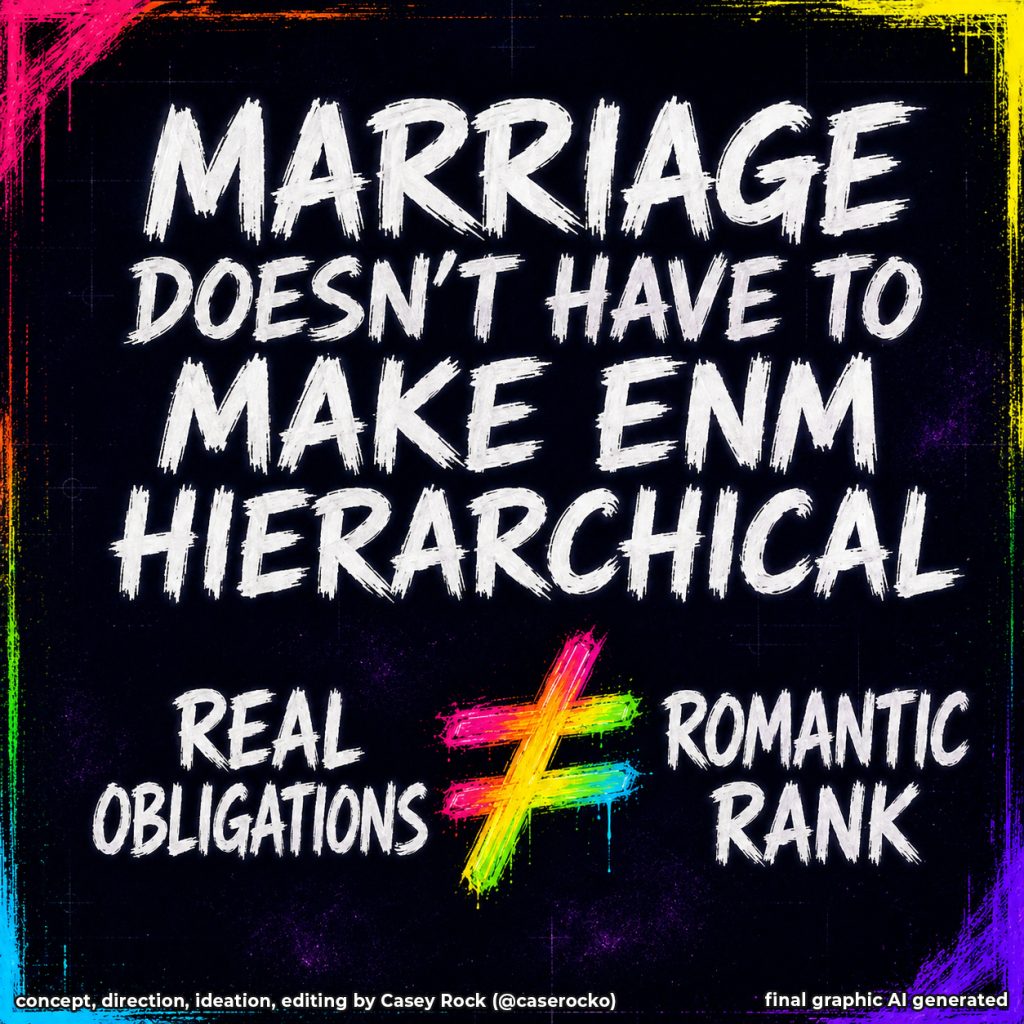
Married people can practice non-hierarchical ENM if they separate practical obligations from relationship rank. Marriage, nesting, children, and shared finances can create real differences in responsibility. Egalitarian treatment comes from giving every partner dignity, transparency, direct communication, and autonomy over the relationship they are actually building.
TLDR – How Marriage & Non-Hierarchical ENM Can Coexist
- Marriage and shared lives create obligations without requiring relationship rank.
- Egalitarian ENM means equal dignity, transparency, autonomy, and agency.
- Different time, history, money, or entanglement does not mean greater importance.
- Let each relationship grow through the people actually inside it.
- Shared responsibilities require coordination, not authority over other relationships.
- Disclose real limits, commitments, and availability before attachment deepens.
- Build safety through communication, testing, precautions, and informed consent.
- Judge hierarchy by vetoes, permission gates, ceilings, and automatic priority.
- Discuss values, power, expectations, and structure early enough to spot incompatibility.
- Respect different relationship styles — sometimes that means choosing not to begin one.
Let’s Stop Before Feelings Get Involved
Recently, a planned first date ended before it started because a husband I’d never met was taking a role in how my relationship could potentially develop.
I’d been talking with a woman online. During our initial introduction she mentioned that, until I met her husband, we couldn’t do anything beyond kissing. She said this was an issue of safety more than anything, which seemed plausible enough. We continued talking through the night and had a very pleasant conversation.
However, after sleeping on what she’d said about her husband, I couldn’t shake the feeling that the dynamic I was being introduced to was one that felt more like a triad, or monogamish.
So I opted to cancel the planned first date and put a stop to any further relationship development before feelings got majorly involved. I explained this to her, and her response felt a bit telling. One of the things she said in her response was that her “marriage comes first” — which is a very different story than one that revolves solely around safety concerns.
Not that there’s anything wrong with putting one’s marriage first. In fact, if you skip to the last section, you’ll see that I applaud this woman for her transparency and commitment.
But we’re getting ahead of ourselves, first we should ask what exactly a marriage means inside ethical non-monogamy (ENM), or, as I like to call it, multiamory.
What Does It Mean To Put Marriage First In ENM?
Putting marriage first in ENM may mean that real obligations — children, caregiving, finances, legal duties, or shared history — require more of your time. But those obligations do not require hierarchy. We can prioritize responsibilities while still treating other partners equally and preserving their autonomy.
To be clear, I respect the hell out of consciously monogamous people. And I respect the hell out of consciously married people. And I would never want to compromise something so important to them.
Putting a marriage first can mean many different things. It can mean that there are obligations that take precedent over other things: children, a mortgage, caregiving, legal duties, or years of intimate history. But obligations in a relationship don’t necessarily mean you have to elevate that relationship over others. Obligations don’t necessarily mean you have to treat your partners differently. And they certainly don’t mean that one partner should get access to, or a say in, another partner’s relationship and how it develops.
Even though reality may require us to prioritize certain things above others, it doesn’t mean multiamorous relationships have to be hierarchical — each partner can still be treated in an egalitarian way.
This distinction is where I think a lot of conversations around hierarchy get muddled. We collapse responsibility, priority, entanglement, importance, and authority into one thing. But a relationship can require more logistical attention without making the people in it more valuable.
A sick child may suddenly need an entire evening, a shared mortgage requires joint financial decisions, and twenty years together creates history a six-month relationship simply doesn’t have. Those realities create different responsibilities and levels of entanglement — but they don’t make another partner less important, less equal, or subject to someone else’s authority.
Terms To Keep In Mind When Discussing Hierarchy & ENM
Clear terms can help us make sure we’re on the same page. So, here is how I am using language throughout this article.
- Multiamory
- Multiamory is the term I prefer for relationships where people can form multiple loving or intimate partnerships with everyone’s knowledge and consent. I prefer it over terms like “ethical non-monogamy” (ENM) or “consensual non-monogamy” (CNM) because it doesn’t put these relationships into direct contrast or competition with monogamy (or insinuate that they are inherently less ethical or consensual than monogamy). That said, I use it interchangeably with phrases like “ENM” and “CNM” because those terms are better known.
- Egalitarian Multiamory
- Egalitarian multiamory allows relationships to grow and evolve organically, branching in whatever different ways they will, while every partner retains equal dignity, transparency, autonomy, and the ability to make fully-informed decisions. It’s largely interchangeable with Non-Hierarchical ENM.
- Non-Hierarchical ENM
- Non-hierarchical ENM is consensual non-monogamy that does not automatically rank one romantic relationship above another. Partners can have different histories, commitments, and levels of entanglement while still receiving equal dignity, independent relationship agency, and freedom from outside veto or approval.
- Prescriptive Hierarchy
- Prescriptive hierarchy ranks relationships through rules established in advance. A primary relationship may receive guaranteed priority, veto power, sexual restrictions, or control over how other relationships develop. Rank determines what another relationship is allowed to become, even when the people inside it want something different.
- Couple Privilege
- Couple privilege describes advantages an established couple can carry through law, shared resources, social recognition, or everyday assumptions. In multiamory, those advantages can become relational power when the couple’s comfort or continuity automatically outweighs the needs and agency of other partners.
- Metamour
- A metamour, or meta, is our partner’s partner. We may become friends, stay politely parallel, or barely interact at all. Being connected through a shared partner does not automatically make a metamour a decision-maker inside our separate relationship, though shared risks or logistics can sometimes benefit from coordination.
- Multiamorous Network
- A multiamorous network is a term I use to describe the wider web of entangled relationships that exists in multiamorous arrangements. It’s similar in concept to a polycule, but much more expansive.
- Polycule
- A polycule is similar to a multiamorous network, and is the better known term. However, it generally refers to people who date together or have integrated their lives to a degree — more like a chosen family than a multiamorous network might be.
Can You Be Married And Practice Non-Hierarchical ENM?
Yes. Marriage can create legal, financial, domestic, and caregiving ties while we still practice relational equality. The important distinction is between practical entanglement and interpersonal rank. A spouse may share more responsibilities with us without receiving automatic control, greater dignity, or permanent priority over our partners.
This is not an abstract thought experiment for me. I’ve dated people who are married and live with their partner full-time. There are things we’ve shared that have been unique to us. And, of course, there have been things that have been unique to my partners and their spouses.
And if any relationship within our multiamorous network changes, there could of course be impacts throughout the entire network — including changed feelings, needs, or logistical concerns. But none of that inherently makes any one of us a lesser partner than another.
When I ended the conversation that prompted this article, I told the woman that I was “looking for something different and more egalitarian.”
This doesn’t mean that all my relationships have to look the same — or that I have to have a central, prioritized role in all of my partners’ lives. But it does mean that the decisions in my relationships should be between me and my partner — not me, my partner, and their partner.
At its core, non-hierarchical ENM is a more egalitarian multiamory — which allows relationships to grow and evolve organically, branching in whatever different ways they will, while every partner retains equal dignity, transparency, autonomy, and the ability to make fully-informed decisions.
What Does Equal Treatment Actually Look Like In Multiamory?
Equal, or egalitarian, treatment means every partner receives the same baseline of dignity, honesty, consideration, and autonomy even when relationships look different. It does not require equal hours, identical commitments, or matching milestones. Egalitarian multiamory gives each relationship room to become what its participants mutually want, within the real capacity everyone has available.
“Equality” can become another impossible standard if we confuse it with sameness — which is why I often swap in “equitability” or “egalitarianism.”
We have finite time. We have jobs. Some of us have children. Someone may need daily care while another person loves having one sleepover every other week. Trying to divide every hour into mathematically equal slices would ignore the actual people involved.
A better baseline looks like this:
| Area | What Can Differ | What Stays Egalitarian |
|---|---|---|
| Time | Parenting, work, caregiving, availability | No partner has an automatic claim to anyone else’s time |
| Money | Bills, housing, shared expenses | Financial entanglement doesn’t create authority over another relationship |
| History | Years together, traditions, memories | More history doesn’t make a relationship more legitimate or deserving of priority |
| Home | Shared time, chores, privacy, routines | Shared life creates unique situations, but not authority or preference over others |
| Sexual Health | Practices and individual risk | Clear sexual-health information and fully informed consent |
As mentioned above, transparency is a big part of egalitarian multiamory and non-hierarchical ENM. That doesn’t mean every partner gets every private detail. And it certainly doesn’t mean forwarding conversations or scrutinizing a partner’s relationship. (Though I’ll admit I’ve been guilty of this in the past and hope those I’ve done this to can forgive me. We’re all eternally growing.)
What transparency really means here is giving people the information they need to fully consent to their own relationship.
If you’re unavailable every weekend because of parenting, say that. If cohabitation is permanently off the table, say that. If sexual-health agreements affect a new partner, explain them before sex.
People can work within reality or walk away if it’s not for them. But trying to build something on false pretenses is unethical, to say the least. Learning that the relationship you thought you were building actually operated on different rules you weren’t aware of can be legitimately traumatizing.
When Does A Married Or Nesting Relationship Become Hierarchical?
A married or nesting relationship becomes hierarchical when its position grants automatic authority, protected rank, or predetermined priority over another relationship. The clearest signs are vetoes, permission requirements, fixed ceilings, or rules imposed by people outside the relationship. Shared responsibilities can shape our choices without becoming control over someone else’s connection.
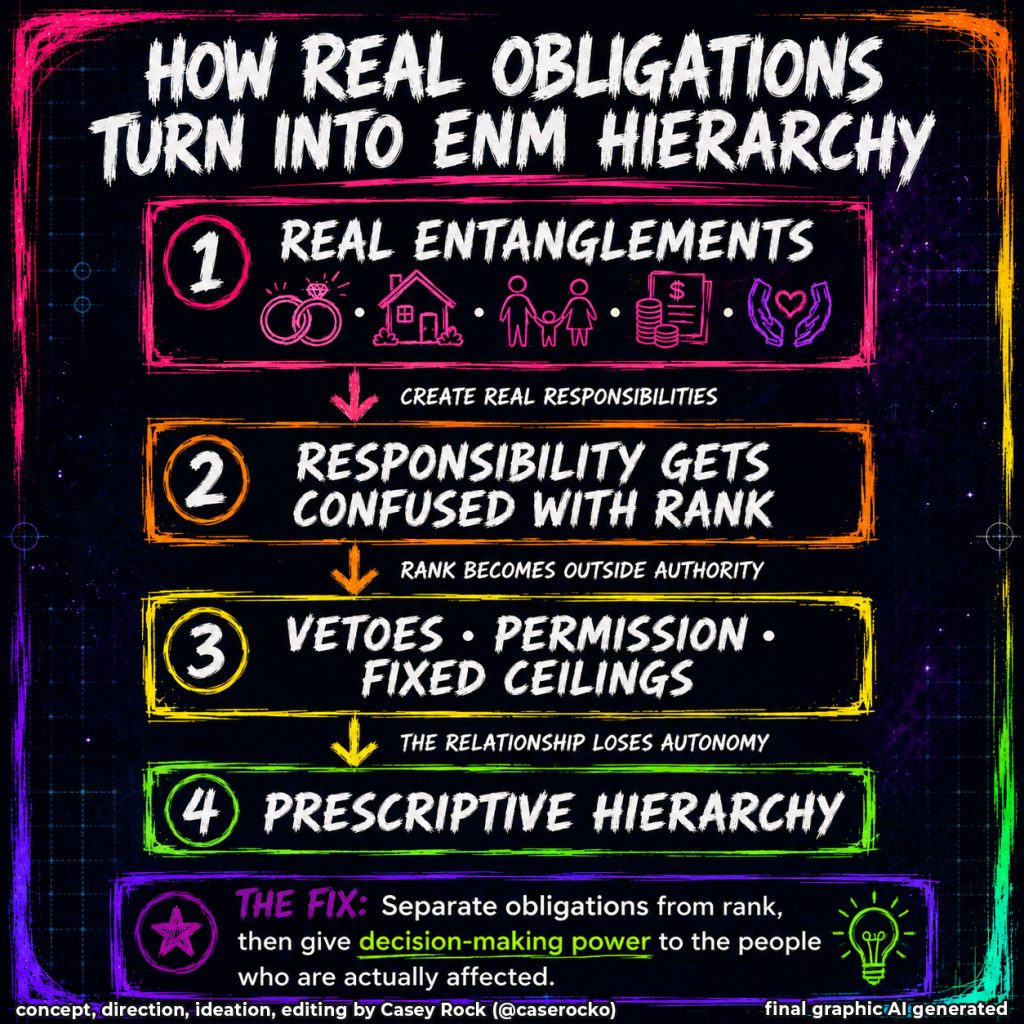
The difference between obligation and authority is particularly key here.
Imagine I’m in a nesting relationship. If I want to host someone overnight, my nesting partner has a legitimate say in how our home gets used. However, if my nesting partner decides whether I am allowed to have sex with someone somewhere else, we have moved into hierarchical and potentially unethical areas of ENM.
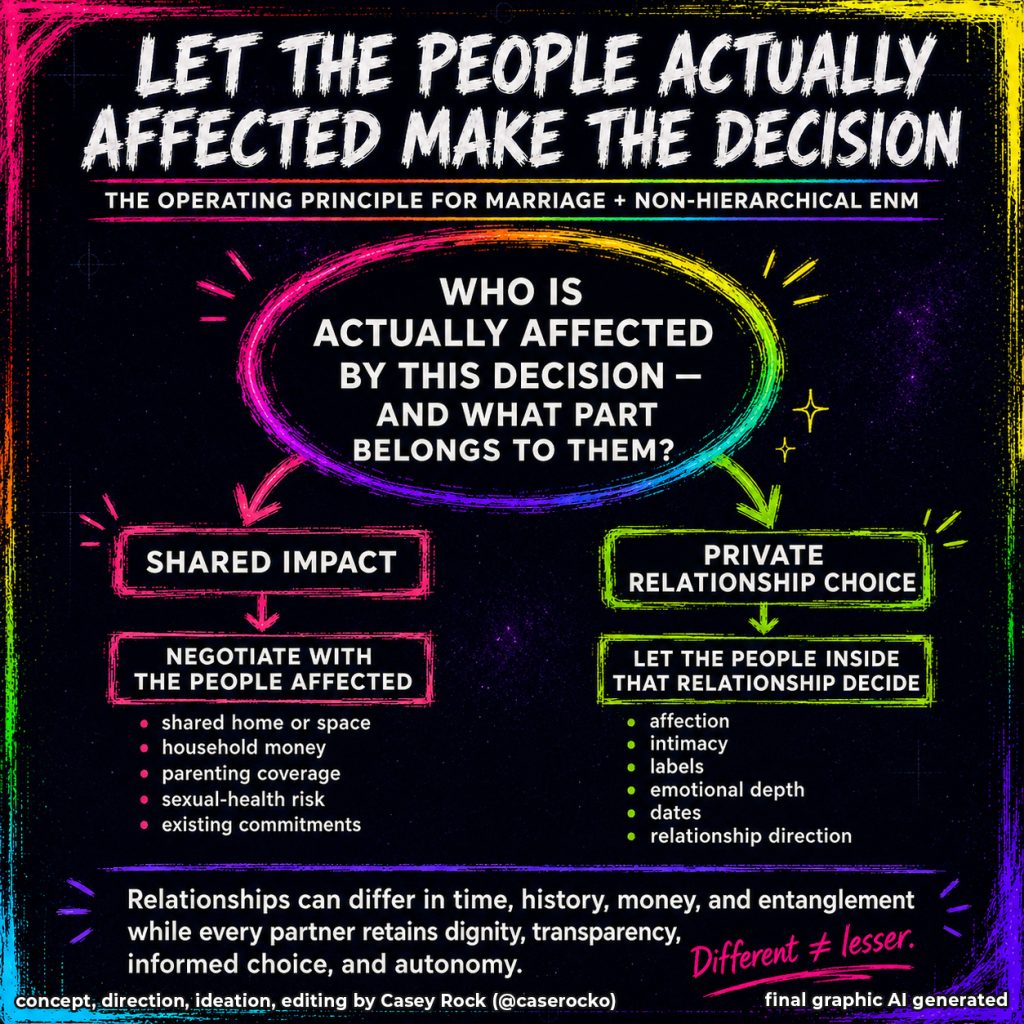
You can gauge the ethicality of decisions in ENM dynamics with a simple question that works almost universally: Who is actually affected by this decision, and what part of the decision belongs to them?
Can We Protect Safety Without Giving A Spouse Approval Power?
Yes. Safety in ENM can be built through direct communication, sexual-health testing, barrier choices, public first meetings, independent transportation, emergency check-ins, and clear risk disclosure. Involving one’s spouse can make sense as a part of this or as a part of community building, but having a relationship’s existence or evolution hinge on their involvement places this firmly under prescriptive hierarchy.
Direct communication, testing, safer-sex practices, meeting precautions, risk discussions, and more all offer ways to practice safety in a budding relationship that don’t hinge on the approval or involvement of other people who are outside the relationship.
And, certainly, sexual history should be discussed early — ideally prior to meeting for the first time and definitely prior to any sexual activity. It’s important to ask questions like:
- When were you last tested, and what were you tested for?
- What barrier practices are you currently using?
- What contraception or pregnancy considerations matter?
And when it comes to meeting people for the first time, precautions are always smart:
- Meet in a busy, public place with other people around.
- Tell a trusted person (such as a spouse) where you’ll be and with whom.
- Share your live location and expected check-in time.
- Use your own transportation so you can leave anytime.
- Keep your phone charged, accessible, and connected.
- Avoid getting intoxicated enough to impair your judgment.
- Trust any red flags or bad feelings and leave if you feel the need.
As you can see above, there are certainly legitimate reasons to involve a spouse in the process of meeting someone new. And a person practicing non-hierarchical ENM might want someone new to meet their spouse for other valid reasons as well — such as community building.
However, dictating that the existence or evolution of a relationship hinges on meeting the spouse (and getting their approval) puts the relationship dynamic firmly in the territory of prescriptive hierarchy.
How Do We Practice Egalitarian ENM While Sharing A Marriage, Home, Or Family?
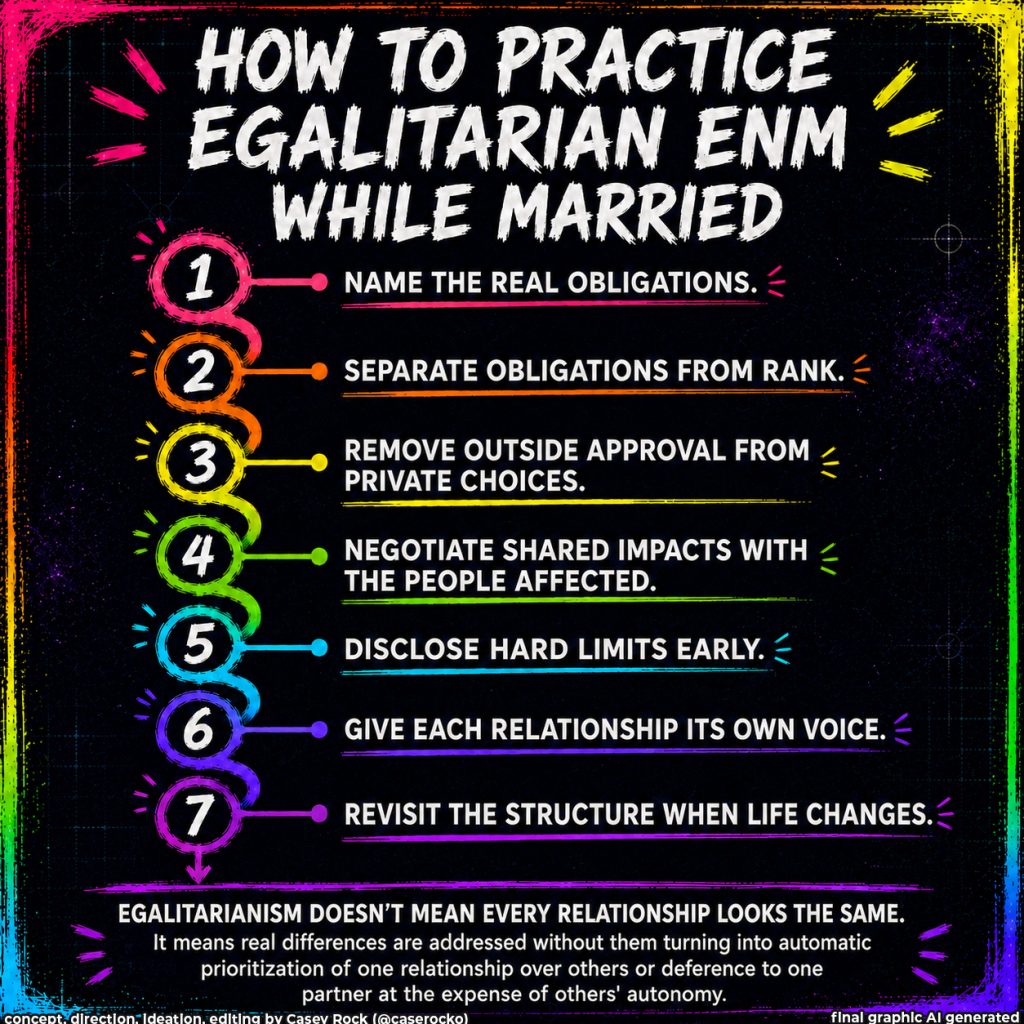
We practice egalitarian ENM by acknowledging real entanglements and refusing to turn them into automatic rank. That means defining responsibilities, protecting each relationship’s decision-making space, disclosing genuine limits early, and negotiating directly with the people affected.
Here is the practical process I would use:
- Name every real obligation. Write down responsibilities created by children, caregiving, housing, finances, health, work, and existing commitments.
- Separate obligations from rank. Ask whether each constraint requires actual time or coordination needs, or whether its simply become an automatic priority due to the partner it’s attached to.
- Remove outside approval from private relationship choices. Let people inside each relationship decide affection, intimacy, labels, emotional depth, dates, and direction when shared risks remain unchanged.
- Negotiate shared impacts with the people affected. Address household money, parenting coverage, sexual-health risk, shared space, or an existing promise with the people who are actually impacted.
- Disclose hard limits before attachment deepens. Say early where overnighters, travel, holidays, cohabitation, public visibility, sexual practices, or deeper entanglements stand. If you don’t have the bandwidth or autonomy for these things, tell people right away.
- Give each relationship its own voice. Ask each partner what makes them feel cared for, secure, respected, and free instead of copying one relationship onto another.
- Revisit the structure when life changes. Children grow, jobs shift, people move, relationships deepen, and capacity changes. Renegotiate around current reality instead of protecting old rules by default.
Egalitarianism does not require that each relationship be the same. We can build homes together. We can raise children. We can merge money. We can nurse someone through illness and make enormous commitments.
What matters is whether we turn those into a permanent rank over every other relationship or treat each relationship with the autonomy, transparency, and dignity it deserves.
Does Marriage Itself Create Hierarchy? What Do We Do, If So?
Legal marriage does create structural advantages and “couple privilege” that other partners may not share. I don’t think we should hide those differences. But unequal legal or practical entanglement doesn’t require unequal treatment of partners, automatic romantic rank, or someone’s external authority over a relationship they aren’t part of.
If one person is legally married, lives in the home, shares finances, raises children there, and has decades of history, a new relationship with someone else is certainly structurally unequal. Does that make it inherently hierarchical?
By some definitions, sure. It certainly creates some level of couple privilege. We can argue about vocabulary or semantics forever. But this is precisely why I lean on behavior for dictating whether something is hierarchical or not.
Can a spouse veto another relationship? Do they have to approve aspects of another relationship’s progression? Can they demand a date be canceled because they feel jealous? Is another relationship forbidden from becoming more serious?
Those answers tell us more than a straight label ever will. And I’d argue if the answer is “yes” to any of these, then we’re dealing with prescriptive hierarchy.
How Do We Know Whether Our ENM Styles Are Actually Compatible?
We know by talking about power dynamics, limits, expectations, and available relationship space before chemistry starts making it harder to say no. If two people want fundamentally different structures, respecting that difference usually means declining the relationship rather than entering it with plans to change each other.
I want to be super clear here that the woman in my introductory story did everything absolutely RIGHT. She told me in our very first conversation what the rules and expectations of entering a relationship with her were.
It was because of the transparent conversation that I was able to quickly determine that pursuing a relationship with her was probably not the right call.
That doesn’t necessarily mean she’s wrong for putting her marriage first. Or that her spouse is wrong for getting involved in her other relationships. In fact, she mentioned that this is the way they’ve done things for years — and that none of their other partners have ever had an issue with anything.
So clearly it’s working for people.
But I definitely think it’s wrong for me. And that’s okay. But this experience definitely highlights why it’s good to talk about goals, priorities, values, and lifestyles early. It’s so much more preferable to people getting deeply hurt down the line.
So, before dating someone in an established relationship, ask:
- How might your marriage or your spouse impact our relationship?
- Can anyone outside our relationship veto, pause, approve, or restrict it?
- Which time and resources are already committed elsewhere?
- What kinds of relationship growth are realistically available?
- What information about us will be shared with other partners?
- Is metamour contact optional, preferred, expected, or required?
- What happens when two partners have conflicting needs?
Then listen to the answers you actually receive and work through what they realistically mean for you and a potential future together.
Don’t Try To “Fix” People Or Change Their Lifestyles
Don’t date a hierarchy-minded married person while hoping love will eventually make them abandon hierarchy. And don’t date a relationship anarchist while hoping they will eventually want a conventional primary partnership. In general, you shouldn’t take the approach of hearing someone clearly describe their needs and deciding you know what they really need better than they do.
Curiosity helps here. I’ve written before about replacing expectation and judgment with curiosity and understanding. And sometimes greater understanding gives us a clearer no.
That’s okay. Walking away from a mismatch can show far more care than forcing a connection to work.
Frequently Asked Questions About Marriage And Non-Hierarchical ENM
Does Non-Hierarchical Polyamory Mean Every Partner Gets Equal Time?
No. Non-hierarchical polyamory does not require identical calendars. Partners can want different amounts of time, have different schedules, or share different responsibilities. What matters is that one person’s title does not automatically make their time more valuable. We negotiate time around real needs, commitments, capacity, and the relationships we are actually building.
Is A Nesting Partner Automatically A Primary Partner?
No, although nesting creates practical entanglement that should be disclosed clearly. Sharing a home affects schedules, money, chores, privacy, and emergencies. Some people call those differences descriptive hierarchy. Others do not. The more useful question is whether nesting grants automatic authority or permanent priority over partners who live elsewhere.
Can A Spouse Have Veto Power In Ethical Non-Monogamy?
People can consensually choose hierarchical ENM that includes veto power, but everyone affected should know that before becoming invested. I would not choose that structure myself. A veto allows someone outside a relationship to determine whether it continues, which conflicts directly with the autonomy I want each relationship to retain.
Do I Have To Meet My Partner’s Spouse Or Metamour?
No universal ENM rule requires metamours to meet. Some people love kitchen-table dynamics, while others prefer parallel relationships. A meeting can be wonderful when everyone wants it. If contact is mandatory, we should ask what function it serves, what happens if someone declines, and whether the meeting could impact our relationship.
Is Non-Hierarchical Polyamory The Same As Relationship Anarchy?
No. Non-hierarchical polyamory usually focuses on avoiding rank among romantic or sexual partners. Relationship anarchy goes further by questioning default hierarchies across romantic, sexual, platonic, and other relationships.
Is Non-Hierarchical ENM Better Than Hierarchical ENM?
I prefer non-hierarchical relationships because autonomy and egalitarian treatment matter deeply to me. That preference is not proof that everyone should organize love the same way. Research shows wide variation in how CNM people understand hierarchy. The ethical baseline is honest disclosure, meaningful consent, respectful treatment, and choosing partners whose relationship structures genuinely fit.
Can Marriage And Egalitarian ENM Really Coexist?
Yes — if we define equality by how people are treated rather than pretending every relationship has identical circumstances. Marriage, children, nesting, money, caregiving, and history create real obligations and structural differences. They do not have to create automatic romantic rank or outside authority. Egalitarian ENM asks us to make those differences visible while protecting each partner’s autonomy within them.
And that brings me back to where this article started. That woman did us both a service by being transparent and up front about her relationship dynamic. And I applaud her commitment to her chosen way of life.
She isn’t necessarily doing ENM wrong. Nor am I. We are both simply doing it differently. Her marriage occupied a place in her relationship structure that I would not be comfortable participating in. Realizing that before the first date was disappointing for us both, but it was also healthy.
We do not have to minimize or otherize different beliefs or lifestyles. Nor do we need to convince someone that our version of relationships is the better one. Respecting another person means believing them when they tell us what they want — and recognizing when what they want is simply incompatible with what we want.
For me, the goal is to treat the people inside my relationships well — with as much honesty, dignity, consideration, and autonomy as I can — regardless of the material differences between them.
And sometimes treating people well means knowing when not to begin.
Casey Rock is a writer and marketer exploring relationships, culture, politics, and the systems that shape how we live. Drawing on years of experience with multiamory, he writes about autonomy, egalitarian relationships, curiosity, and treating people well — even when our lives or values don’t align.