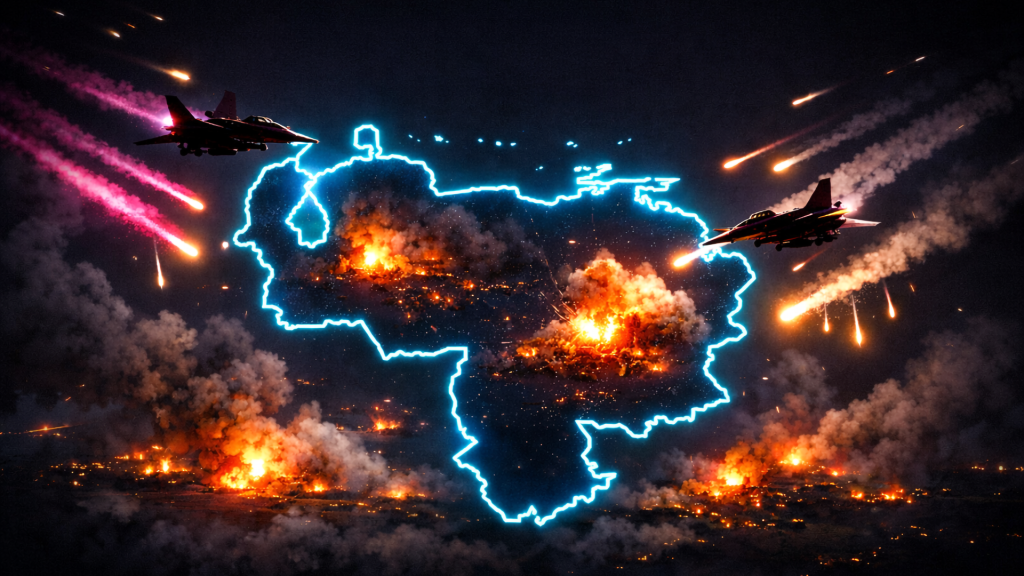
Trump’s “liberation” of Venezuela might sound good at first glance — but it’s really just repeating a long history of similar mistakes by the United States. And they never end well. This problem crosses party lines and branches of government (though Trump’s unilateral execution of Operation Absolute Resolve is cause for extra concern).
Whether you’re military brass, boots on the ground, or just an American citizen, it’s okay to say NO. In fact, it’s critical.
Unconstitutional Action (That Rarely Works)
I understand that Maduro is despised by many Venezuelans and not seen as the legitimate president of the country. Believe me, I sympathize hard with that. But Trump’s unilateral bombing and kidnapping of a foreign political official does not bode well for Venezuela, the United States, or the world.
First and foremost, this action raises serious questions about executive overreach — echoing actions from Clinton, Bush, and Obama. There are times when these administrations should not have acted unilaterally or under false pretense. Neither should Trump.
Secondly, the U.S. has a deep, rich history of doing this. And it has never ended well. It’s hard to compile a comprehensive list, but here are some of the biggest “interventions” committed by the U.S. over the last several decades.
U.S. Interventions Over The Last Several Decades
1953 Iran Coup
This set up a “U.S. friendly” regime that had difficulty gaining legitimately in the eyes of Iranians. It was a major contributor to the mistrust and backlash that led to the 1979 revolution — which ultimately installed a hardline oppressive theocracy within Iran and decades of hostility toward the United States that continues to this day.
1954 Guatemala Coup
In a CIA-backed operation, Guatemala’s president was ousted to prevent communist influence. The result was decades of internal armed conflict, massive human rights violations, and at least 200,000 dead or missing. While the civil war ended in 1996, it remains destabilized with fragile rule-of-law.
1965 Vietnam Intervention
The U.S. entered the Vietnam War presumably to defend and spread democracy. 8 years later, The U.S. left, bloodied and no closer to victory. In between, deaths mounted on both sides. Ultimately, Saigon was claimed by North Vietnam in 1975 and the country was reunified under communist rule.
1970s Chile Covert Intervention
Covert CIA interference ultimately (even if unintentionally) helped create the environment that led to the 1973 Chilean coup that installed Pinochet as a dictator (and who committed severe human-rights violations during his regime).
1983 Grenada Intervention
The U.S. attempted to evacuate U.S. citizens from Grenada and restore order after a violent coup upended the country’s government and stability. While an interim government was successfully installed and democratic elections followed the next year in 1984, questions remain on whether the move (and its costs) were constitutional and justified.
1989 Panama Intervention
In a military operation, The United States captured Panama dictator Manuel Noriega and restored an elected civilian government. However, civilian deaths and destruction were significant and it raised questions about Panama’s sovereignty. Despite the supposed “success,” it continues to be a point of tension in U.S.-Panama relations.
1995 Bosnia Intervention
While the U.S. intervention in Bosnia helped pave the way for the Dayton Accords, which ended large-scale war in the region, the postwar governance remains fragile and politically paralyzed.
2001 Afghanistan Invasion
Despite two decades of efforts, the U.S. ultimately withdrew from Afghanistan in 2021 without achieving real success. The transitional Afghan government collapsed in their absence and the Taliban returned to power. It continues to suffer from instability and violence.
2003 Iraq Invasion
To this day, U.S. boots remain on the ground in Iraq. Despite this, the U.S. invasion of Iraq has mostly fueled instability and encouraged insurgency dynamics from local terrorist groups. The area continues to deal with fragile governance and recurring violence.
2011 Libya Intervention
What started as an “intervention” evolved into a full-blown regime change. What followed was state collapse and disorder. The area continues to be a hotbed of conflict.
2014 Syria Intervention
In 2014, the U.S. partnered with local forces to help dismantle ISIS. However, despite continued bombings (as recently as December 2025) and the ouster of Bashar al-Assad (by rebel forces), the country continues to be destabilized and fractured — and violent actors continue to persist in the region.
Encourage Congress To Act Now
In almost every situation, U.S. intervention has made things worse for Americans, the countries targeted for intervention, their immediate region, and the world as a whole. Even the two “success” stories (Grenada and Panama) are mixed bags.
All this is to say that you should call your legislators immediately and tell them that Trump is walking all over the clearly defined powers of Congress. It is in their best interest to rein Trump in — lest they become obsolete as the Executive Branch continues to act unilaterally without them.